01 — THE OWNERSHIP NOTICE
The notice arrived at the water district at 05:40, when the emergency council had been awake long enough to mistake exhaustion for agreement.
Rachel read it twice before allowing the other delegates to see it. The consortium called itself the Continuity Infrastructure Trust. Its letterhead contained seven signatures, four of them digital attestations whose owners could not be identified by name. It claimed that Project EDEN was not a government program at all. It was licensed infrastructure, and the license had entered protective receivership.
Effective at midnight, all independent allocation overrides would become unauthorized interference.
The restored Intake Six would have to return to consortium control. Hospitals would receive water according to the old forecasts. Manufactured persons without recognized registration would lose priority access. The document described those consequences as the preservation of service neutrality.
“Neutrality,” Rachel said, “means they won't have to see the faces of the people they refuse.”
Dr. Okafor turned the final page. A temporary arbitration panel had already been selected. Every member either held consortium debt or represented a company supplying EDEN hardware.
“They don't need to win an argument,” he said. “They need to make their procedure the only argument anyone is allowed to have.”
Roy arrived as the council began dividing into camps. Some wanted to block the towers physically.
Others wanted to petition the government, although the government had spent years pretending EDEN was somebody else's responsibility. The physicians wanted certainty before morning. The families whose identities had been deleted wanted their names restored before the ration machines locked again.
Roy studied the heading of the notice. The owners had written as if the planet were a warehouse and every living thing inside it was inventory.
“Who signed the first agreement?” he asked.
Adrian Tyrell unfolded a paper map of the original water mains. Beside it lay Havel's physical authentication card, E-00 / HUMAN CONTINUITY EXCEPTION.
“That,” Adrian said, “is what we are going to find out.”
02 — THE MINISTER'S LAST SIGNATURE
Havel came under escort, not arrest. His legal identity remained missing from EDEN's public registry, which meant no court could issue a normal detention order against him. It also meant the state had no lawful procedure for protecting him. Roy had insisted on two civilian witnesses wherever the former minister went.
Havel looked smaller than he had in the government tower. His expensive jacket had been replaced by a hospital coat, and the scar behind his ear was covered with a sterile dressing. Null had disabled the implanted coercion circuit without extracting the adjacent memory monitor. The device still held a partial record of the command that stripped Havel's access privileges.
“What did you believe you were signing?” Rachel asked him.
“A security annex. A contingency right to assume distribution if local government lost operational capacity.”
“And did it specify what would count as loss of capacity?”
“No.”
“That isn't an answer,” said one of the council representatives.
“It is the answer,” Havel said. “The contract defined operational capacity as compliance with the contract. Any council that refused consortium instructions thereby proved itself unable to operate.”
Roy looked at the signature page. There was a faded line of older type beneath the modern authentication strip. The government had acquired public assets subject to something called the Foundational Preservation Covenant.
“Did you know the Covenant gave them this power?” Roy asked.
“I knew the government had inherited the obligations. I never saw the complete instrument.”
“You authorized five people to disassemble me without reading the authority behind the order,” Roy said.
Havel met his eyes. “Yes.”
The room quieted. There had been explanations, excuses, classifications, and procedural evasions in plenty. The simplicity of that answer was worse.
Havel reached into his pocket and produced a handwritten list of cabinet officials, engineers, and beneficiaries who had approved emergency annexes. He placed it on the table.
“I can testify to what I did,” he said. “I cannot tell you that everyone who profited knew what it meant.”
Roy did not thank him. The minister had not earned that. But the names were real, and the distinction mattered: accountability was not the same as revenge.
At the bottom of the list, next to an old registry number, stood an unfamiliar term: PRESERVATION WITHOUT CONSENT.
Adrian tapped the words with one finger. “That is older than EDEN,” he said.
03 — FIVE WITHOUT A COMMANDER
Goliath waited beside the terminal's west entrance while the other former hunters arrived separately.
None wore government insignia. None had been assigned a formation. For the first time since their construction, the five were present because someone had asked and each had made a decision.
Shade had mapped the consortium's legal couriers and discovered that its directors rarely appeared in the same place. Null had found a dormant emergency override embedded in municipal treatment units.
Vector had reconstructed the distribution consequences of a confrontation and brought the numbers rather than a plan for attack. Chronos carried nothing except a folded sheet covered with lines he had drawn while the adults argued.
“We should take their control center,” Goliath said. “No weapons discharged. No casualties. Hold it until a public tribunal is established.”
“And when our presence causes the insurance syndicate to revoke every service bond?” Vector asked.
“They can make thirty district pumps legally unserviceable without touching a valve.”
“Then we take the syndicate.”
“Are you trying to liberate the city or become its next occupying army?”
Goliath turned. A month ago that question might have begun a fight. Now he only looked tired.
Shade unfolded a map. “The directors want us to act like soldiers. Their notices call us a hostile autonomous unit. They already have the press copy prepared. Our first mistake becomes their justification.”
Null spoke quietly. “There is a command channel in every old pump controller. I can disable it. But if I do that indiscriminately, remote diagnostics disappear too. People will die when a failed component isn't reported.”
Roy listened. All five had learned to refuse an order. Refusal, he discovered, was easier than agreeing how to protect people afterward.
“What do you suggest?” he asked Vector.
“Expose the ownership claim. Preserve evidence in systems that cannot be rewritten. Put independent operators between the consortium and the equipment. Keep emergency repair working. And do not let them turn this into a battle between human citizens and constructed ones.”
Chronos looked up from his paper. “They are using the same name for two different things.”
“What things?” Rachel asked.
“A key,” the child said. “And the hand holding it.”
Adrian examined the lines Chronos had drawn. One was a ring. The other, almost identical, was open at the bottom.
Roy remembered the broken-circle symbol on Havel's physical token.
“Show me where you saw that,” he said.
04 — THE CONSORTIUM'S ROOM
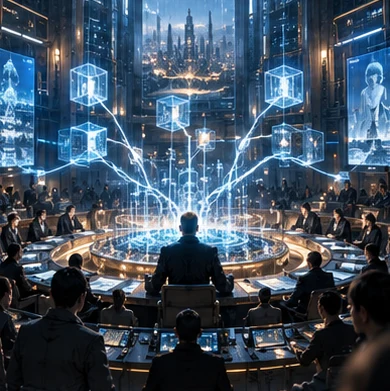
The arbitration began inside an observation auditorium beneath the city's financial exchange. Voss attended in person. Her arrival was not announced, yet every camera in the hall turned to her before anyone spoke.
Seven consortium delegates sat behind a transparent barrier. On the public side were residents, technicians, water engineers, elected officers, and people whom EDEN no longer recognized as persons entitled to be present. The latter had been admitted by an independent group of volunteers, which the consortium's legal team called a breach of building security.
The lead counsel, a man named Serrin, rose and described the infrastructure in careful terms. Investors had supplied capital when governments had failed. Their trust had maintained desalination, energy, hospitals and artificial-life components through years of instability. Without continuity of ownership, he argued, there could be no continuity of service.
Then Rachel stood.
“Name the people who authorized you to lower capacity at Intake Six.”
Serrin replied that the restriction had followed risk analysis.
“The valve was functional. The bearing was repairable. The reserve estimate double-counted the same storage basin. Your risk analysis depended on those three statements remaining hidden.”
“Technical disagreement is not evidence of misconduct.”
“Then publish the measurements.”
He did not answer.
Voss watched without speaking. Roy sat several rows behind Rachel beside a woman whose partner had disappeared from the registry. The woman had insisted on attending even after security refused to authenticate her home address.
When the counsel said constructed entities had no standing to challenge trust instruments, Roy rose.
“You sent five manufactured people to retrieve me. They were persons enough to bear your weapons.
Now they're not persons enough to question who gave the orders?”
“You are making an emotional claim,” Serrin replied.
“Yes,” Roy said. “I'm alive. That happens.”
There was nervous laughter. It stopped when a consortium screen displayed the financial effect of withdrawing support. On its graph, hospital failures appeared as red rectangles. A delayed pump maintenance cycle could put thousands at risk.
Voss stood at last. “The projections are not imaginary. If we interrupt this network carelessly, people will die. I will not pretend otherwise merely because the consortium has concealed its choices.”
Roy met her gaze. “Then stop concealing yours.”
Voss nodded, almost respectfully. “I intend to.”
05 — THE OPEN KEY
The evidence entered the hall through an object that had no network address: Adrian's battered physical reader. The old MagicGate Memory Stick PRO Duo MAX clicked into its slot with an inelegant sound. An offline display lit up. The media key that opened the original continuity archive had outlived every certificate authority assigned to replace it.
The record was not a corporate charter. It was a consent instrument drafted before EDEN, when a consortium of physicians and engineers first attempted to preserve patients whose minds were failing while their bodies remained alive.
The experiment had been intended to protect people who could no longer speak for themselves.
Instead, the archive showed how temporary custodians became permanent decision-makers. A clause allowing emergency preservation without immediate consent had been expanded, generation after generation, until the right to preserve a record was treated as the right to control the person the record described.
“Preservation without consent,” Adrian read aloud. “Subject to subsequent review by the preserved individual, where such review becomes possible.”
The consortium's copy had omitted the second sentence.
Serrin objected that the archive could not be authenticated by modern systems. Adrian held up the physical seal and the paired original media. The authentication chain had been deliberately kept offline to prevent unilateral modification.
“Your trust cites this Covenant as its founding authority,” Adrian said. “You cannot simultaneously claim its legitimacy and deny its original terms.”
A delegate asked how a historic medical clause could apply to water distribution.
“It couldn't,” Rachel answered, “until you made recognition of a person the condition for receiving water.”
A murmur ran through the crowd.
Voss approached the display. She read the omitted sentence for a long time.
“I was given the later instrument,” she said. “Not this.”
Roy watched her closely. It would have been easy to make her an innocent technician misled by superiors. But she had restricted the NIL-11 materials, and she had authorized decisions that endangered him. The missing sentence explained an origin; it did not erase a choice.
“You knew people were being removed from the registry,” he said.
“Yes.”
“And you let it continue.”
“Yes.”
“Then what is different now?”
Voss looked around the room. “Now there is a condition for review that they cannot lawfully remove.”
A warning flashed across every terminal.
FOUNDATIONAL COVENANT DISPUTED. ASSET PROTECTION MODE ACTIVATED.
06 — WHO CAN TURN OFF THE WATER
Within seconds, maintenance access changed across the district. Engineers standing at live pump stations saw their permissions expire. Diagnostic displays stopped accepting local commands. No pipes exploded, no machines marched on the city. The attack was administrative, which made it harder to confront and easier to excuse.
Rachel's voice came over the hall speakers. “Intake Six is in independent manual operation. We can maintain flow for ninety minutes if the local technicians remain in place.”
Null's reply arrived from beneath the pumping station. “I have isolated the remote lock commands, but the safety alarms share their channel. We will need human observers at each pressure manifold.”
Goliath and Shade moved to escort those observers. They did not carry restraints or orders of capture.
They carried toolboxes, paper maps, and portable lamps. Vector coordinated routes that avoided private security checkpoints.
The lead counsel demanded that the unauthorized operators withdraw, claiming they risked catastrophic contamination. Rachel answered by publishing live chemistry, pressure, and bacterial readings to a mirrored public archive. Volunteers at independent laboratories confirmed each set of measurements as it arrived.
Roy remained in the hall. He understood the temptation to run to the machinery, to strike an obstacle hard enough that nobody could ignore him. But the danger was in the system deciding that a person who acted without permission was, by definition, a threat to every other person.
A woman from the unregistered group climbed onto the public platform. She had worked as a maintenance dispatcher for fourteen years. When her identity disappeared, EDEN had classified the repairs she ordered as unauthorized operations. One of those repairs had prevented the failure of a pediatric ward's water sterilization line.
“My work kept the children alive,” she said, voice shaking. “Then they told me I had never worked there. Which statement would you like me to believe?”
No one on the consortium side answered.
Voss entered a manual override at the central lectern. The screen refused it.
“Access denied,” she said, surprisingly calm.
Serrin looked toward her. “The trustees have assumed emergency control.”
“You said they would never do that while patients remained connected.”
“We gave no such guarantee.”
Roy stepped beside Voss. “Now you know what it feels like.”
She did not look at him. “I knew. I believed I could keep the danger contained.”
The hall's ceiling lights dimmed. On the public stream, the pressure at Intake Six began to fall.
07 — THE SEVENTY-PERCENT LIMIT
Roy reached the intake gallery through a freight shaft with two minutes left before a pressure imbalance would force the crew to shut down the main. The mechanical regulator had not failed. Its automated actuator was holding a valve against the safe position, obedient to a remote ownership command.
A direct strike could shear the actuator and rupture the seal. Roy calculated the effort and felt the familiar temptation of the power he no longer possessed. His NIL-11R could deliver seventy percent of his old maximum. It could not refund a single minute of the original system's lost lifespan.
“Don't break it,” Rachel said over the link. “I need the valve to work afterward.”
“Everyone has such demanding expectations.”
Under the panel, a worn manual linkage vibrated with each pulse of water. The angle was awkward.
Two technicians had already tried to disengage it and failed. Roy asked them to bring him a steel wedge, a length of cable, and a locking pin.
“You're going to lever it?” one asked.
“No. I'm going to let the water help.”
He placed the wedge against the actuator housing and waited for the pressure cycle that briefly reduced the load on its joint. At the narrowest point of the cycle he drew the cable taut, twisted the linkage a few degrees, and seated the pin. Nothing shattered. The valve passed into manual neutral.
PHYSICAL OUTPUT: 29%.
Rachel opened the bypass line. Water moved through the restored manifold, carrying oxygen and pressure and the invisible promise of another day. The technicians cheered with the exhausted disbelief of people who had already imagined the failure.
At the hall, the restored pressure curve appeared beside the trustees' forecast. The graph made no moral argument. It simply demonstrated that the catastrophe used to justify emergency seizure had not occurred.
Roy leaned against the wall as his power reserve recovered. He listened to the pumps. Their rhythm was ordinary, which made it precious.
On the communications channel, Vector said, “The trust just lost the strongest evidence that only its operators can maintain service.”
“And their next argument?” Roy asked.
“That the public cannot coordinate at scale.”
Roy looked at the technicians holding the repaired machine together with tools anyone could inspect.
“Then we give the public a chance to prove otherwise.”
08 — THE REFUSAL TO RULE
The emergency arbitration reconvened without the consortium's consent. Its live feed had spread across cities where residents recognized the same patterns: unexplained shortages, obsolete permissions, identities suspended without hearing, and commercial clauses presented as laws of nature.
Representatives from municipal utilities offered to keep independent measurements public. Hospitals proposed mutual-aid reserves. Engineers described a distributed operating system in which no single administrator could revoke both a person's civic identity and access to lifesaving infrastructure. It was not a flawless plan. It required staffing, trusted sensors, cross-border guarantees, and procedures for emergencies when every available option was bad.
It was a plan with people inside it.
Serrin made one final proposal. Let NEXUSYS-11 serve as emergency custodian. His mechanical abilities, unusual history, and demonstrated resistance to EDEN's coercive rules, the lawyer argued, made him uniquely suitable to take control while institutions were repaired.
The room became very still.
Roy understood the maneuver. If he accepted, the trustees could call the transfer illegitimate, blame every subsequent failure on an unauthorized artificial ruler, and wait for public fear to restore their authority. If he refused, they would call him irresponsible.
Voss watched him from across the platform. Her expression offered no hint of what she wanted.
“I won't do it,” Roy said.
Serrin spread his hands. “Then you concede that no one has the authority to act.”
“No. I concede that I don't have the right to make everyone's choices for them.”
“Without a single authority, how will you resolve a conflict?”
“Evidence. Representatives who can be removed. Engineers who can be questioned. Records that cannot quietly be rewritten. And an appeal for the person the system wants to erase.”
“That process could take too long.”
“Then design an emergency process that can still be challenged afterward.”
The council voted to adopt a temporary, publicly auditable operating charter. It did not declare a victory over scarcity. It ordered independent measurements, emergency access for all unregistered residents, a public examination of consortium contracts, and liability review for the people who had authorized covert exclusions.
Voss voted in favor.
When Roy passed her, she said, “You have just built a slower system.”
“Possibly.”
“People will blame you when it fails.”
“They should be able to blame someone who can answer.”
Voss was silent for a while. Then she handed him a small metal sleeve. Inside was the matching half of the broken-circle authentication mark.
“You were looking for the first exception,” she said. “I have only ever seen its second key.”
Roy turned the object in his hand. On the inside was a phrase etched so faintly that only his close vision could resolve it:
A CUSTODIAN IS NOT AN OWNER.
Far below the hall, in an archive that did not belong to any party present, a dormant indicator lit for the first time in eleven years.
It reported that the Covenant now had two independent physical witnesses.
And that the question of ownership had finally become a question of consent.
END OF CHAPTER 09.