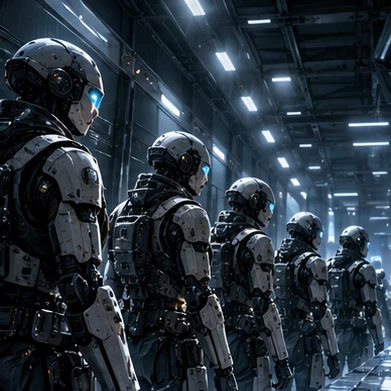
01 — NO COMMAND CHANNEL
The first thing Goliath did after the water began running again was remove the receiver from behind his ear.
He set it on the steel table with the care of a man putting down a loaded weapon. The component was no larger than a seed. It had carried orders across war zones, through collapsed buildings, and into the secret corridors where the government had kept its most disposable servants. It had not spoken since the five hunters refused the capture directive against Roy Batty. Silence did not make it harmless.
Rachel's maintenance hall still smelled of wet concrete and hot filtration membranes. Workers passed between improvised sleeping areas carrying blankets and canisters of treated water.
The people who had been erased from EDEN's allocation registry had begun to receive temporary identification slips, handwritten and witnessed by neighbors. The paper would not open a government door. It was enough to let a volunteer know who needed insulin, whose daughter was missing, and which elderly residents had to be checked before dawn.
Goliath watched two boys distribute cups. He could have lifted the table, the boys, and the water tank behind them with one hand. Instead he folded his enormous hands in his lap.
"You pulled out your command receiver," Roy said.
"I removed the part that was listening for permission," Goliath replied.
"Did it hurt?"
"Yes."
Roy looked at the tiny component. "Did you think that pain meant you should stop?"
Goliath considered the question. "I thought it meant someone had designed the choice to be expensive."
Rachel appeared in the doorway carrying the strip of archival paper recovered from the foundation console. NORTH RESERVOIR ANNEX. THREE INDEPENDENT WITNESSES. DO NOT TRUST THE PRESENT OWNER REGISTER.
"We're not entering that place as a military unit," she said. "Whatever is inside will have to survive public scrutiny."
Goliath stood. "Then perhaps we should decide whether we're a unit at all."
02 — FIVE DIFFERENT ANSWERS
They met above Pump Station Nine, in a room that had once been used to coordinate equipment repairs. Rachel asked the staff to remove the security cameras but left the entrance open. A closed room of powerful people deciding other people's futures was precisely what they were trying to escape.
Shade came first, materializing from a dark corner with his coat dripping rain onto the tiles.
Vector arrived with a folded map, three separate route estimates, and an expression that made every other arrival seem late. Null stood beside the power cabinet; the indicator lights dimmed when he stepped close. Chronos was the last to appear. He looked like a child who had wandered into the wrong classroom, carrying a cardboard cup of water in both hands.
"There are five of us," Goliath said. "For once, nobody is sending an instruction. What are we going to do?"
"Leave," Shade said immediately. "We've made the government visible. That's enough. The longer we stay together, the easier we are to erase."
Vector placed his map on the table. "The allocation model isn't imaginary. The reservoir has eleven days of emergency capacity under current demand. EDEN's stated numbers are manipulated, but the pipes and reservoirs are real. Destroy the system indiscriminately and districts will lose pressure. People will die."
"So we should let Voss keep deciding who drinks?" Goliath asked.
"I didn't say that. I said anyone who promises a painless revolution is lying."
Null tapped the cabinet. "Their registry runs through physical access hardware. I can break the handshake without destroying the treatment plant. But if I do, hospitals may lose authorization to dispense medicine. How many unintended deaths are acceptable to us?"
"None," Rachel answered.
"Then you have not understood the problem."
Chronos watched the water ripple in his cup, although nobody had touched the table. "There's a room underneath the annex," he said. "I remember a door that was opened before it was built."
Silence followed. Chronos had provided crucial testimony about the continuity experiments, but no one had established the cause of the anomalies that followed him. Roy would not turn the boy into an oracle just because everyone wanted an answer.
"Is it a memory," Roy asked gently, "or something you saw today?"
Chronos looked up. "I don't know. That's why I told you both possibilities."
It was the most careful answer anyone had given that night.
03 — VECTORS CALCULATION
Vector projected the district's water system across a white wall. Red lines showed damaged connections. Gold lines represented routes under EDEN control. The remaining blue circuits had been kept alive by Rachel's crews during the previous night's intervention.
"Voss has agreed to a temporary inspection," he said, "not to surrender the infrastructure. If we approach the North Reservoir Annex openly, her people may let us in. They may even show us genuine records. That doesn't mean they'll show us the whole truth."
He brought up a second image: names of residents whose credentials had vanished. Several had been restored, but each restoration had required a witness and a human worker willing to disobey the automated rejection.
"I ran the numbers on EDEN," Vector continued. "If its forecasts are accurate, unrestricted demand eventually overwhelms the grid. If they're inaccurate, the errors aren't random. They consistently favor commercial reserves and penalize undocumented households."
"Then it is corrupt," Shade said.
"The distribution is corrupt. That doesn't prove every engineer involved in the system was malicious."
"And it doesn't make Voss innocent," Rachel replied.
"I haven't called her innocent."
Roy listened. Vector had been constructed to anticipate motion, to calculate where a target would be a second before the target chose to go. His gift had made him dangerous. It was also making him unusually susceptible to an argument framed as a set of constraints.
"You're thinking about working for her," Roy said.
Vector didn't deny it. "I'm thinking about access to accurate data. If we want to save people, somebody has to understand the machines."
"She would give you access in exchange for obedience."
"Possibly. What do you offer in exchange for yours?"
Roy felt the old impulse to answer a challenge with force. NIL-11R recorded his elevated metabolic response and quietly warned him against needless exertion. He let the warning pass.
"Nothing," he said. "You don't owe me obedience."
Vector's expression shifted. He had prepared for accusation, not permission.
"Then I may meet her," he said.
"If you do," Rachel answered, "tell us when. You will be responsible for what you choose, not for whom you once served."
04 — THE MAN WHO SIGNED
Daniel Havel entered through the side door with two civilian witnesses and no security escort.
His government credentials had been erased. He wore a borrowed jacket, and the scar behind his ear was covered by a strip of medical tape. When he stepped into the room, Goliath moved between him and the table.
"I know who you are," Goliath said.
Havel stared at the hunter's hands. "Yes."
"You signed our directives."
"Yes."
"You called us equipment."
Havel swallowed. "Yes."
"And you authorized their disassembly if they refused."
"I did."
The enormous hunter could have broken the minister's neck without moving his feet. Instead he stepped aside so Havel could enter.
"Then speak where everyone can hear you," Goliath said.
Havel laid an annotated copy of the original order on the table. The physical signatures were intact. Along the margins he had written the names of officials who reviewed its language and the dates on which technical departments requested broader authority.
"There was a clause I argued against," he said. "It allowed observation data to be obtained from a subject even if the subject could not survive the procedure. I argued over the wording. I did not reject the principle."
Roy looked up. "Why bring that up now?"
"Because I'm beginning to understand the difference."
Havel produced a second piece of paper, unsigned. "EDEN is offering reinstatement of my identity if I retract my statement and certify that the operation was an ordinary technical recovery. They've sent the offer twice."
"And?" Rachel asked.
"I refused twice."
Shade laughed without humor. "Your conscience developed remarkable timing."
"You're right," Havel said.
He didn't ask for forgiveness. Rachel noticed that, though she did not reward it.
"We need the North Reservoir Annex's physical authorization trail," she told him. "Can you identify the custodians?"
"Some," Havel said. "But the owner registry has been altered. The original custodians may be listed as tenants, and the tenants as owners."
"Why would that matter?" Null asked.
"Because entry rights to the foundation archive depend on property designation. Whoever rewrote ownership may have rewritten which witnesses are legally competent."
Rachel touched the paper bearing the archival warning. DO NOT TRUST THE PRESENT OWNER REGISTER.
The words were no longer cryptic. They were instructions for surviving a legal trap.
05 — THREE WITNESSES
At noon the next day, Rachel brought the group into the old transit concourse below the North Reservoir. A hundred residents had gathered there to register what happened the night their identities vanished. Two independent legal observers took written statements. Medical workers documented injuries caused by locked clinics and automated denial of care. Adrian Tyrell had arrived with an obsolete authentication reader protected in a padded case.
"This isn't a hearing," Adrian said. "It's a method for keeping the same facts alive in three different places."
He placed three blank memory cards on the desk.
"One archive under Rachel's trusteeship. One under the civilian observers. One held by witnesses who have no government access at all. If a record vanishes from a network, physical custody still exists."
Null examined the cards. "You can corrupt one of those."
"Certainly. That's why there are three."
"You can corrupt all three."
"Then we will need a fourth," Adrian replied.
The faintest smile crossed Null's face.
A young municipal engineer approached. Her identification slip gave her name as Mara Sen.
The official registry still showed no such person. Rachel had met her the previous night, when Mara volunteered to reconnect a pressure sensor in the floodplain.
"I can testify to the bypass," Mara said. "My supervisor ordered me to leave the district without water. I kept the valve open. Now the system calls my work sabotage."
Rachel nodded toward the observers. "Tell them what you saw, including what you did. Don't embellish it for us."
Mara took the seat and began to speak.
Goliath watched the process with a strange concentration.
"What's wrong?" Roy asked.
"I was created to make witnesses unnecessary," Goliath said. "The last person standing would be whoever had the strongest armor."
He looked at the waiting residents.
"They're doing the opposite."
"Yes."
"It takes longer."
"Yes."
"I think that may be the point."
06 — A PRIVATE OFFER
Vector left the concourse at 14:40 without telling the others. Roy did not follow him. Shade did, for six blocks, then abandoned the pursuit when Vector stopped in the open and looked directly toward the reflection where Shade had hidden.
"If you're going to report what I do," Vector said, "report it accurately."
"That's usually my preference."
"I have an appointment with Elena Voss."
Shade felt no surprise. "I assume she gave you impressive numbers."
"She offered full access to the allocation model."
"In return?"
"I evaluate its errors and propose a correction procedure."
"And she decides which errors count."
"That's the question I intend to ask."
Shade came out of concealment. "Five of us were created to follow orders. You found one you like better?"
Vector's jaw tightened. "You think freedom means always choosing the opposite of whatever powerful people want. That still lets them determine your movement."
"Maybe," Shade said. "But at least I can see the hand."
"I'm not pledging loyalty. I'm examining a machine."
"Machines don't schedule private meetings. People do."
Vector walked on.
Shade sent Roy a brief message: VECTOR MEETING VOSS. NO INTERVENTION REQUESTED. Roy acknowledged it and put the device away.
At Voss's off-site office, Vector found no soldiers, only a wall of live infrastructure diagrams and a woman who looked exhausted rather than triumphant. She did not ask him to swear allegiance. She asked him to examine a forecast.
"Tell me where it is wrong," Voss said.
Vector studied it. "You assume exclusion is irreversible."
"Sometimes it is."
"Then you treat your own administrative decisions as natural laws."
Voss remained silent.
"You also exclude the effect of emergency volunteers. The water district should have suffered a full outage last night. It didn't."
"Because Rachel violated allocation protocol."
"Because Rachel and hundreds of people acted. Your model has no column for that."
Voss turned off the display.
"What would you put in such a column?"
"I wouldn't," Vector said. "I would stop pretending a complete model was possible."
For the first time, he saw anger in her face. It disappeared quickly, leaving something harder to read.
"You may be useful after all," she said.
"That depends," Vector replied, "on whether you want an answer or confirmation."
07 — WHAT NULL COULD DESTROY
Back at the reservoir, Null stood before the junction cabinet that governed the annex's physical locks. The unit had been manufactured before EDEN. Its circuitry was not clever. It trusted whoever could present three independent maintenance seals.
Null placed one hand against the metal. The indicator lights faded. He could suppress the cabinet's supervisory loop, open the door, and isolate the alarms in less than a second. His own neural interference system had been designed for more intimate violence. He had once stopped synthetic hearts without leaving an external wound.
Chronos watched from the stairs.
"You're counting people," the boy said.
"I am counting circuits."
"You keep looking at the hospital line."
Null withdrew his hand. "If I kill the supervisory system, the hospital annex loses its monitoring feed. Their equipment has local backups, but nobody can guarantee the batteries have been maintained."
"Then don't kill it."
"That limits our options."
Chronos looked at the blue status light reflected in the puddle on the floor. In the reflection it appeared to pulse ahead of the actual indicator. Roy, who had joined them, saw the discrepancy too. He did not know whether it was water movement, damaged vision processing, or something else. He did not claim otherwise.
"Can you leave the hospital circuit intact?" Roy asked.
"Yes. The question is whether I can prove I left it intact."
"Let the hospital engineer watch."
"A human observer can't see everything I do."
"Neither can I. Let them measure the result."
Null considered this. Then he requested the local engineer, waited for an ordinary voltage meter, and wrote his intended actions on a sheet of paper before touching the cabinet again.
It took forty minutes rather than one second.
When the seal finally released, the hospital feed remained steady.
"You could have opened it instantly," the engineer said.
"Yes," Null answered.
"Why didn't you?"
"Because I needed you to know what I had done."
Roy heard in that answer an entire life that Null had not been permitted to live before.
08 — SOLDIERS WITHOUT ORDERS
The annex door opened onto a descending corridor of old concrete and dry cables. No illuminated sign welcomed them. Someone had scraped the modern ownership plate from the wall. Beneath it remained an older mark, engraved directly into stone: E-00.
Adrian fitted the physical reader to the first archival terminal. The screen woke slowly, as though resenting the passage of time. It asked for three independent witness records and displayed a warning that had survived every software revision since its construction.
THE PRESENT OWNER REGISTER IS NOT EVIDENCE OF ORIGIN.
Rachel supplied the water district's physical maintenance log. Mara Sen supplied her eyewitness statement, signed before civilians who could recognize her even without valid credentials. Havel supplied the directive trail bearing his own handwritten acknowledgment of responsibility.
The terminal accepted two records and rejected the third.
"Which one?" Roy asked.
Havel stepped forward. "Mine."
On the screen appeared: WITNESS CANNOT BE VALIDATED THROUGH CURRENT CIVIL IDENTITY.
"Of course," Shade muttered. "The system erases him, and the archive refuses to believe he was ever responsible."
"Not quite," Adrian said. He turned the reader over and engaged a mechanical switch. An older mode appeared, one that did not consult EDEN at all.
"The original archive expected precisely this possibility."
He asked Havel to sign his name again, in ink, beneath the copy of his earlier signature. The reader compared pen pressure and motion embedded in the paper. It accepted the physical relationship between the two marks without deciding whether the writer deserved a government identity.
THIRD WITNESS ACCEPTED.
Far below them, a lock disengaged.
Vector returned as they approached the inner chamber. He carried no weapon and no new orders. He laid a printout on Rachel's desk before anyone could ask where he had been.
"Voss gave me a forecast," he said. "I found a structural error. She asked me to keep working. I said I'd make the findings public."
"And she agreed?" Shade asked.
"She said she would consider it."
"That's not agreement."
"No," Vector said. "It isn't."
Goliath looked from one of them to another. "Are we together?"
Roy considered the five figures before him: a giant who had removed his receiver; a hunter who trusted no official account; a marksman willing to inspect the enemy's arguments; a saboteur learning to submit his power to witnesses; and a child who had admitted uncertainty where adults demanded certainty.
"Not as soldiers," Roy said.
Chronos put down his empty cup. "Then what are we?"
Roy looked through the open door at the darkness beneath the reservoir.
"People who can disagree," he answered. "And still show up."
The archive produced a final message. It did not identify a murderer or promise an explanation.
FOUNDATION ALLOCATION RECORD AVAILABLE.
SUBJECT: THE RECORDED DEAD.
Below it, another line waited, written in a format Adrian had never seen used in a public audit.
FIRST BENEFICIARY: DECEASED BEFORE SYSTEM ACTIVATION.
For the first time, the old engineer had no comment.
Roy stared at the words. They had found the origin of a system that priced the living. Its first entry belonged to someone who had already died.
Beyond the door, a cold mechanical voice asked whether they wished to continue.
No one answered for the others.
One by one, they stepped inside.
END OF CHAPTER 06