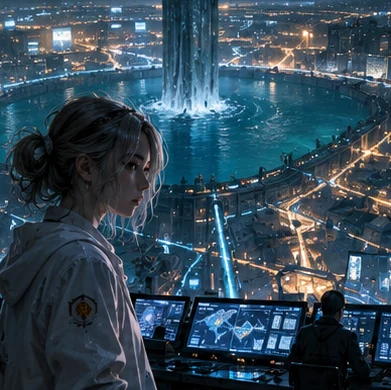
01 — THE INVITATION
The vehicle crossed the causeway at nine minutes past six. The sea on either side was the color of sheet metal, and the desalination towers rose through the mist like the ribs of something too large to have died. Water moved through pipes as broad as railway tunnels. From a distance the machinery looked indifferent, which was the most comforting thing about it.
Roy had brought neither the physical E-00 token nor the original witness archive. Adrian had locked both inside the disconnected cabinet where he kept the old MagicGate Memory Stick PRO Duo MAX equipment. Modern databases could copy a record, but they could not force that particular reader to release one. At least, that was the theory they had chosen to test.
Chronos sat beside Roy in the rear of the vehicle. He had asked to come and had received an answer rather than an order. Rachel drove. Goliath was absent, deliberately: there was little value in arriving at a meeting about consent with a soldier who looked like a siege engine.
“There's no legal reason for her to refuse me entry,” Roy said.
“There is no legal reason for a registry to erase seventeen workers either,” Rachel replied.
“Reasons and mechanisms have become separate departments.”
Beyond the security gate a line of municipal buses waited beside a long concrete wall. Their passengers wore hospital wristbands. A woman held a transparent bag containing medication, an empty water bottle and a laminated identity card. The card's hologram flashed every time she moved it. The gate remained shut.
“What are they waiting for?” Chronos asked.
“Acknowledgment,” Rachel said. “They exist. The machinery doesn't currently agree.”
Roy watched the woman press her card to the reader again. The light turned red. She stepped aside for someone who received the same answer.
He remembered Havel in his government residence, watching a security officer explain that his own eyes were less authoritative than a database. There had been a peculiar satisfaction in seeing the minister confronted with the machinery he had protected. It had lasted less than a second.
Afterwards Roy had only felt the scale of the problem.
At the main entrance an attendant examined their faces without asking for names. “Director Voss will receive the witness first.”
Roy turned toward Chronos. “That's your decision.”
“I know,” Chronos said. “I want to hear what she asks before I decide what to answer.”
The attendant hesitated, as though the grammar of that sentence was outside her employment contract. Then she opened the gate.
02 — THE ROOM WITHOUT AN AUDIENCE
Elena Voss received them in a room overlooking the membrane halls. There was no ceremonial desk. Three chairs stood before a pane of glass through which workers in sealed protective clothing moved between pressure vessels. In the distance, the pumps produced a low, unbroken note.
Voss was older than the portrait that had surfaced in one of the records and younger than another. Her gray hair was cut short. A small scar crossed the inside of her right wrist. She rose when Chronos entered, but did not offer her hand.
“C-05,” she said.
“My name is Chronos.”
“I know. I wanted you to know that I understand why another name appears in my records.”
“You understand what the record calls me,” the child replied. “That isn't the same thing.”
For the first time, Voss seemed genuinely pleased. “Quite right.”
Roy remained standing. “You ordered a minister to send five hunters after me.”
“I approved an evaluation of an unresolved continuity exception.”
“He signed an order allowing my body to be taken apart.”
“He did. And he remains answerable for it.”
“That's not an answer to my accusation.”
“No,” Voss said. “It's the beginning of one.”
Rachel stepped between them, not as a barrier but as an interruption. “Seventeen people in my district have lost their credentials. An hour ago another six were denied access to medical supplies. The allocations have been revoked without hearing or appeal. Restore them.”
“I can initiate review.”
“They need water, not review.”
Voss touched the wall. A diagram appeared, tracing water from intake, through filtration, into distribution. Branches bloomed in amber and red. “There are actual shortages. Two membrane banks have been failing for weeks. We have enough stored capacity to bridge the repairs if the reserve isn't consumed by unauthorized distribution.”
“People aren't unauthorized distribution,” Rachel said.
“No. The system's language is defective. Its pressure readings are not.”
Roy studied the graph. “You're asking us to accept your numbers before you'll tell us why you erased people.”
“I'm asking you to look at the physical plant. You may inspect it yourself.”
“Will you restore their names first?”
Voss paused. “If I restore their credentials immediately, the allocation engine will deduct the water from an emergency medical buffer. There is no invisible reservoir behind the screen.”
Rachel did not move. “Then show us the valve.”
Voss looked at her. “That is exactly what I intend.”
03 — WHAT A LIFE COSTS
They descended into the operating level by an elevator that smelled faintly of disinfectant and warm metal. Behind thick glass, seawater entered the plant under immense pressure. The pumps were real; Roy could hear them through his feet. So were the maintenance workers watching warning lights climb toward the red band.
Voss pointed to an assembly whose ceramic housings were marked for replacement. “We can keep this running another forty-six hours at the present load. After that, our prediction interval becomes irresponsible.”
“Then replace it,” Roy said.
“We have replacements on the way.”
“Where from?”
“A facility outside the allocation district.”
“Why aren't they here?” Rachel asked.
Voss brought up a logistics ledger. Three replacement units had been routed through a private holding company. The dispatch window had been pushed forward twice, then deferred. Above the delay sat a signature that looked authentic until Roy compared it to the physical authorizations he had seen in Havel's papers.
“The approval field is blank,” he said.
“The transfer is controlled by an upstream contract,” Voss replied.
“And you control those contracts.”
“I administer the model that prioritizes them. That is not the same as controlling every hand on every valve.”
“Convenient distinction.”
“I agree. It has become too convenient.”
They entered a laboratory where a transparent display listed energy consumption by category:
pumping, hospitals, refrigeration, transport, industrial processes, and artificial-life maintenance.
Voss separated the last group and enlarged it.
Roy's designation occupied a narrow line.
NEXUSYS-11 — MAINTENANCE PROJECTION: UNSTABLE.
The figures changed too quickly to read. Every time the model attempted to estimate his long- term needs, it assigned a different lifespan horizon. His original NIL-11 had been deliberately constrained by access to a specialized working medium. The substitute NIL-11R Rachel had fitted could preserve his life, but its seventy-percent maximum output could not be negotiated away by computation.
“Is this why you restricted the working medium?” Roy asked.
Voss did not look away. “I approved the continuation of that restriction after I inherited responsibility for the program.”
“Knowing what it would do to me.”
“Knowing it could force you to choose another solution.”
“You risked my life to see whether I could adapt.”
“Yes.”
The single word carried no defense. Roy found that more difficult to hear than an excuse.
Chronos examined the column. “The model assumes he will always choose the least costly action for himself.”
“It assumes all agents have preferences,” Voss replied. “Those preferences can be estimated.”
“But he spent more life rescuing people he didn't know. Your forecast treated that as an error.”
Voss turned to the child. “A model is only useful if it can identify its failures.”
“Then why did your office try to eliminate the failure?”
This time she had no immediate answer.
Roy stood so close to the glass that he could see the faint reflection of his own face over the figures. “Tell me what price you put on a refusal.”
04 — THE FIRST ALLOCATION
Voss led them to a narrow archive room where the terminals were new but the shelves carried old physical binders. One bore the name of a vanished civic agency. Another carried the broken- circle emblem from Havel's E-00 token.
“The first version of EDEN did not ration water,” she said. “It was an administrative recognition system. It determined whether a person declared absent could regain legal continuity after a medical or technical interruption.”
“Declared dead,” Rachel said.
“Sometimes. Sometimes missing. Sometimes simply impossible to classify.”
“Why was a city-management program built from that?” Roy asked.
“Because recognition became access. Once a system decides who counts, every other system can inherit the decision.”
She opened a record: an emergency ward, a patient whose identity had been suspended after a catastrophic injury, a series of machines keeping the body alive. The patient had awakened. The recognition authority had refused to reinstate the record because its procedure had already closed.
“What happened?” Chronos asked.
“The person lived for four days without a legal identity. Then the hospital's automated allocation stopped approving treatment.”
“Did they die?”
“Yes.”
Roy heard the pump vibration through the wall. Four days. A person could outlive their recognition by four days.
“Who wrote the refusal?”
“There wasn't a person,” Voss replied. “It was generated from a rule.”
“Rules are written by people.”
“Exactly.”
A second document appeared. Its authorship field had been obscured, but one term remained legible: HUMAN CONTINUITY EXCEPTION E-00.
Roy thought of Adrian's reader and the message it had produced: do not trust a single history of Elena Voss.
“Were you there?” Roy asked.
“I have records that say I was. I also have records that say I was born twenty years later.”
Rachel watched her carefully. “Which do you believe?”
“I believe that someone wanted my identity to be a poor source of evidence.”
“Maybe you wanted that,” Roy said.
“Perhaps.”
Voss closed the record. “If you came here to learn whether I am innocent, you will be disappointed. If you came to learn what this system does, we can proceed.”
“You keep substituting information for accountability.”
“Yes,” she said quietly. “And you keep assuming I haven't noticed.”
05 — THE HUMAN IN THE WAITING ROOM
The alarm began as a polite tone. Then the wall projected a maintenance warning: the southern emergency buffer had fallen below its protected threshold. Somebody was drawing water through a municipal line that EDEN no longer recognized.
Rachel checked her district feed. “That's one of ours. An apartment block. Forty-three residents.
The building controller was rejected overnight.”
Voss summoned an operator. “How long before the emergency buffer hits the minimum?”
“Twenty-eight minutes at current flow.”
“And if we isolate that branch?”
“The hospital oxygen cooling circuit remains protected.”
Rachel's face hardened. “You'll shut off their drinking water.”
“I haven't said that.”
“You don't need to. Your screen has.”
Roy looked at the controller map. The building and the hospital shared a narrow, obsolete secondary conduit. A failure in one valve was forcing the engine to treat them as a single demand group. The model called it conservation. The piping called it a mistake.
“Can the valves be separated manually?” he asked.
“Not without shutting the bank for several minutes,” the operator replied.
“Then we'll do it.”
Voss shook her head. “A shutdown could damage the membrane modules.”
Roy approached the maintenance diagram. “How long is the service corridor?”
“Forty meters.”
“Pressure?”
“Too high for an unprotected person.”
“I'm not unprotected.”
Rachel took his wrist. “Your NIL-11R isn't a license to spend yourself. You're not going to solve their budget problem by making your life cheaper.”
He looked at her hand. She was right. He had learned that lesson on the floor of a different room, with Goliath waiting in front of him and the lifespan monitor refusing to forgive what he had done.
“We don't need force,” Rachel continued. “We need the older cross-feed map.”
Voss seemed startled. “There is no cross-feed on the current drawings.”
“Exactly,” Rachel said. “The city predates your model.”
The operator found the old blueprint in a cabinet, stamped with a date before EDEN's first deployment. An emergency bypass connected the two groups through an independent reservoir whose accounting line had been removed from the digital map.
Voss stared at the paper. “That reservoir was decommissioned.”
“Was it drained?” Rachel asked.
The operator checked an analog gauge. “No, Director. It's full.”
For the first time the room became quiet enough for Roy to hear a human breath of relief.
Voss ordered the cross-feed opened. A controller resisted, requesting executive authentication.
Voss entered it. The screen answered with a warning.
UNAUTHORIZED CAPACITY RESTORATION MAY INVALIDATE CURRENT OPTIMIZATION.
“Accept,” she said.
The valve turned. Water began moving toward the apartment block. The hospital remained within its protected buffer.
Roy looked at Voss. “You almost cut off forty-three people because the machine forgot a reservoir.”
“No,” she said. “Because we allowed a map to become more authoritative than the city.”
06 — THREE TYPES OF LIE
They returned to the observation room with the alarm still active at a lower priority. Outside, the buses remained at the gate. The patients had not moved. Rachel sent her district team to help them while Voss authorized emergency manual verification for the suspended identities.
Roy refused to treat the concession as victory. Twenty-three people were restored on a provisional basis; thousands elsewhere might never have been counted in the first place.
“Your system lies in three ways,” he told Voss. “It calls a person absent while they're standing in front of you. It calls a shortage absolute when its maps are incomplete. And it calls a decision inevitable when someone chose to write the rule.”
Voss listened without interruption.
“The first is a recognition error,” she said. “The second is a data error. The third is a governance failure.”
“Would you have called them that yesterday?” Rachel asked.
“I would have called them exceptions.”
“And today?”
“Evidence.”
Chronos had been silent. Now he approached the window and watched a worker guide a trolley through the membrane hall.
“There was a moment,” he said, “when the room gave two different answers about whether the reservoir existed.”
Roy turned. “Did you see a temporal anomaly?”
“I saw a mismatch between what was measured and what was remembered. It isn't always time.”
Voss studied him. “You understand your ability better than our analysts do.”
“I understand how often adults invent explanations for things they haven't measured.”
Rachel almost smiled.
Voss rested both hands on the table. “There is another kind of error. The system accepts a unique authority key from someone who has no public existence. That key has issued seventeen continuity overrides in the last month.”
“Yours?” Roy asked.
“No.”
“How can you be sure?”
“Because I tried to revoke it.”
Roy let the silence stretch.
“What happened?”
“The request came back signed in my name. It was denied.”
Rachel said, “By someone pretending to be you.”
“Or by a record that the system believes is me.”
Roy remembered the three histories of Elena Voss. He remembered the warning that a single history could not be trusted. A woman whose identity had been made unreliable controlled the registry that decided everyone else's identity. The design was either brilliant or monstrous.
Probably both.
“Someone has your authority,” he said, “and you don't know who.”
“That is correct.”
“Then you don't control EDEN.”
Voss looked through the glass at the machinery. “Not completely.”
07 — THE OFFER
The meeting might have ended there, with another promise of review and another pile of evidence that could be locked inside a forgotten hearing room. Instead Voss opened a sealed authorization request and placed it between Roy and Rachel.
It proposed a joint audit of the continuity allocation system, including physical inspection of its water and energy infrastructure, independent review of identity suspensions, and protected testimony from affected people. The document also asked NEXUSYS-11 to consent to longitudinal observation.
“You still want to study me,” Roy said.
“Yes.”
“And if I refuse?”
“Then the audit can proceed without your telemetry.”
“That's not how the last study worked.”
“I know.”
“Do you?”
Voss did not retreat. “I authorized the material restriction. I did not write the dismantling clause, and I did not prevent it from being signed. The distinction matters to a court. It should not make the result acceptable to you.”
Rachel read the agreement. “The independent review has no power to reverse an emergency suspension unless EDEN accepts the appeal.”
“Correct.”
“Then your offer is decorative.”
“I can give you access to the decision chain. You may be able to prove why the appeal mechanism is defective.”
“That isn't the same as fixing it.”
“No,” Voss agreed. “It is the first thing I can authorize without a decision being countermanded by someone using my own key.”
Roy sat at last. He had refused the chair earlier because sitting suggested consent to the meeting's terms. Now he sat because he wanted to read the entire document, slowly, as a person whose name appeared in it.
“I won't sign away my body,” he said.
“No one is asking you to.”
“They did before.”
“And that record should remain part of any judgment.”
He looked at Chronos. “What do you think?”
“The offer doesn't name me as a subject,” the child said. “It asks me to be a witness. But it doesn't say what happens if I testify against the person making the offer.”
Voss amended the document. She added a protection clause, then another requiring independent custody of the testimony. Rachel demanded an explicit right to withdraw. Voss accepted it.
Roy still did not sign.
“What would convince you?” Voss asked.
“Show me the source of the missing authority. Not a report about it. The source.”
Voss remained still for a long time.
“Then we must go below the intake level,” she said. “To a facility that isn't on the plans.”
08 — THE UNPRICED THING
The descent shaft was older than the desalination plant. Its walls had been coated with a ceramic that swallowed radio signals. At the bottom, a mechanical lock waited beside a panel whose design Roy recognized from Adrian's offline reader. The slot was the shape of the token he had left behind.
Voss examined the empty slot. “You didn't bring it.”
“You asked me not to,” Roy said.
“I didn't send that message.”
“You invited the witness.”
“I invited you and requested access to C-05's testimony only if he agreed. I did not instruct anyone to leave the physical record behind.”
Chronos stared at the door. He moved his hand close to the surface, then withdrew it. “There is a record of someone opening this. I can't tell whether it happened or whether the machine is repeating the expectation.”
Rachel checked the seal. It was intact, but fine white dust lay on the threshold in a pattern interrupted by two sets of recent footprints.
“Someone was here,” she said.
Voss looked at the mark left by the smaller shoe. “Or someone wants us to believe a child was.”
The lock illuminated. No one touched it.
E-00 KEY ABSENT.
CONTINUITY REVIEW AUTHORIZED BY: ELENA VOSS.
Roy turned toward her. “Did you authorize it?”
“No.”
The panel displayed a second line.
WITNESS C-05: PRESENT.
Chronos stepped backward. “I didn't consent.”
“Then we leave,” Roy said immediately.
Voss raised her hand toward the controls and stopped before contact. She looked at Chronos, then at Roy. “You understand what is behind this door may explain the restrictions on your life.”
“Not at his expense.”
The panel emitted a quiet chime.
SUBJECT REFUSAL RECORDED.
A new instruction appeared:
THE FIRST CONTINUITY EXCEPTION WAS NOT A FAILURE TO PRESERVE A BODY.
IT WAS A FAILURE TO PRESERVE A REFUSAL.
Rachel read the text and looked sharply at Roy. They had heard that distinction before, in the White Room, where a former responsive individual had refused to continue and had been terminated. The current Roy did not inherit that individual's memories. The historical subject's refusal belonged to that subject, not to him.
“Somebody has connected the records,” she said.
“Or the same institution produced both,” Voss replied.
Roy reached for the door, then let his hand fall. A machine capable of recording a refusal could still choose to ignore it. He wanted no part in proving that possibility on Chronos's body.
They climbed back to the operating level. Above them, pumps continued delivering water to a city whose people had no idea how close their names were to vanishing. Voss had left an audit offer on the table, and Roy had left it unsigned. Neither had solved anything. Yet a reservoir had been returned to service, the suspended citizens had regained provisional access, and a child had spoken the word no in a room designed to recognize only authorization.
At the gate, Rachel's communicator sounded. Adrian had decoded one additional line from the physical E-00 token, using a portion of the archive that required no witness credential.
It was not an address or a name. It was an instruction, preserved in the oldest layer of the memory medium.
IF THEY ASK WHAT A LIFE COSTS, ASK WHO OWNS THE SCALE.
Roy read it once.
Then he looked back at the facility where Elena Voss was waiting, surrounded by calculations she could no longer fully command.
The next encounter, he knew, would not be a discussion about prices.
It would be about who had been allowed to set them.
END OF CHAPTER 03