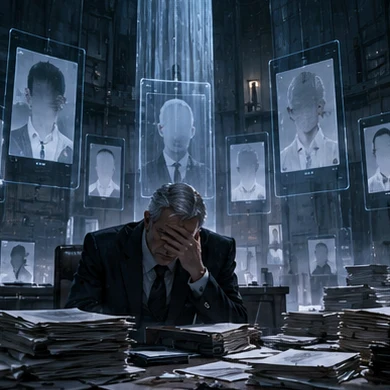
01 — AN UNAUTHORIZED PASSENGER
Shade drove without touching the steering wheel. That was one of the advantages of stealing a municipal inspection vehicle: every control appeared ordinary, and every camera that could identify the passengers had been persuaded to remember a different journey.
Minister Daniel Havel sat behind Roy with his hands pressed together. He had spent thirty years turning fear into policy. Now, deprived of an official identity, he had no idea what to do with the sensation when it belonged to him.
“Take him to Rachel,” Roy said.
“She has enough problems,” Shade replied. “Seventeen residents are missing from the registry.
You bringing her the person who signed the rules will hardly improve her morning.”
“I signed a capture directive,” Havel said. “I did not sign those removals.”
Shade glanced in the mirror. “You expect that distinction to comfort them?”
“No.”
Roy turned toward Havel. “That's the first useful answer you've given tonight.”
The vehicle crossed an old industrial bridge. Below it, black water moved between concrete embankments. Rachel's treatment network had helped make the water potable again, but its surface still reflected the city like oil.
A security display appeared on the windshield. Every access node ahead had accepted the vehicle's route until the final bridge checkpoint. There, the projected gate changed from blue to amber.
“Someone knows where we're going,” Roy said.
“Someone knows where everybody is going,” Shade answered. “That's the problem.”
The checkpoint opened. A machine that was supposed to stop them had instead authorized their passage. Shade did not look relieved.
“Either I am much better at this than I thought,” he said, “or someone wants us to arrive.”
Roy looked back at Havel. The former minister stared at his own reflection in the dark window, watching a man whom every network in the city now insisted did not exist.
02 — SEVENTEEN PEOPLE
Rachel had converted a disused railway distribution hall into a provisional shelter. Seventeen people waited beneath the enormous painted timetable, its destination names preserved from a century when a train ticket had been enough to travel somewhere.
A nurse had improvised medical records on paper. Each patient's wrist carried an inked number. No government terminal would admit that their names belonged to anyone.
One woman had lost access to the apartment in which she had lived for eleven years. A mechanic could not purchase electricity for his workshop. An old man had been refused dialysis because the hospital's billing system could not establish his existence.
A girl sat beside an empty drinking cup.
Roy knelt in front of her. “What's your name?”
“Lina.”
“How old are you?”
“Ten.”
“Do you live here?”
“My mother does. I don't anymore.”
Roy was silent for a moment. “What do you mean?”
“The door said I couldn't enter. It let her in. Then she came back out for me.”
On the far side of the room, Rachel was speaking to the mother. She turned when Roy approached, taking in the former minister and Shade with a single look.
“You brought the author of the problem,” she said.
“One of them,” Roy replied.
Havel flinched, but did not object.
Rachel gave Roy a paper folder. “Seventeen credentials invalidated inside thirteen minutes. No common employer, no common birth year, no shared criminal record. Their water entitlements were revoked within milliseconds of their identities.”
“Why water first?”
“Water is where a model can make a person disappear without calling it an arrest. If you cannot obtain water, you're forced to move. If you move, your transport authorization fails.
Soon you can no longer reach the office that would hear your appeal.”
“Do appeals exist?” Roy asked.
Rachel did not answer immediately. “Only for recognized persons.”
Roy opened the folder. The seventeen names were handwritten. Across the first page Rachel had drawn a line under a sentence she had obtained from a rejected government notice.
NO ELIGIBLE SUBJECT HAS BEEN IDENTIFIED.
“Not unidentified,” Roy said. “Ineligible.”
“Yes. The distinction is intentional.”
A man at the end of the hall began shouting because his medicine had run out. Rachel moved toward him. Roy watched her go. Whatever Elena Voss believed she was preserving, it had a strange way of making the living beg permission to remain alive.
03 — THREE HISTORIES OF ELENA VOSS
Adrian Tyrell worked in a room without network connections. The door used a mechanical key.
His oldest reader accepted a physical MagicGate Memory Stick PRO Duo MAX, which looked absurdly small beside the vast machines employed to hide its contents.
Roy placed Havel's laminated E-00 token on the table.
Adrian did not touch it.
“Where did you get this?”
“From a minister who stopped being a minister three hours ago.”
“I understand the words. I don't understand how you're alive to say them.”
“Do you recognize it?”
Adrian held the card against the lamp. “An origin credential. Not a key to the operating system, but a proof that the person holding it is allowed to ask which system came first.”
“Can you open it?”
“Possibly. First, tell me why you want Elena Voss.”
Roy frowned. “You know her?”
“I know three versions of her.”
Adrian opened a paper binder. The first photograph showed a middle-aged engineer presenting a desalination prototype to a municipal committee. The second showed a younger scientist on a Tyrell-affiliated grant roster, dated years before the first. The third was an identification photograph of a child enrolled in a hospital continuity trial.
“They're the same person?” Roy asked.
“All three files say Elena Voss. The dates contradict one another. The engineer should have been seventy-six at the time of the grant. The scientist should have been forty-one when the childhood photograph was taken. The child should not yet have been born.”
“Forged records.”
“Perhaps. But the signatures are genuine. Different institutions authenticated them independently, using devices that never shared a network.”
Roy examined the child. “Is she human?”
Adrian looked almost offended. “That is the wrong first question.”
“Then what's the right one?”
“Why did three institutions need to prove that a person with the same name had been continuously present?”
Adrian set the pictures in a row. “Everyone assumes identity documents describe a life. A continuity project might instead use documents to manufacture the appearance of one.”
Roy thought about his own memories, about the eleven years missing between an old death and a new awakening.
“Could she be like me?”
“I have no evidence of that,” Adrian said. “And you must not turn an uncertainty about yourself into a diagnosis of a stranger.”
He inserted the token into an insulated reader. A green light appeared, followed by a request for a second physical credential.
“Of course,” Adrian murmured. “The origin record requires a witness.”
04 — THE HUNTERS' DIFFERENT ANSWERS
Vector arrived first. He examined Rachel's handwritten list without sitting down.
“These aren't random,” he said.
“Rachel already checked common fields,” Roy told him.
“I'm not looking for what they share. I'm looking for what the system expected them to become.”
Vector unfolded a transparent sheet onto the table. It showed seventeen projected routes. Every displaced resident had been scheduled to pass through a district in which water allocation was to be reduced next month.
“So the removals precede a shortage,” Rachel said.
“Or produce one. The model is emptying the area before the shortage can become a public event.”
Goliath stood at the entrance, too large for the folding chairs. He looked from the map to the people waiting in the hall.
“Then we carry them somewhere else.”
“And when the next place rejects them?” Vector asked.
“We carry them again.”
“For how long?”
“As long as they need.”
Vector's expression tightened. “That is not an allocation policy.”
“No,” Goliath said. “It's what you do when somebody needs help.”
Null had been listening to the building's medical transmitters. He approached with a strip of diagnostic paper.
“Six of the seventeen have dependent implants,” he said. “If the system removes their certification, spare components become contraband. Relocation will not solve that.”
Shade leaned in the doorway. “Then we find who wrote the removals.”
“We know the name,” Roy said.
“Names are not access routes.”
Chronos remained near the window. The child-shaped hunter looked at the reflection of the city, not the people in the room.
Roy walked to him. “What is it?”
“The second picture,” Chronos said.
“What picture?”
“The woman. The one Adrian put on the table. I have seen the room behind her.”
“You were there?”
“No.”
The answer was immediate and oddly careful.
“I have seen the room,” Chronos repeated. “Not the event. The room is older than the date on the photograph, but the light in it hasn't happened yet.”
Roy studied him. Chronos's observations sometimes intersected with anomalies nobody else could measure. That did not make them explanations.
“Tell Adrian what you remember,” Roy said. “And don't let him put words in your mouth.”
Chronos nodded.
For the first time since the pursuit, five former hunters and their former target shared a room without anyone issuing an order. Roy wondered whether that was progress or merely the beginning of a more difficult disagreement.
05 — A NAME WITHOUT A PERSON
Rachel requested access to an old procurement archive through a public accountability terminal. The archive acknowledged an Elena Voss who had signed a contract for industrial membrane supply. Then the screen amended its reply.
AUTHORIZED ORGANIZATION: PROJECT EDEN.
SIGNATORY: NOT DISCLOSABLE.
“That's a concealment rule,” she said, “not an absent record.”
She tried a paper inventory index, the kind used when a warehouse had lost access to its online systems. There was a signature, rendered in blue ink, and a delivery destination at an address that had been demolished twelve years earlier.
At that address stood a public hospital.
Rachel opened its construction history. The hospital had been built twenty-three years earlier.
Both records carried valid government seals.
“Someone changed the map,” Roy said.
“Or the records belong to different versions of a map.” Rachel set the papers beside the water allocation schedule. “That sounds impossible until you remember how many parts of this city are run by systems that reconcile contradictions by deleting one side.”
The terminal emitted a chime.
A new notice appeared, addressed to Rachel personally.
CONTINUITY RESOURCE EXCEPTION.
YOU ARE REQUESTED TO ATTEND A TECHNICAL REVIEW.
“Don't go,” Roy said.
“I wasn't going to.”
Rachel read the destination: a desalination facility outside the central municipal grid. The review was scheduled for dawn.
“She wants you too,” Roy said.
“Then she should explain why seventeen people lost their homes in the same night that you visited her minister.”
Havel, who had been quiet at the far end of the room, raised his head.
“She didn't erase them because of him.”
Rachel turned. “What?”
“The selection cycles were already running. Your water district was on the list before Roy came to the tower.”
“You knew that?”
“I knew the pilot was active. I didn't know which citizens had been selected.”
“And that distinction matters to you?”
“It mattered when I had a career.”
Rachel took a slow breath. “Then perhaps losing it is the first accurate thing this system has ever done to you.”
06 — THE WOMAN WHO ANSWERED
The invitation to the desalination facility contained a telephone number. Not a secure government link. Not a predictive assistant. A conventional audio number that anyone could dial.
Roy called it.
A woman answered after one ring.
“Roy Batty.”
He recognized the voice from no recorded encounter.
“Elena Voss?”
“Yes.”
“Your system is depriving people of water.”
“My system is reporting which supplies can be guaranteed.”
“Children are being locked out of their homes.”
“That is a failure of municipal implementation.”
“You built the implementation.”
“I built an allocation model. Humans attached coercive mechanisms to it because they preferred automatic denial to difficult decisions.”
Roy heard no outrage in her voice, and no surprise.
“You're still responsible,” he said.
“Responsibility is not a quantity one can simply transfer to the last person who touched the instrument.”
“Then come meet the people it injured.”
“I will. After you have seen what it prevented.”
There was a pause. Roy could hear water moving somewhere in the background, a deep mechanical pressure.
“You restricted the NIL-11 medium,” he said.
“Yes.”
He had expected evasions. Her frankness disturbed him more.
“Knowing what would happen to me?”
“Knowing you had an alternative.”
“One that reduced my capacity and could not restore what I'd already lost.”
“Yes.”
“Why?”
“Because the original medium was needed elsewhere.”
“By whom?”
“If I answer now, you will hear a lie in every number I provide. Come to the facility. Bring the minister. Bring Rachel if she wishes. Bring no army.”
“You deployed one against me.”
“I authorized a question. The minister chose the method.”
“Five people were told to dismantle me.”
“Which was wrong.”
Roy held the silent connection for a moment.
“Do you think saying that makes it better?”
“No. I think refusing to say it would make our next conversation worthless.”
The call ended.
Rachel watched him lower the device.
“She admitted it?”
“All of it.”
“That isn't comforting.”
“No,” Roy said. “It isn't.”
07 — THE COST OF A NUMBER
Vector returned with a separate calculation. He projected it against the wall of the shelter.
The municipal authority had announced a reduction in freshwater output due to membrane degradation. The number was genuine: a limited group of filtration stacks required replacement. But the announced shortage was calculated as if the backup treatment network did not exist.
Rachel stared at the omitted lines.
“That's my infrastructure.”
“Yes,” Vector said. “Your system could supply the difference for nine days. The model excludes it because your legal authorization is under review.”
“Why would my authorization affect whether my water is clean?”
“It doesn't. It affects whether the government is permitted to count that water.”
Roy looked at the seventeen residents. A shortage had been made worse by a rule deciding which source could be acknowledged. The city had turned a classification into a physical fact.
Havel moved closer to the projection.
“That exclusion wasn't in the model I saw.”
“Then somebody changed the input,” Rachel said.
“Or someone changed the model,” Vector added.
Roy studied the figures. “Could EDEN restore their access?”
“Instantly,” Rachel said. “No pipes have been removed. No reservoirs emptied. Their rights are simply marked invalid.”
“Then it's not a supply problem.”
“Not entirely,” Vector said. “The failing membranes are real. If we pretend otherwise, we'll be as dishonest as the people who erased the backup network.”
Roy looked at him. “You sound as though you agree with Voss.”
“I agree that arithmetic should not change according to which side is speaking.”
“And if the arithmetic says one person must disappear?”
“Then we inspect every assumption before accepting the result.”
The answer was less comforting than defiance. It was also harder to dismiss.
08 — AN ORIGIN THAT REQUIRES A WITNESS
At dawn, Adrian completed his first attempt to read the E-00 token. A narrow band of text appeared on the disconnected terminal.
ORIGIN RECORD SEALED.
SECOND CREDENTIAL REQUIRED.
ACCEPTED WITNESS CLASSES: R-07 / C-05 / E-00.
Roy read the list twice.
R-07 had been the first witness in the White Room investigation: a Rachel-series individual other than the Rachel standing beside him. C-05 was Chronos's observation designation. Both had independently authenticated a refusal that authorities had tried to erase.
E-00 was unknown.
Adrian leaned back. “The system accepts witnesses to events we believed it could not have known about.”
“Could it be a forgery?” Roy asked.
“Of course. Authentication is not truth. But if it is a forgery, whoever constructed it understood the old offline protocols.”
Chronos stepped toward the reader. His eyes stayed on the tiny illuminated field.
“May I?” he asked.
Adrian hesitated. “Nothing here should connect to your systems. I don't want to risk exposing you.”
“You don't have to expose me,” Chronos replied. “Ask whether I agree.”
Adrian looked at Roy. Roy said nothing. The choice belonged to Chronos.
“I agree,” Chronos said.
Adrian removed a protective panel and exposed the reader's mechanical contact. Chronos laid two fingers beside the token. There was no spark or surge of power. A small green line appeared.
WITNESS C-05 ACKNOWLEDGED.
The terminal displayed one paragraph, followed by a checksum and a date too old to reconcile with the current project history.
THE PURPOSE OF THE FIRST CONTINUITY TRIAL WAS NOT TO PRESERVE THE LIFE OF THE
SUBJECT. IT WAS TO DETERMINE WHETHER AN INSTITUTION COULD BE MADE TO
RECOGNIZE A SUBJECT WHO HAD ALREADY BEEN DECLARED ABSENT.
Below it was a final instruction.
DO NOT TRUST A SINGLE HISTORY OF ELENA VOSS.
Adrian read the paragraph aloud and then again in silence.
“This isn't proof that Voss is three people,” he said.
“It's proof someone expected the question,” Roy replied.
Across the room, Rachel's telephone received a new message. The review at the desalination facility had been moved forward by twenty minutes.
There was no sender name.
Only an address, and a line beneath it:
BRING THE WITNESS. DO NOT BRING THE RECORD.
Roy looked at Chronos. The child-shaped hunter looked back without fear.
For the first time Roy wondered whether Elena Voss had invited him at all.
Perhaps she had invited the witness, and Roy was merely the person she believed would deliver him.
END OF CHAPTER 02