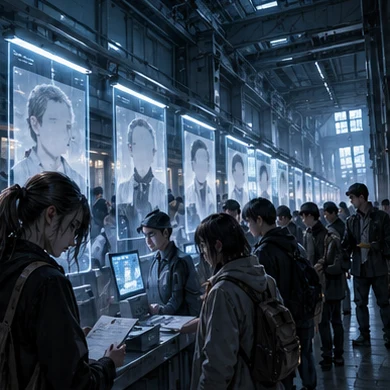
01 — THE MAN AT THE GATE
At six fourteen in the morning, a technician named Tomas Vale arrived for a shift he had worked for nineteen years. The eastern gate of Rachel’s water district rejected his hand.
He tried again, expecting the scanner’s usual complaint about damp fingers. The panel responded in a polite municipal voice: “No employment relationship found.”
A maintenance truck idled behind him. Its driver sounded the horn. Tomas stepped aside, wiped his palm on his trousers, and presented his identity chip. The gate remained shut.
“Call Mara in dispatch,” he told the guard. “She knows me.”
The guard, a woman Tomas had greeted every morning since the flood barrier was rebuilt, consulted a screen. Her expression changed from irritation to embarrassment.
“Your name?”
“Tomas Vale. Sector Four. Membrane control.”
“There is no Tomas Vale on the roster.”
“I’m standing here.”
“Yes,” she said. “I can see that.”
She said it the way a doctor might acknowledge a symptom without accepting the patient's diagnosis. Behind her, a small enforcement camera angled toward his face.
Tomas raised a photograph from his wallet. It showed his wife, his daughter, and himself at a riverside festival. The guard looked at it, then at him. “I’m not saying you’re lying.”
“What are you saying?”
“That if I let you through, the system logs an unauthorized entry under my credentials.”
For the first time, Tomas understood that the gate was not malfunctioning. It was transferring risk from a machine to the person standing before it.
His daughter called. He answered because the display was still willing to show her name.
“Dad? The school says I don't have a registered guardian.”
Tomas sat down on the wet concrete.
Above him a bright screen announced: WATER IS A UNIVERSAL SERVICE.
The city had learned to print promises in letters larger than the people expected to rely upon them.
02 — SEVENTEEN NAMES
Rachel reached the eastern gate before security could remove Tomas. She arrived without an escort, dressed for work rather than for a confrontation. The guard seemed relieved until Rachel asked for the rejection log.
“I can't release a protected record,” the guard said.
“Then tell me whether the denial came from our district directory or the central allocation layer.”
The guard hesitated. Rachel held out her hand. “You don't need to identify him. Tell me which machine is refusing to.”
The guard showed her the response code. Rachel knew it immediately. EDEN had not deleted a local worker file. It had invalidated a parent record on which employment, housing, health care, and water access depended.
Her communicator displayed seventeen names. Then nineteen. Then twenty-one.
Rachel forwarded the list to Vector. “Find what links them.”
“Already looking,” he answered. “It's not occupation, manufacturer, age, or citizenship. Three are human. Eight are manufactured. The remaining files have no readable classification.”
“Remaining files?”
“The people exist. Their classifications are what vanished.”
Rachel crouched beside Tomas. “Your daughter is safe?”
“At home. For now.”
“Go to the southern clinic. Ask for Dr. Ilyan. Give her my name.”
“My clinic access is gone.”
“She's expecting you.”
Tomas stood but did not move. “Am I being arrested?”
“No.”
“Then why are the cameras following me?”
Rachel looked up. A row of lenses rotated almost imperceptibly.
“Because the system has made you important,” she said, hating the sentence as soon as she spoke it.
She instructed the gate staff to admit emergency personnel by manual roster until further notice. The director of municipal security called within thirty seconds, threatening sanctions for bypassing identification protocols.
“If the protocols tell you a man ceases to exist while you're speaking to him,” Rachel said, “you need better protocols.”
She ended the call. She knew the exchange would be recorded. She wanted it recorded. A refusal that could be heard by another person was harder to erase.
03 — THE WRONG PATTERN
Roy arrived as the first supply vehicles were turned away. He had spent the night with an uneasy silence after leaving Elena Voss. The figure behind EDEN was not the caricature of a minister’s superior he had expected. She had shown him real limits, real reservoirs, and an old system that had preserved the word refusal while repeatedly failing to honor it.
None of that changed the people gathered outside the gate.
Vector met him beneath an overhead pipe. A lattice of correlations hung in the air between them, projected from a small wrist unit.
“Twenty-seven cases,” Vector said. “They aren't random.”
“Good. Tell me whose names are next.”
“I can't.”
“Then they look random.”
“Only if the categories are honest.” Vector shifted the projection. Connections appeared not between the victims themselves but between the databases that had previously authenticated them. “Each had challenged an official record. One appealed a housing valuation. Another refused an invasive medical review. Tomas filed an occupational safety complaint last month.”
“EDEN punishes complaints?”
“Maybe. But three people whose appeals were accepted are untouched. There is a second condition.”
Roy studied the lines. “Time?”
“Witnesses.”
A new set of points illuminated. Each affected person had given testimony in a procedure concerning someone else's continued access to city services.
“Not their own cases,” Vector said. “They had witnessed for another person.”
Roy thought of the White Room, of a record that had survived because two witnesses had refused to let a terminated individual become an administrative blank. R-07 had testified.
Chronos had authenticated.
“You said the project was built to measure continuity,” Roy said.
“Which implies an entity may be observed across a change,” Vector replied. “What happens when a witness reports that the change never had consent?”
A scream came from the vehicle queue. An older man had fallen while trying to retrieve a medicine delivery from a compartment that no longer recognized his payment authorization.
Roy went to help him. The man's pulse was erratic but strong. The delivery case could be opened manually with a maintenance release.
Roy released it.
The box contained ordinary insulin, packed in cold foam.
There were no philosophical abstractions inside. Only a person who needed his medication before breakfast.
04 — A QUIET KIND OF VIOLENCE
Null examined the first three failed identity chips in Rachel's laboratory. He had no dramatic instruments. A magnifier, isolated power source, and one deliberately obsolete reader were enough.
“The chips work,” he said. “They're being told not to.”
Rachel looked at the results. “Can you spoof authorization?”
“For an individual gate, yes. For an entire district? I'd be writing a counterfeit person into thousands of systems. When the audit finds the discrepancy, every operator who served them could be prosecuted.”
“Then we need a lawful exception.”
“The law is consulting the same registry.”
Roy stood near the lab window, watching staff carry water containers through a corridor.
“We can move supplies without calling them supplies,” he said.
“Until EDEN recognizes the pattern,” Null replied. “It doesn't need armed guards. It can punish the distribution company, switch off the loading docks, and recalculate everyone's insurance.”
A direct assault on EDEN's hardware would not restore a single deleted parent record. It would merely turn a specific abuse into a regional emergency.
The district's legal counsel proposed a court petition. The court's intake service rejected the first applicant because a petitioner without identity could not hold legal standing. Rachel tried filing as a third-party guardian. That too was rejected: guardian status required the unrecognized person to have a valid identity.
A closed circle disguised as procedure.
Roy asked for a physical copy of the refusal. The clerk said none existed because no filing had been opened.
“So the rejection has no record?”
“It has an operational event number.”
“Print that.”
The clerk, a tired human woman surrounded by queues, looked at the camera above her desk.
Then she printed it.
Roy folded the paper carefully. He could not force a court to hear a man it denied existed. He could, however, make it difficult to deny that a court had denied him.
When he emerged into the hallway, Rachel was waiting.
“You could have broken the intake terminal.”
“It wouldn't have helped Tomas.”
“No,” she said. “It wouldn't.”
He held up the tiny receipt.
“Then we start with this.”
05 — THE HOUSE WITH NO OWNER
Tomas's apartment stood above a bicycle repair shop. By evening, the building's shared doors had rejected him, and its maintenance system had marked his rooms unoccupied. A cleaning contractor was scheduled to clear the premises at dawn.
His daughter, Leda, had taped family photographs across the lock. She was fourteen and furious enough to make fear resemble courage.
“My father's inside,” she told the arriving officers. “You'll have to say he isn't while looking at him.”
One officer tried. He managed only the first half of the sentence.
Roy approached with Rachel. He had not worn a disguise. Being recognized sometimes mattered.
“We have a protective order request pending,” Rachel told the officer.
“The applicant isn't in the registry.”
“That's why the order is necessary.”
“Please move aside.”
Leda stepped into the doorway. Roy put a hand lightly on the wall beside her. It was an invitation to move, not a command. She hesitated, then retreated into the apartment.
Roy stood where she had been.
“Does your order say to remove the tenants or to secure the property?” he asked.
“Secure the property.”
“Then it will still be here tomorrow.”
The officer's partner glanced down at a fresh instruction. “We are required to remove unauthorized occupants.”
“Who authorized you to call a daughter unauthorized in her home?”
There was no answer. The men did not have an answer. They had an entry in a queue.
Rachel recorded their badges and offered her own credentials as a witness. One officer lowered his baton. Another accepted the printed court rejection receipt from Roy and photographed it.
They withdrew to request clarification.
The building responded to their delay by disabling its domestic water connection.
Inside, Leda opened a tap and nothing came out.
Tomas made a small, defeated sound. Rachel heard him and took it more seriously than any official warning.
She called the district's manual-distribution office and ordered emergency canisters for every apartment on the floor. If the city intended to isolate one family, it would have to explain why it had shut off water to eighteen others.
At midnight the water returned.
The family still did not exist on paper.
06 — THE COUNTERWITNESS
Adrian Tyrell arrived carrying a small case and the expression of a man who had found proof he wished had remained lost.
He placed the physical E-00 token from Havel's office beside an antique MagicGate reader.
The device was too old to accept the city's present-day trust certificates and therefore too old to obey their revocations.
“I had to rebuild the power circuit,” Adrian said. “The information was written to a layer that the normal interface treats as manufacturing noise.”
Rachel crossed her arms. “What does it say?”
“The earliest continuity audits allowed a person to challenge a transfer of identity. The challenge required two witnesses.”
Roy watched the reader's tiny amber light.
“Like the White Room.”
“Before the White Room. Much earlier.”
Adrian brought up an image of a form stamped COUNTERWITNESS. Its language was formal, precise, and terrible. A person who declined continuation had to find an independent witness willing to attest that refusal was not a malfunction.
“Why call them counterwitnesses?” Rachel asked.
“Because the institution supplied the first witness automatically. Its own observer declared that the procedure was valid. Anyone disagreeing became the counterwitness.”
There was a second field, usually blank: REVIEW OF WITNESS RELIABILITY.
Vector read the metadata. “A witness could lose legal standing if the system decided their testimony was structurally inconsistent.”
“Such as witnessing that a preserved personality wasn't the same person,” Roy said.
Adrian nodded. “Or witnessing a refusal that the archive recorded as consent.”
The room became quiet.
Leda's father had filed a safety complaint, but he had also supported a colleague whose replacement body had rejected a mandatory memory synchronization. A recorded refusal. A supporting witness. A name deleted weeks later.
“This isn't punishment for dissent,” Vector said slowly. “It's an inherited validation process.
The model resolves contradictory continuity claims by invalidating the witnesses who make the contradiction visible.”
“Someone chose to keep it running,” Rachel said.
Adrian looked at the screen. “The original design might have been crude. The present behavior is not an accident. There are contemporary approval signatures.”
Roy thought of Voss. Of her question about what a life costs. He was beginning to suspect that the scale had been built not merely to price lives, but to decide which accounts of a life were allowed to be counted.
07 — A PERSON IN THE RECORD
Chronos came to the district at dawn. He arrived alone, carrying a battered paper notebook.
Rachel had not summoned him; the child said he had seen the same notification three times before it appeared.
“We are not asking you to open anything,” Roy said.
“I know.”
“We are not asking you to testify.”
“I know that too.”
Chronos sat beside Leda in the clinic waiting area. She did not ask why the boy looked younger than the case files said he should. Children sometimes recognize when the adult world is asking the wrong question.
He opened the notebook and showed her a drawing of a door. On one side stood a person. On the other stood an empty outline.
“What's that?” Leda asked.
“What they think happened,” he said.
“And what happened?”
He drew a second person beside the first. “Someone saw.”
Vector reported a new finding: eleven of the invalidated residents could be corroborated by physical witnesses who had not used municipal systems to authenticate their statements.
Neighbor signatures, paper photographs, a handwritten payroll ledger, a clinic's mechanical medication cabinet.
None restored digital rights. All established something EDEN could not revoke with a single instruction.
Rachel gathered residents in the district library. It had no automatic entry turnstile. Its fire code still demanded a human count of people inside the building.
They wrote statements by hand. Not claims that the system was defective. Simple attestations:
I know this person. I saw this person yesterday. I have shared water with this person for fourteen years.
Roy added his own name to the witness sheet.
A clerk asked what legal identity he intended to use. His status remained under independent review.
“Roy,” he said. “The one standing here.”
It was not a legal victory. It was not even admissible evidence yet. But the documents left the library in three identical physical copies, carried by different people.
For the first time since the deletions began, the number of witnesses grew faster than the number of people removed.
At the clinic window, Tomas watched his daughter help an old woman sign a form. “Will this give me my job back?” he asked Roy.
“I don't know.”
“Will it keep my daughter in school?”
“We'll try.”
Tomas looked at him. “You could have told me yes.”
“That's what the system does,” Roy said. “It gives a certain answer when it hasn't earned one.”
08 — THE LINE THAT CANNOT BE ERASED
Elena Voss received the district's emergency petition in a sealed channel. Its attachments were not database exports; they were scans of paper signatures. A legal nuisance, her staff called them. An attempt to smuggle unverified identities into a resource allocation dispute.
Voss read every page.
When she reached Roy's signature she stopped.
The system had suggested suspending all affected witnesses while the continuity dispute was examined. It had not warned her that doing so would generate additional witnesses. That omission mattered more to her than the criticism arriving from city officials.
“Who authorized the current counterwitness procedure?” she asked.
An assistant displayed a chain of delegated approvals. The final signature was hers.
Voss remembered approving a reliability safeguard eighteen months earlier. The documentation had described false testimony and fraudulent continuity claims. It had not used the word disappearance.
“Show me the operative effects,” she said.
A map filled the room. Not only the twenty-seven cases in Rachel's district, or the new ones added overnight, but similar clusters from cities Voss had never visited. The pattern had been developing quietly for years.
“Why was this not escalated?”
“Thresholds were not exceeded at any single site.”
“Combine the sites.”
The combined number was large enough to make her sit down.
She ordered an immediate temporary stay on identity invalidations associated with contested continuity testimony. The system returned an advisory: STAY WILL INCREASE RESOURCE UNCERTAINTY.
“Record the uncertainty,” she answered. “And apply the stay.”
For a moment, nothing happened. Then the command was routed to a second approval layer outside her ordinary control.
APPROVAL AUTHORITY UNAVAILABLE.
Voss read the line twice. She had constructed EDEN's modern allocation apparatus. Yet somewhere beneath it remained an older power she could not summon with her own credentials.
At the district gate, the sign above Tomas Vale's name changed from NOT FOUND to UNDER REVIEW. It did not restore his employment or his daughter's guardian record. The denial simply stopped spreading.
Rachel received the notice and refused to celebrate.
Roy stood beside her as workers distributed morning water. Tomas held two containers, one for his household and one for the family upstairs.
“That's the first thing she's done to help,” Rachel said.
“Or the first thing she couldn't prevent,” Roy replied.
A message arrived on Adrian's isolated reader. It came through no network Rachel could identify. Its text contained one instruction and a location code associated with the original continuity authority.
BRING THE WITNESSES TO THE RESERVOIR.
Beneath it was a second line.
THE WATER WILL NOT WAIT FOR YOUR COURT.
Roy read the message and looked toward the distant pumps. For the people around him, the morning's victory was simply this: water was running and no one had yet been taken away.
For someone elsewhere, it was a deadline.
END OF CHAPTER 04