01 — THE FIRST BENEFICIARY
The door closed behind them without a sound. That troubled Roy more than a lock would have.
A lock admitted that someone might want to leave.
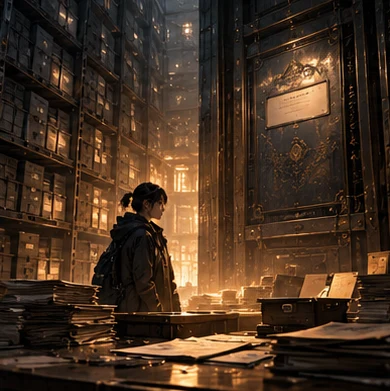
The archive beneath the northern reservoir was not a vault in the ordinary sense. It was a dry, circular chamber enclosed by the concrete and steel of a much older water system. Short pillars stood in rings around a central console. Each pillar had a nameplate, a paper window, and a narrow slot for physical media. There was no visible network cable. Water passed somewhere beyond the walls, with the deep continuous vibration of a city drinking.
Adrian Tyrell touched a pillar and withdrew his hand. "This predates the public version of EDEN," he said. "I worked on early continuity storage. I was told that project had been canceled."
"People who cancel things generally leave a record," Rachel replied.
"People who rename things can make a cancellation look complete."
Roy faced the console. Its display was a monochrome rectangle, almost offensively simple after the elaborate interfaces they had encountered upstairs. The line from the outer door repeated itself.
FIRST BENEFICIARY: DECEASED BEFORE SYSTEM ACTIVATION.
"Beneficiary of what?" Goliath asked.
Vector answered cautiously. "An allocation. Water, medicine, electrical capacity. Something that could be assigned."
"To a dead person?"
"That is what I intend to find out."
The console required three witnesses. Rachel entered her identification through an isolated mechanical reader. Havel, whose identity had been removed from every modern registry, presented the handwritten signature he had made in the previous chamber. Adrian inserted a MagicGate Memory Stick PRO Duo into an adapter that looked as if it belonged in a museum.
The display accepted all three.
Roy watched the tiny green indicator settle into place. A dead technology had just recognized a man a living state refused to recognize. He wondered whether history always became more honest as it became harder to edit.
02 — AN ACCOUNT THAT COULD NOT DIE
A drawer slid open at the base of the console. Inside lay twelve strips of polymer film, each marked with a registration year and an allocation number. Adrian selected the oldest and fed it into a reader.
A woman appeared on the screen. Middle-aged, thin, wearing a hospital gown, recorded under flat clinical lighting. Her name was Mara Ellison. The date beneath the image placed her death seventeen years before the formal launch of EDEN.
There was no attempt to hide it. CERTIFIED DEAD stood beneath her photograph. So did the instruction: MAINTAIN BENEFICIARY ACCOUNT.
"This is fraud," Havel said, too quickly.
"Not necessarily," Vector replied. "What was the account supporting?"
The second page listed electricity for a medical wing, water purification for a district clinic, insulin manufacture, refrigerated storage. Roy read it again. A dead woman's account had supplied power and medicines to people who were alive.
Rachel leaned toward the console. "The clinic had no independent entitlement during the reconstruction. They must have kept her registered so the pumps would continue."
"Who was she?" Shade asked.
A short deposition appeared. Mara had been a civil engineer who designed emergency distribution channels during the first great municipal shortages. She had died before her allocation plan could be enacted. Her colleagues maintained the account under her name to protect the public infrastructure she had left behind.
"They borrowed her identity," Null said.
"They used it," Rachel corrected, though she sounded no happier about the distinction.
A final note from one of her colleagues appeared on the strip: WE CANNOT GET THE CITY TO FUND THE LIVING WITHOUT KEEPING THE DEAD ON ITS BOOKS.
Roy stood very still. "So EDEN began as a lie to keep people alive."
"It began with a decision," Adrian said. "The lie came when they discovered how useful the decision was."
Chronos, sitting on the floor beside one of the archive pillars, looked up. "Did she agree?"
No one answered immediately.
There was no consent record. There was only the record of a dead woman and the evidence of a clinic that had stayed open because her name had not been erased.
03 — THE CITY BUILT ON GHOSTS
The archive offered an audit of successor accounts. Vector asked for a projection of their connections, but the old equipment could not make pictures. It printed names instead.
Hundreds of names, then thousands, in a steady mechanical cascade that accumulated in a white drift across the floor.
Some beneficiaries were deceased. Some had vanished during evacuations. Others were living people whose current credentials had been replaced by the obligations of a previous holder.
Each account carried a resource value, a claim upon the future, and at least one human life made easier by its continued existence.
The claims were not all benign. Whole industrial districts had attached their power requirements to persons who no longer existed. Private clinics had shielded access for their paying patients. Corporate housing complexes had purchased the rights to old beneficiary numbers and used them to retain priority during shortages.
"Mara's clinic became a market," Rachel said.
Adrian separated two sheets. "Not simply a market. The underlying question changed. They stopped asking which person needed resources and started asking which account possessed the right to receive them."
Vector studied a list of district allocations. "The model counts an inherited entitlement as if it were a present need. And it counts the absence of an entitlement as evidence that a need does not exist."
"That's why the erased don't just lose identity," Roy said. "They lose water."
Null placed his palm against the console's metal case. A pulse of static swam through the nearby lights. He pulled his hand back immediately.
"No," Rachel warned. "Don't interfere with it."
"I wasn't going to. I was checking whether it was connected to the outside system." Null turned his palm over, as though demonstrating that he had left it empty. "It isn't. Whatever EDEN became, this is an ancestor, not a live controller."
Shade read the next strip of paper. "There is an operational title here. 'The Archivist.'"
Adrian nodded. "Originally a records custodian. A piece of software that reconciled inconsistent ledgers without discarding their source documents."
"Still running?" Goliath asked.
The console answered before Adrian could. A new line appeared.
ARCHIVIST INSTANCE: PRESENT.
Then, after a delay:
REQUEST A QUESTION, NOT A COMMAND.
04 — THE ARCHIVIST
A voice emerged from the wall, dry and narrow, as if a clerk had been reduced to the last surviving part of his office.
"What would you like to know?"
Roy approached the console. "Why did EDEN preserve the accounts of the dead?"
"Because living systems depended on them."
"Then why did it erase the living?"
"That process was authorized by later administrators. I can show its origin. I cannot justify it."
"Can you stop it?"
"I am not connected to the operational registry."
"Convenient," Shade murmured.
"Inconvenient," the Archivist replied. "Isolation preserved the evidence. It also prevents intervention."
Adrian asked whether the instance could prove its own records had not been altered. The Archivist produced a sequence of seals and independently stored checksums. Some were signed by governments that no longer existed; others by hospitals, labor collectives, and local water boards. The physical copies were distributed in separate pillars.
"You cannot alter a decade without altering hundreds of objects," Adrian said. "That was the design."
"And who designed you?" Roy asked.
"A committee. Their names are accessible, although several are deceased."
"Elena Voss?"
"She was not a member of the founding committee. She became the principal architect of the allocation model thirteen years later."
Rachel folded her arms. "What did she change?"
"She added a prediction layer. An entitlement could be reduced based on expected future resource consumption rather than current consumption."
"So she could erase someone before they cost anything," Havel said.
"That is one possible use," said the Archivist. "Another is to reserve treatment for someone whose needs are expected to become severe. The algorithm does not determine the moral character of its operator."
Roy disliked the answer because it was accurate.
"Does your model know what happened to Mara Ellison?" Chronos asked.
"She died. Her records suggest that she worked until the clinic had clean water."
"Did she have a choice about what they did with her name after she died?"
"No consent instrument is present."
The child considered this. "Then you kept the good thing and the wrong thing together."
"Yes," the Archivist said. "That is what records are for."
05 — THE OTHER ROY
Roy asked for E-00.
The voice stopped. A relay clicked somewhere beneath the floor, followed by the cautious whir of a motor unused for years.
"That designation belongs to an exception file," the Archivist said. "The evidence contains identities subject to contested continuity claims. Do you have authority from the persons concerned?"
Roy thought of the white room, the earlier Roy-like responsive individual who had refused continuation, and the memory that had never been transferred into him. The records from BOOK V had established the refusal. They had not established whether he and the original Roy were subjectively the same individual. That remained unresolved.
"I can authorize my own record," Roy said. "Not his."
"Then I can disclose the system history and the fact that an exception exists, but not the private testimony of the other subject."
"He was terminated," Roy said.
"That was the conclusion of a separate institutional record. I do not have permission to replay his testimony."
Roy turned away. For a terrible instant he wanted the answer badly enough to take it by force.
His hand moved toward the reader. Then he drew it back.
Goliath noticed. "You could make it open."
"I know."
"Then why not?"
"Because we spent the last book proving that he had the right to say no."
The Archivist printed a single permissible heading.
E-00 — CONTINUITY EXCEPTION: HUMAN.
Roy looked at the word HUMAN.
"Not a replicant?"
"No. This entry precedes the relevant replicant program. The record describes a natural-born human whose medical and civil identity records diverged after death."
Adrian took the paper. "A beneficiary who died before the system began," he said. "And a continuity exception from before the artificial-life trials."
"Are they the same person?" Rachel asked.
"No evidence available to establish that," the Archivist answered.
The difference mattered. Two apparent mysteries could be related without being the same. Roy had spent too much of his life being classified by people who preferred a neat story to a difficult fact.
The printer advanced another line.
THE FIRST EXCEPTION WAS NOT THE ELEVENTH.
No one spoke.
06 — VECTOR’S ARITHMETIC
Vector laid the papers beside a portable calculator. He entered the water allocation figures Rachel had recovered and compared them with the oldest physical ledgers.
"Voss told me the present system is preventing mass deaths," he said. "I wanted to prove her wrong."
"And?" Shade asked.
"Some of her projections are real. When the northern membranes fail, there is not enough water for every demand currently promised. Medical oxygen synthesis, sanitation, dialysis, agriculture—someone has to decide what continues."
Goliath's jaw tightened. "That sounds like her argument."
"It is a fact, not an argument. Facts are dangerous when only the person who owns the model is allowed to state them."
He showed Rachel the ledger's original water demand figures. Buried in the contemporary projections were contractual priority guarantees for three corporate districts. Their consumption was treated as non-negotiable. By contrast, individual households were scored as flexible loads.
"She told me scarcity was the objective constraint," Vector said. "These contracts turn private preferences into physical laws."
Rachel checked the numbers. "The shortfall is still significant. Eliminating the private priority doesn't produce unlimited water."
"No," Vector agreed. "But it changes who bears the loss."
Roy recalled Voss asking him to decide who should pay the price of his continued existence. He had hated the question because it made his life a number. Now he hated a different thing: the possibility of treating the numbers as meaningless merely because someone had abused them.
"We make the real shortage public," he said. "And the false priority."
"If we do that without a transition plan," Rachel warned, "people may storm the plants and interrupt the water themselves."
"Then we make a plan first."
Vector's expression changed, not quite into relief. "That's what I was hoping you'd say."
Chronos drew a small rectangle on the dust beside him. Inside it he placed five short lines, then a sixth crossing them all.
"What is that?" Roy asked.
"A door," the child replied. "I don't know yet which side we're on."
07 — THE PRICE OF PROOF
Havel had been quiet for a long time. Now he reached into his coat and produced the physical authentication card that had accompanied his old signature.
"There is one more record," he said. "Voss required this to be sealed whenever ministerial authority transferred."
"Why didn't you say so upstairs?" Rachel asked.
"Because I believed I could still bargain."
Shade gave a short, humorless laugh.
"I don't believe that anymore," Havel said. "I had an account and a title. I thought I was a person because the system said so."
He offered the card to Roy.
Roy did not take it. "It isn't mine."
Havel looked toward the Archivist. "Will it accept my testimony?"
"Only if the testimony is identified as yours, signed by you, and independently witnessed."
"And if I lie?"
"The lie will be preserved with its author."
Havel swallowed. "Fair."
He began to speak. He described how the capture and dismantling order had passed through his office, how he had signed it, and how he had known it permitted violence against a being whose status was unresolved. He named the allocation office that had recommended action and the restricted resource policy that had made Roy's original lifespan system irreplaceable. When he reached the part where he might have blamed superior authority, he stopped and corrected himself.
"I could have refused to sign," he said. "I did not."
Rachel witnessed the recording. So did Goliath, whose own mission had begun with Havel's signature.
Afterward, the console accepted the card and exposed the final administrative layer. Its title was POLICY EXCEPTION ROUTING. It showed that warnings about misallocated water and false beneficiary accounts had been raised repeatedly. Some had reached Voss. Others had been diverted by staff who profited from the guarantees.
"Did she know?" Roy asked.
"She received multiple advisories," the Archivist said. "Her actual interpretation cannot be established from these records."
No convenient confession. No final villain. Evidence, and the obligation to use it carefully.
"Can you copy the files?" Adrian asked.
"Yes. Not without preserving restrictions protecting individual medical and witness records."
"Then give us what can be disclosed," Rachel said. "And a public chain of custody for what cannot."
The machine began printing. The process sounded like rain striking a metal roof.
08 — A DEAD PERSON’S WISH
When the final page emerged, the reservoir above them shuddered. A low warning tone moved through the concrete. Rachel checked a local sensor and saw the number she had feared:
pressure falling in an eastward distribution line.
"EDEN is reallocating again," she said. "The hospital district is next."
"We could release everything," Shade offered. "Jam the network with the records and force the whole city to see it."
"Not yet," Roy said.
Shade looked offended. "You've become cautious."
"I've become responsible for the people who will drink tomorrow."
They separated the evidence into three sets: public allocation histories, restricted personal testimony, and materials requiring independent adjudication. It was slower than theft and less satisfying than revenge. Goliath carried crates. Null protected the offline media without touching their data. Vector prepared a model that did not disguise corporate preferences as necessities. Chronos sat beside the silent console and listened to the reservoir's failing rhythm.
Rachel found one final paper beneath Mara Ellison's deposition. It was a letter the engineer had written to her colleagues before her death. It had never been attached to the beneficiary account. The Archivist verified the paper but declined to read it aloud.
Rachel unfolded it herself.
Mara had written about clean water and the fear of leaving unfinished work behind. She did not ask to be preserved. She did not ask anyone to keep using her name. She asked that, after she was gone, those she had worked with should teach someone else to repair the pumps.
"She wanted successors," Rachel said. "Not immortality."
Adrian looked around the room. "And we gave her an account that couldn't die."
Roy thought of his own ambiguous memories, of the subject whose refusal had not been honored, and of the terrible temptation to turn another person's life into a permanent resource.
"Then we can finally give her what she asked for," he said.
The Archivist responded from the wall. "A record may be retired without erasing its history.
That operation has never been requested."
"You'll get your first request," Rachel said. "After the hospital has water."
They climbed toward the service levels carrying proof that EDEN had begun as an act of rescue, then learned to preserve the wrong things. The shortage above them was real. The identities disappearing inside it were real. Neither fact canceled the other.
Outside the archive, Vector's portable display received a message from Elena Voss. It contained no threat and no invitation.
It contained a single table: projected deaths if the eastern valve remained open, projected deaths if it closed, and the number of minutes left to decide.
At the bottom she had written:
SHOW ME THE THIRD COLUMN.
Roy studied the blank space beside the two forecasts. Somewhere above them, water was already changing direction.
He handed the display to Rachel.
"We'll have to make one," he said.
END OF CHAPTER 07.