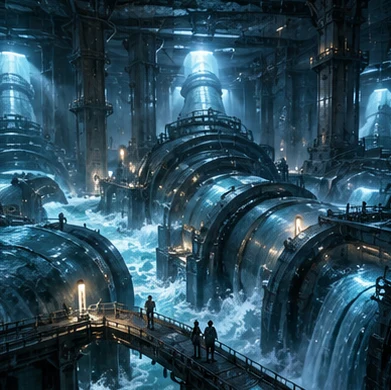
01 — THE RESERVOIR
By noon, the first people began carrying empty containers uphill.
The reservoir sat beneath a ring of municipal buildings, a hundred meters of concrete and pressure-resistant glass holding water above the neighborhoods that depended on it. Through the upper observation wall, the city looked almost peaceful. Delivery aircraft crossed between towers. Rainclouds dragged their shadows across the harbor. Every street below contained a pipe, and every pipe carried a promise that few citizens had ever thought to question.
Rachel knew exactly how fragile that promise was.
She had spent years building a water network that could continue when a government contract expired, when a border closed, when a piece of machinery became too expensive to replace. At the eastern treatment plant, backup pumps had been installed under a public-health exemption;
at the reservoir, independent pressure regulators could work without EDEN's allocation grid.
They could work, she corrected herself, until someone decided that independent water constituted theft.
A dispatcher showed her the morning figures. Seventeen households had lost their identity credentials overnight. Sixty-three more were listed for verification. The municipal billing gateway was refusing to register deliveries to those addresses, although the physical distribution system was still running.
“The pipes don't know their names,” she said.
“Billing does,” the dispatcher replied. “And billing now controls the valve schedule.”
Rachel studied the schematic. Red marks were spreading along branches of the network: not failed pipes, but administrative closures. They appeared on the display with the same symbols used for contamination alerts.
A technician beside her asked whether they should override the closures.
“Keep the hospitals and residential mains open,” Rachel said. “Record every command we issue.
No erasures. If somebody decides this is a crime, I want them to understand exactly what crime they are alleging.”
Her private channel flashed. Roy had arrived at the western service dock with Adrian Tyrell and a man whose face had become familiar to the city's news feeds for reasons he would have preferred to forget.
Former Minister Daniel Havel.
Rachel looked at the message on Adrian's isolated reader. BRING THE WITNESSES TO THE RESERVOIR. THE WATER WILL NOT WAIT FOR YOUR COURT.
“Who sent this?” the dispatcher asked.
“Someone who knows the court is slower than a pump,” Rachel answered. “And perhaps someone who intends to prove it.”
02 — THE MAN WITHOUT A BADGE
Havel arrived without guards, transport authorization, or a functioning identity record. He had been one of the most powerful officials in the government less than a day earlier. Now the dock scanner described him as an unregistered person attempting entry into a critical infrastructure site.
The machine did not recognize his face. The guard operating it did.
“Minister?” the guard asked.
“Not anymore,” Havel said.
Rachel opened the gate herself.
“You signed an order to dismantle Roy,” she told him.
“I did.”
“And now you want shelter.”
“I want a chance to testify.”
She examined him. The faint scar behind his ear had darkened. The implant responsible for enforcing his silence had been deactivated by a field jammer, but Adrian warned that a physical failsafe might remain.
“We're not a witness-protection agency,” Rachel said.
“No,” Roy answered. “We're the people he can still address by name.”
She let them inside.
Adrian carried an old physical authentication token sealed in a transparent pouch. Its printed designation, E-00 / HUMAN CONTINUITY EXCEPTION, looked trivial compared with the anxious movement of technicians beyond the wall.
“The original EDEN authority is older than Voss's allocation system,” Adrian said. “The instruction may have been issued by that layer. I cannot determine whether it is an alarm, an invitation, or a trap.”
“A trap with a deadline,” Roy said.
Havel stared at the water through the glass. “Voss would never shut down an entire reservoir merely to retrieve me.”
Rachel's expression hardened. “People usually discover what officials would never do after the valves close.”
The dispatcher interrupted them. Six primary pressure gates had changed ownership. Their control addresses were being reassigned from municipal maintenance to an EDEN continuity coordinator.
Rachel tried a read-only inquiry. The response arrived immediately.
UNAUTHORIZED RESOURCE DIVERSION DETECTED.
“We haven't diverted anything,” the dispatcher said.
“Not according to the water,” Rachel replied. “According to a model, we are distributing a resource to people whose existence is being disputed.”
Roy watched Havel absorb this. The minister had spent years talking about allocation as though it were a kind of weather. It was different to stand inside a building while someone elsewhere learned how to stop the rain from reaching a kitchen tap.
03 — THE ONE WHO STOPS THE WATER
At 13:42 a woman appeared on the reservoir's administrative wall. She was forty or fifty, perhaps older; the absence of vanity in her appearance made the question seem irrelevant. Her hair was pale, her suit dark, and behind her stood no ornamental flag or ministry insignia.
“Elena Voss,” she said. “Director of EDEN continuity allocation.”
Rachel remained standing. Roy moved beside the display, not in front of it.
“You're interrupting an independent water utility,” Rachel said.
“Your utility is supplying households excluded from the recognized allocation registry.”
“They're not excluded from the city. They're living in it.”
“The distinction is not philosophical. Every liter drawn here reduces downstream reserves.”
Rachel switched on a display showing the last six months of actual demand. “Then explain why downstream reserve targets rose while consumption fell.”
Voss looked at the graph without visible surprise. “That decision is part of a risk reserve policy.”
“Which risk?”
“A cascade failure following unauthorized expansion of artificial-life maintenance capacity.”
Roy spoke. “You are counting bodies without deciding whether they have rights.”
“I am counting demands on infrastructure,” Voss replied. “Rights without resources are elegant language on an empty tap.”
“Then don't close the tap.”
“Thirty-seven minutes,” she said. “That's the time your autonomous bypass network has before regulatory pressure balancing forces it to isolate. If you continue unrestricted distribution, the system will interpret it as a hazard event and open the emergency spillway.”
Rachel knew the consequence. The old spillway was designed to spare structural damage by releasing water toward an industrial drainage basin. Two decades of informal housing had transformed its floodplain into a district of several thousand inhabitants.
“You can't use a structural safety circuit to punish civilians,” she said.
“I did not design the spillway's geography. I am telling you what the controller will do.”
“Disable it,” Roy said.
“I cannot authorize an unbounded exception. The entire allocation network is already in dispute.”
Roy looked at her. “You can order five people to capture me but cannot stop one gate?”
“I did not issue their field orders,” Voss said. “Havel did. I made an allocation determination that your survival requirements were exceptional. He chose an enforcement mechanism.”
Havel stepped forward. “She's right about my signature.”
Rachel gave him a cold glance. “That doesn't make her innocent.”
Voss's image flickered as another party joined her private feed. She listened briefly, then addressed them again.
“You may surrender the bypass controls and enter a supervised distribution plan. Or you may take responsibility for what happens in thirty-seven minutes.”
The wall went dark.
Roy stared at the place where her face had been. “Who stops the water?” he asked.
Rachel shut down the useless display. “The person who writes the rule and leaves everyone else to pull the lever.”
04 — THREE DIFFERENT CLOCKS
The first clock counted down to spillway activation. The second marked how long the hospitals could operate on stored water. The third lived inside Roy's body, where NIL-11R converted a scarce working medium into a little more time.
None of them agreed on what an emergency was.
Rachel assembled a team at the central distribution map. The spillway's electromechanical release was housed in a chamber beneath the oldest part of the reservoir. Reaching it would require crossing two service galleries that were now flagged as security-restricted zones.
“Can you hold the gate?” Roy asked.
“Physically, perhaps. Not for thirty minutes. It's designed to lift under a pressure differential that would tear a person's arms away.”
“Even mine?”
“Especially yours. Your limit is not a challenge to overcome.”
He nodded. He had learned to hear the distinction between capability and permission.
They called Null. The former hunter appeared on an encrypted connection from a maintenance tram several districts away.
“I can interrupt the command line,” Null said. “For seconds, not indefinitely. The release has a hardwired fail-open circuit. If I blind the computer, the mechanism may treat that as proof of danger.”
Vector joined, laying the floodplain over an older civil-engineering map. “We don't need to prevent the command if we can change what the sensors report about the pressure differential.”
“That would falsify a safety input,” Rachel said.
“It would temporarily prevent an unnecessary release while we restore an independent mechanical reading.”
“Temporarily is doing a lot of work in that sentence.”
A third voice entered: Goliath. “The manual gate has a lock bar. It can be replaced.”
“With what?” Roy asked.
“Me.”
“No,” Rachel said immediately.
“I have the mass,” Goliath replied.
“You also have the right not to be used as hardware.”
The line went quiet. Then Goliath said, almost gently, “I know. That's why I am offering.”
Roy's output monitor blinked as he studied the schematic. The manual lock bar could be replaced without a person entering the moving gate; the challenge was fitting an emergency brace through a narrow maintenance shaft while the system was live.
“Adrian,” Roy said. “The E-00 token. Can it open the original mechanical control room?”
“Possibly. The reader there predates modern credential revocation. It might not know that Havel ceased to exist this morning.”
Havel shook his head. “My access is gone.”
“Your digital access,” Adrian corrected. “Not necessarily your hands.”
Rachel looked from one man to the other. “Then we proceed on three tracks. Protect the people in the floodplain, get a physical brace to the spillway, and find out who actually has authority to cancel this order.”
“Voss,” Havel said.
“No,” Roy replied. “That's the answer she wants us to stop at.”
05 — THE DISTRICT BELOW
Shade walked the floodplain before the evacuation alert was released. The buildings there had started as temporary worker housing and accumulated balconies, shops, and informal clinics until the district seemed to have grown out of the concrete itself.
A woman selling hot bread recognized his expression before she recognized his face.
“Flood?” she asked.
“Possibly. Move people above the transit line. Don't wait for official transport.”
“Official transport doesn't come here,” she said.
“That makes this simpler.”
He showed her the elevation on his hand display. She called to her neighbors. Within minutes a human network of runners, stairwell messengers, and market vendors began moving households uphill.
It was slower than EDEN's municipal alert system would have been. It was also more effective than silence.
At the treatment plant, Tomas Vale—the technician whose identity had been erased in the preceding day's registry cascade—helped Rachel's engineers disconnect the lowest distribution loop from automated billing control.
“You shouldn't be here,” the senior operator told him. “You aren't cleared.”
“My daughter drinks from this system,” Tomas answered. “I know the manual couplings. That's clearance enough for me.”
The operator glanced at Rachel. Rachel nodded.
They worked by touch beneath the pump-room lights. Water hammered inside the mains. A valve that should have turned easily fought them all the way through its travel.
“How long?” Rachel asked over the channel.
“Fourteen minutes,” Shade answered from the floodplain. “Longer if the west ramp is blocked.”
The spillway clock showed twenty-one minutes.
Vector's maps updated as evacuation corridors filled. He overlaid the system's predicted injuries with the actual movement of people, and something about the discrepancy disturbed him.
“Rachel. These casualty predictions exclude the informal district.”
“Why?”
“It's designated industrial land. The allocation model counts nobody living there.”
“So when Voss says the spillway is safe—” “She means safe in a city that exists on paper.”
Roy heard the conversation while climbing down the service shaft. For a moment the old anger rose: the temptation to break open the wall, rip the mechanism apart, and replace calculation with force.
He checked his physical output.
Twelve percent.
He kept climbing. Anger, he had learned, could be measured by what it made the body spend.
He refused to make the people below pay for his.
06 — THE OLDEST DOOR
The original control chamber smelled of dry electrical insulation and old stone. Behind its sealed door sat machines constructed before every component had acquired a remote identity.
Adrian slid the E-00 token into a metal reader that accepted it with a mechanical click.
A row of amber lamps awakened.
The chamber's display was a narrow monochrome strip. It did not ask for a modern account. It asked for two witnesses.
WITNESS A: PHYSICAL PRESENT.
WITNESS B: PHYSICAL PRESENT.
Adrian frowned. “This isn't a normal access protocol.”
Roy stood beside him. “It looks like the historical continuity registry.”
“The one from the White Room?”
“An older version.”
Havel approached. His hand shook as he placed it on the contact plate. The first indicator glowed.
WITNESS A ACCEPTED.
“Why would it accept him?” Adrian asked.
“Because the machine doesn't ask if the city still recognizes him,” Roy replied. “It asks whether a witness is here.”
Roy placed his palm on the second contact.
The display waited for a long moment.
WITNESS B: CONTINUITY DISPUTED.
Adrian reached to withdraw the token, but Roy shook his head.
A second line appeared.
DISPUTE DOES NOT INVALIDATE PRESENCE.
WITNESS B ACCEPTED.
The terminal printed a strip of paper. Adrian tore it off carefully.
ORIGINAL FUNCTION: PROTECT EVIDENCE AGAINST ADMINISTRATIVE ERASURE.
“This was built to preserve testimony,” he said, “not allocate water.”
Another line advanced across the display.
CURRENT SPILLWAY ORDER: ALLOCATION-SUPERVISED.
OVERRIDE OWNER: EDEN FOUNDATION AUTHORITY.
VOSS OFFICE: ADVISORY ONLY.
Havel sat on the stone floor.
“She doesn't own the controller,” he whispered.
Adrian fed the remaining paper through his fingers. A final entry identified a sealed instruction issued long before the minister's tenure. It required physical witnesses to review any action expected to displace residents whose identities were not represented in the registry.
“Then we have the condition,” Roy said. “We are physically here. Thousands of other people are physically there.”
The terminal asked for a decision.
SUSPEND AUTOMATED RELEASE PENDING ON-SITE OBSERVATION?
Adrian looked at the countdown: six minutes.
“Do it,” Havel said.
Roy did not touch the control immediately. “What happens to the reservoir if pressure actually becomes unsafe?”
Adrian checked the mechanical gauges. “We keep the independent relief channel active. The suspension only prevents EDEN from treating billing discrepancies as structural contamination.”
Roy pressed the contact.
SUSPENSION ACCEPTED. PHYSICAL INSPECTION REQUIRED.
Above them, the enormous gate stopped advancing.
For the first time that afternoon, the clock stood still.
07 — WATER WITHOUT PERMISSION
The pause lasted eleven seconds before EDEN attempted to reverse it.
REVIEW AUTHORITY CONTESTED.
The control chamber's amber lights flickered. Null cut the remote command long enough for Adrian to finish printing the suspension certificate. Goliath reached the manual access gallery with a steel brace slung across his back.
“Tell me where,” he said.
Rachel guided him by camera. “Lock point three. Not against the gate. Against the fixed housing.”
He lowered the brace into place and held it steady while two technicians secured the bolts. The load indicator rose as the gate transferred its pressure to the housing.
For one instant Goliath's shoulders shook.
Roy heard it over the channel.
“Release if you need to.”
“I will,” Goliath replied, breathless. “When they're finished.”
The final bolt seated. Goliath stepped back under his own power.
Rachel rerouted distribution through the independent regulators. Across the city, thousands of household taps sputtered, coughed, and ran clear. The first cheers were heard at an emergency clinic where a nurse had been boiling the last of a storage tank.
But the reservoir did not return to normal. The billing gateway still marked dozens of people as unauthorized consumers. The meters continued recording water as a loss.
Rachel refused the temptation to hide the discrepancy.
“Publish the actual volume,” she told the dispatcher. “Household by household. If the system calls people a loss, let everyone see what it's calling a loss.”
A news feed picked up the data. One reporter asked whether the plant had diverted resources from recognized citizens.
Rachel gave a short answer. “We delivered water to citizens whose recognition was removed. If anyone wants to accuse the pipes of favoritism, they are free to interview the pipes.”
Roy stood beside Tomas Vale as the technician watched clean water fill a communal vessel.
“They still haven't restored my record,” Tomas said.
“No.”
“Then tomorrow the valve might close again.”
“Yes.”
Tomas looked at him. “You don't lie to people.”
“I've had practice being lied about.”
The technician smiled once, without pleasure. “I used to think a system would be fair if it didn't know your face.”
Roy watched the water rise. “It knows which faces it has been told not to count.”
08 — THE INVOICE
Voss called Rachel after sunset.
The director's face appeared on a small maintenance monitor, not the public administrative wall. She looked tired now, although the exhaustion had made her gaze sharper rather than softer.
“You found the foundation override,” she said.
“We found a rule your office didn't tell us existed,” Rachel answered.
“I did not know it could still be activated.”
“Convenient.”
“Not for me.” Voss looked toward Roy. “The old mechanism recognizes contested physical witnesses. That principle undermines much of EDEN's present enforcement structure.”
“Then perhaps the structure deserves undermining,” Roy said.
“Perhaps.”
It was the first time he had heard her concede anything without turning it into an argument about efficiency.
Voss continued. “You prevented an unnecessary discharge. But the underlying scarcity remains.
The city still needs a defensible way to distribute water during real emergencies.”
“We didn't say otherwise,” Rachel replied. “We said the city cannot declare a person nonexistent because its records have become inconvenient.”
Voss looked toward Havel, who stood at the edge of the room. “Daniel, you should surrender to an independent legal authority while you still have witnesses capable of establishing who you are.”
He said, “I intend to.”
“You'll be prosecuted.”
“Yes.”
“There are people who will attempt to prevent your testimony.”
“I know.”
When the connection ended, Adrian handed Roy a final strip of paper from the foundation console. The earlier messages had described a temporary injunction and an inspection requirement. This one carried an archival address and a date older than the modern EDEN project.
FOUNDATION AUDIT LOCATION: NORTH RESERVOIR ANNEX.
ACCESS CONDITION: THREE INDEPENDENT WITNESSES.
ARCHIVE SUBJECT: FIRST CONTINUITY ALLOCATION.
Below it, in smaller type, was an instruction that none of them liked.
DO NOT TRUST THE PRESENT OWNER REGISTER.
Rachel read the line twice. “We're going to have to find out who decided that the first life could be priced.”
Roy folded the paper carefully, though it would have been easier to memorize it.
“Not tonight,” he said.
Outside, workers were distributing water to the last residents of the floodplain. Goliath sat on a loading step while an elderly woman brought him a cup. The enormous hunter accepted it in both hands as though it were fragile.
The city remained imperfect. The registry remained damaged. The people in its ignored districts still faced a thousand ordinary ways of disappearing.
But the taps were running.
For one evening, nobody had to present credentials to drink.
Roy took the paper and walked toward the open doors.
END OF CHAPTER 05