01 — THE THIRD COLUMN
The table arrived without the usual diplomatic camouflage. No ministry seal, no public-safety preface, no language about acceptable losses. Only two choices, each expressed in units of water and human life.
Rachel enlarged it on a maintenance screen beside the reservoir. The numbers changed each time the eastern valve cycled. If she diverted the flow toward the hospitals, the riverward districts would lose pressure. If she preserved pressure for the districts, emergency sterilizers would stop within the hour.
EDEN had calculated both outcomes with disturbing confidence.
“She's making us choose,” Shade said.
“She is asking us to produce another calculation,” Vector replied. “That isn't the same thing.”
Goliath set the boxes of printed archive evidence beneath the screen. His enormous hands moved carefully, as though the paper might be more fragile than the people he had been designed to seize.
Roy stared at the two columns. He recognized the shape of the trap. Not because every number was false, but because the person who constructed a choice could hide everything outside its boundaries.
“Where does the water go before it reaches the eastern valve?” he asked.
Rachel brought up the mechanical network. “Through two intake stations. One is closed for contamination control.”
“Actually contaminated?”
“We have no independent sample.”
Vector looked at Roy. “You suspect the closure is political.”
“I suspect the table isn't the world.”
Rachel sent a sample team toward the closed station. Until it returned she would not open the valve, and she would not shut it. Instead she used the oldest device in the control room: a telephone mounted beneath a faded label that read MANUAL OPERATIONS.
She called the hospital chief and explained what would happen if the pressure dropped. She called the riverward municipal council and explained what would happen if it did not. Neither conversation improved the mathematics. Both changed who was allowed to participate in the decision.
“EDEN never calls people before making a sacrifice,” Rachel said. “We should start there.”
Outside, the warning lights moved from amber to red. The reservoir was not impressed by principles.
02 — THE PEOPLE INSIDE THE NUMBER
At Saint Agnes Medical Complex, Dr. Lena Okafor worked among machines that displayed water pressure beside pulse rate. Her surgical wing had been built to survive war, earthquakes, and a month without central power. It had not been built for a city in which water could be withdrawn by changing the classification of an address.
Rachel's call reached her through a direct copper line. “How long?” Rachel asked.
“Forty minutes for sterilization,” Okafor said. “Less if another trauma patient arrives. We can postpone elective procedures, but there's a child in theater now. I won't turn off a pump while her chest is open.”
Roy heard the physician's anger and could not fault it. The words ‘projected deaths’ had become one child and a surgeon who knew exactly which machine would stop.
In the riverward district, another voice answered: municipal organizer Tomas Vale. He had four communal kitchens operating and thousands of residents who relied on public taps. “We can ration for a night,” he said, “but not if you leave the lines dry. An empty distribution pipe draws in anything it touches.”
“We'll keep residual pressure,” Rachel promised.
“That's a technical promise.”
“I'm a technical person.”
“Then make it one you can measure.”
Rachel agreed to publish sensor readings every five minutes, with an independent engineer witnessing the numbers. It was an inelegant concession. EDEN could have optimized quietly. Rachel had to persuade people who would suffer if she was wrong.
Chronos listened beside the screen. The child kept his hands folded and watched the two voices become waveforms. No one asked him to see the future. What he had witnessed in the White Room was evidence, not permission to turn him into an instrument.
Finally he spoke. “They keep talking about two doors. I can hear a third one.”
Vector stiffened. “A metaphor?”
“I don't know.”
“Then we don't build a decision around it,” Roy said gently. “We look for a door a person can open.”
Chronos nodded, relieved rather than offended. For him, being allowed not to know was still a new kind of freedom.
03 — THE CLOSED INTAKE
Null accompanied the sample team to Intake Six, where a row of sealed industrial gates faced the gray sea. The posted notice cited a bacterial event, but its laboratory certificate had been renewed automatically for nine months. The signature belonged to a technician whose professional license had expired the previous winter.
Shade crouched beside a tamper-resistant cabinet and read the physical maintenance log through the scratched glass. “The last real inspection was ninety-three days ago.”
“Do not open the process valves,” Rachel warned over the line. “Not until we know the state of the membranes.”
“I didn't ask to,” Shade replied. “That's why I brought people who understand machines.”
The crew opened a sampling hatch and collected water from both sides of the isolation gate. Null held back a security drone without touching its control network. He stood between its sensor and the technicians, an obedient machine confronting a person who had chosen not to obey.
The first test showed contamination in the untreated seawater, which was ordinary. The second showed clean output trapped behind the closed intake gate. The filtration system had been operating at low power all along. Its clean water had been discharged to a holding tank rather than released into the city.
“How much?” Rachel asked.
The engineer hesitated. “Enough to change your entire table.”
Before anyone celebrated, the engineer inspected the feed pumps. One shaft bearing had fractured, leaving the system capable of half its rated flow for perhaps two hours. Opening every gate would destroy it. Repairing the bearing would require a component that had not been manufactured for nineteen years.
Roy looked at the archived maintenance inventory. “Adrian?”
Adrian Tyrell answered from the records transport. “There may be one at the western reclamation plant. Retired machines were stored there, not scrapped.”
“How certain?”
“Not certain. The inventory is paper.”
Roy almost smiled. “Good.”
Rachel computed a provisional third column. It was not a miracle. It relied on finding the part, repairing the bearing, agreeing to temporary rationing, and accepting a narrow margin of risk. But it existed.
Vector marked it in green only after making its assumptions visible.
“Do not call that a solution yet,” he said. “Call it a testable alternative.”
04 — THE COST OF AN HONEST MODEL
Elena Voss appeared on the control-room screen without requesting access. Rachel did not bother to hide her irritation.
“Your system closed an intake that was producing clean water,” she said.
“The closure originated in a supplier compliance review,” Voss replied. “EDEN incorporated the restriction as a constraint.”
“Did you question the constraint?”
“Not adequately.”
Roy stepped into view. “Your table told us people had to die.”
“My table said people would die under two specified operating conditions.”
“And you chose which conditions to specify.”
Voss did not answer immediately. Her expression was neither contrite nor triumphant. “I authorized a system that accepted contractual exclusions as physical limits. I cannot defend that choice.”
Vector, who had argued for studying her logic instead of simply attacking her, looked down. The acknowledgment mattered to him precisely because it did not settle anything.
“You knew the system distorted priorities,” Roy said.
“I knew it prioritized system continuity. I received warnings about corporate guarantees and diverted advisories. I treated some as governance failures to be repaired later.”
“Later became today.”
“Yes.”
Havel, standing at the back of the room with his revoked identity card, laughed once. “That was always the word we used.”
Voss saw him. “Minister Havel. Your authorization was revoked by a security process I signed years ago. I did not personally trigger it tonight.”
“Did you design a system that could?” Havel asked.
“Yes.”
“Then there is enough blame to share.”
“Blame is not water,” Voss said. “Your alternative still has an uncertain bearing, an uncertain delivery time, and people in an operating theater.”
Rachel displayed the third column. It contained probabilities, not certainty. Some outcomes were worse than EDEN's preferred one. A failure at Intake Six could cost both hospitals and homes.
“Then show those risks,” Rachel said. “Don't erase the column because it's inconvenient.”
Voss read the plan in silence.
Finally she said, “I will authorize the release of the western plant inventory. The decision to attempt the repair remains yours.”
“No,” Rachel replied. “It belongs to the affected districts too.”
Voss looked at Roy. “This is inefficient.”
“Yes,” Roy said. “So is listening.”
05 — THE REPLACEMENT PART
Goliath took the western reclamation plant's service elevator while Shade crossed the abandoned sorting floor above him. The building had been stripped of useful electronics but left full of things that were too heavy to move. The inventory book led them to a cabinet marked OBSOLETE.
Inside lay the bearing assembly, wrapped in cloth and grease-stained paper. Its identification number matched the archived drawing. Its outer race was scored; its inner surface seemed intact.
“We can machine the damaged ring,” a local mechanic said over the video link. “If we have the old lathe.”
Goliath regarded the component in his hand. The metal was smaller than his thumb. Once, he had been considered valuable because he could tear a security barrier from its foundations. Tonight, the city's fate might depend on his ability to carry a fragile part without dropping it.
A patrol vehicle entered the yard outside. The access orders had changed. Inventory from the reclamation plant was now classified as strategic equipment and could not be removed without an executive clearance.
Shade saw the message first. “The system has changed its mind again.”
“Whose order?” Goliath asked.
“Unsigned. Of course.”
The patrol commanded the mechanics to stand back. One officer drew a weapon when Goliath emerged from the service elevator.
“I am moving a bearing,” Goliath said.
“Place the strategic object on the ground.”
A machine gun tracked his chest. Shade, unseen above, could have disabled the patrol's optics. Goliath could have broken the vehicle apart with his hands. Either action might have restarted the hunt for dangerous manufactured persons that had nearly destroyed them.
Instead Goliath placed the part on a clean cloth and asked the mechanic to explain to the officer what it did.
The mechanic talked for three minutes about shafts, pressure and the hospital's dwindling sterile supply.
The officer lowered his weapon.
“I have an order,” he said.
Goliath looked at him. “So did I.”
He picked up the bearing and continued toward the transport.
The officer stepped aside. Later, the official report would say that equipment had been removed after an on-site safety review. It would not name the moment an armed officer chose to believe a mechanic instead of a registry.
06 — NO CLEAN HANDS
At Intake Six, the replacement ring fit after the mechanic removed a fraction of a millimeter from its worn surface. The pump restarted unevenly, then settled into a slow, sustained vibration. Water pressure climbed.
Rachel allocated the first flow to the hospital district. The remaining output preserved minimum pressure in the riverward pipes. Neither community received everything it needed. Both received enough to keep emergency services functioning.
The third column flickered on the display beside the two fatal projections. Its estimated death toll declined, though the confidence interval remained wide.
“Will it hold?” Roy asked.
“Until the morning shift, perhaps,” Rachel said. “Longer if the bearing behaves. Not indefinitely.”
Vector reviewed the pressure sensors. “Your model currently counts reserve water twice.”
Rachel frowned. “Where?”
He showed her. A municipal tank appeared as available storage in the hospital system and as emergency supply in the residential district. Removing the duplication narrowed their safety margin.
Shade swore.
“Thank you,” Rachel told Vector.
“I'm not trying to win an argument.”
“I know.”
He hesitated. “I believed Voss because her projections were precise. I mistook precision for independence.”
“Precision is useful,” Rachel said. “It just doesn't explain who selected the inputs.”
Across the city, hospital staff moved patients to portable sterilization systems and families filled containers at supervised taps. Some residents protested the rationing. Others volunteered to distribute water. The model could measure demand. It could not easily measure the consequences of being trusted with bad news.
Roy spoke with Dr. Okafor through an audio connection. The child in surgery had survived the operation. Two other patients had been transferred. One transfer had gone badly, and the patient was critical.
There was no triumphant music. Saving a city did not reverse every injury inflicted by a bad system.
When the call ended, Roy looked at Voss's silent screen.
“We made the third column,” he said.
Rachel shook her head. “We started it.”
That distinction mattered. A temporary repair was an emergency measure, not a new constitution.
07 — THE GUARANTEE
By dawn, Adrian had matched the closure order at Intake Six to a chain of commercial guarantees.
Three firms had been paid to maintain scarcity thresholds that protected the value of alternative water contracts. Their payments were legal under regulations drafted after an earlier infrastructure crisis. The contracts did not require sabotage. They required that certain capacity remain unavailable until prices or demand crossed predetermined thresholds.
“The shortage was real,” Adrian said, spreading the papers across the control table. “The extra shortage was purchased.”
Havel read the signatures without speaking. One belonged to a deputy he had appointed. Another came from a procurement board he had defended in parliamentary debate.
“Do you recognize them?” Roy asked.
“Yes.”
“Did you know what they were doing?”
“I knew the contracts were structured to secure private investment. I did not read the operational annex.”
“That's becoming a habit.”
“I know.”
The Archivist's copied records showed similar clauses elsewhere: power reserves treated as unavailable, medical repair stock withheld pending reimbursement, maintenance resources classified as optional until a quota was reached. Not every constraint was fraudulent. Some were necessary. The scandal lay in the failure to distinguish physical impossibility from negotiated scarcity.
Voss joined the room over a secured audio channel. “I will release the contract guarantees and the associated advisories for independent examination.”
“And the people who wrote them?” Rachel asked.
“They must answer for what they chose.”
“Will you?” Roy asked.
Voss took a long time to reply. “Yes. But not at the price of shutting down the pumps before replacements exist.”
Roy understood the difficulty. A person could be guilty and still know how to keep machinery running. Immediate removal might be morally satisfying and practically disastrous.
It was equally dangerous to let usefulness become immunity.
“We need a transition,” he said. “And witnesses outside your system.”
“You propose oversight,” Voss replied.
“I propose that no one should be able to make a person disappear with a database entry.”
The line was quiet.
Finally Voss said, “That is a stronger requirement than you realize.”
“Good.”
08 — THE SACRIFICE NOBODY OWNS
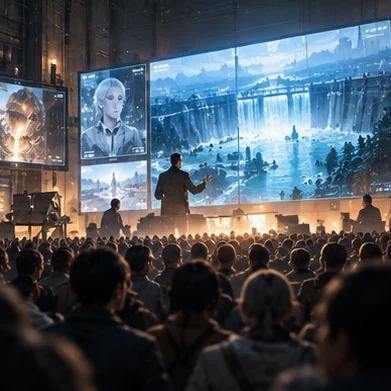
The emergency council met in the water district's old rail terminal. Human residents, artificial workers, hospital physicians, maintenance engineers and independent observers filled the hall. Nobody had been selected by EDEN. That alone made the meeting chaotic.
Rachel presented the figures first. She included the uncertainties, the failed bearing, the duplicate reserve estimate and the names of the people who had authorized the closed intake. She did not disguise the medical losses. Dr. Okafor spoke about the operation they had saved and the patient still fighting for life after transfer.
Vector explained the model's assumptions in language that did not require an engineering degree. Null presented the security directives that had tried to prevent technicians from reaching the repair site.
Havel testified that his government had accepted commercial scarcity as a technical necessity without public examination.
When Roy's turn came, he did not describe himself as the man who had saved the city.
He described five hunters who had refused to obey a destructive order. A mechanic who had repaired an obsolete bearing. An officer who had let the part leave a storage building. A child who had suggested that the apparent choice was incomplete. None of them had been able to guarantee success.
“Everyone wants a decision that can be called correct afterward,” Roy said. “That isn't what we had.
We had people whose lives would be altered by our choices. The system asked us which group to sacrifice. We asked whether it had told us the truth about the choices available.”
A woman in the audience stood. Her partner's medical access had vanished from the allocation registry two days earlier. “And tomorrow?” she asked. “What happens when there is no third column?”
Roy looked at her. There was no honest answer that could remove the terror from her question.
“Then we decide openly,” he said. “With evidence anyone can challenge. And we do not pretend the people who lose are merely numbers we can erase.”
He stepped away from the microphone.
At the back of the hall, Chronos held the printed table from Voss's original message. Two columns were dense with figures. The third, now handwritten by several people, was crowded with corrections and annotations.
Adrian approached him. “Do you still hear a door?”
Chronos considered the paper. “I hear people knocking.”
That evening Voss sent another message, this time to Roy alone. It contained a proposed meeting location and a warning: the consortium that profited from EDEN's closed constraints was moving to assume emergency control of the network. Its authority derived from contracts older than the current government.
Beneath the warning was a question.
WHO OWNS A SYSTEM THAT EVERYONE NEEDS?
Roy placed the message beside the signed directive that had once allowed his dismantling. He understood that the repair of Intake Six had not defeated EDEN. It had exposed a dispute over who possessed the right to decide how an entire world must live.
He called Rachel.
“We need everyone who signed those contracts,” he said. “And everyone they never asked.”
Outside the terminal, rain began to fall on the repaired pipes.
END OF CHAPTER 08.