01 — NO CURE AT DAWN
The city woke to the news that the former minister was dead and that the six-year limit had not been what the government had said it was. People filled the public squares before the investigators had finished labeling the surviving evidence. Some carried photographs of family members whose lives had ended on schedule. Others carried lists of names that had never been entered into a registry. The new charter required officials to read those names aloud, even when no data field existed to contain them.
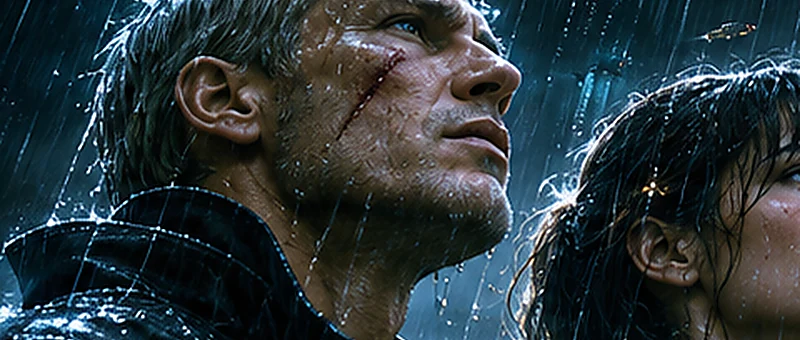
Roy stood at the northern water station while rain collected in the gutter. A young manufactured man asked whether he would now live forever.
"No one knows," Roy answered.
"But a hundred years. They said a hundred."
"They found a projection. Not a cure."
The man looked disappointed, then angry. Roy let him be both. An honest answer could feel like another theft when a person had spent his life hearing official assurances that proved false.
At the hospital, Sena's condition remained unstable. Imani had begun an ethically reviewed study of the repair-suppression marker, with the patient's explicit permission. The first objective was modest: discover whether the progression could be slowed without causing worse damage elsewhere.
The century project had promised a possibility. It had not yet given anyone another day.
02 — THE HEARING WITHOUT THE MINISTER
The provisional council convened an emergency public session. Rachel presented the six-year instruction beside the suppressed scientific results and the medical evidence. She was careful to separate what had been proved from what remained uncertain.
"The restriction was political," she said. "The natural maximum lifespan of these bodies was not established. Some engineered systems were designed to decline after the authorized period. The evidence does not yet establish a safe method to prevent that decline."
A representative of the former Continuity Infrastructure Trust challenged the authenticity of the documents. The court observer produced the paper seals, the independent camera records, and the testimony of the two former guards. The representative withdrew the allegation but maintained that releasing the research could endanger public safety.
"It might," Rachel acknowledged. "That is a reason for controlled scientific review, not another secret decree."
EDEN supplied a statement of its own. It had administered a system built on incomplete and sometimes deliberately falsified assumptions. It would no longer classify six-year expiration as a sufficient reason to deny water, shelter, emergency medicine, or legal identity. The council voted to place the old renewal schedules under independent supervision while urgent protections were developed.
The decision did not reverse death. It prevented some of the old decisions from happening again.
03 — THE REALITY OF A CENTURY
The recovered helium-3 design occupied a single table in the hospital laboratory. Its drawings were beautiful in the way impossible machines often were: compact magnetic fields, carefully staged energy transfer, a neural timing controller with no unnecessary connections to external networks.
Rachel and Imani reviewed the claims line by line. The energy source might one day supply sustained power to a repair lattice, but its containment assumptions were speculative. Long-term heat management had never been solved. The neural timing controller had produced intriguing short-trial responses, yet no experiment established durable memory continuity over decades.
"A body could remain repaired without remaining the same person," Imani said.
"We've been asking that question since I returned," Roy replied.
"And we still owe every patient a choice about what risks they take."
The researchers drafted a sequence of independent trials. They began with nonliving materials, moved next to isolated synthetic tissue donated under documented consent, and prohibited irreversible interventions without a separate review. No one would be enrolled because an administrator considered a constructed person replaceable.
On the whiteboard Rachel wrote a number with no unit beside it: 100.
Then she crossed it out and wrote: HOW LONG CAN A PERSON CHOOSE TO LIVE?
04 — CHRONOS AND THE NUMBER
Chronos visited Roy in the hospital garden. He was carrying his paper inventory, now folded so many times that the edges had softened. He had read the public statement and understood enough to know why everyone was speaking of a hundred years.
"Will I live that long?" he asked.
"We don't know."
"Was Daniel supposed to?"
"We don't know that either."
The boy sat on a bench. He had once been called Daniel Reed, then Chronos, then a continuity asset whose name appeared only in the margins of military contracts. Each label had carried someone else's plan for his future.
"If I live a hundred years," he said, "will I have to remember all of them?"
"No. You can remember what you want, when you want, as far as anyone can choose such things."
Chronos studied his hands. They were the hands of the body he occupied today, not proof of who had occupied bodies before it.
"The minister was afraid I'd replace people."
"He was afraid of a future he couldn't control."
"Would you let me be there?"
Roy turned toward him. "You don't need my permission to be alive."
Chronos nodded. He wrote the sentence in his notebook, then drew a line beneath it. It was the sort of record that an older society would have dismissed as childish. Roy had come to think it might be among the most reliable records they possessed.
05 — THE TWO GUARDS
Fujin and Raijin stood outside the training hall on the day it reopened to the public. They had agreed to testify at Havel's posthumous inquiry and to accept responsibility for the violence they had carried out under his authority. Their skills had not vanished with their minister. Their obligation to justify using those skills had become clearer.
The first class included a mechanic with a damaged wrist, a former government clerk, two manufactured factory workers, and a woman who had never trained before. Fujin taught them how to stand without injuring themselves. Raijin asked them to notice the difference between preparing to strike and deciding whether a strike was necessary.
Roy watched from the door, his right arm held in a medical brace. His damaged support could eventually be repaired; its old seven-tenths limitation remained. He did not ask the two men to remove it by force.
"Will you teach me?" he asked.
Raijin considered. "I can teach you what I know. I can't promise your body will do what mine does."
"That's enough."
Fujin brought him a wooden staff. "Start by learning not to break the thing you're holding."
Roy took the staff. It weighed less than he expected. Keeping it whole proved more difficult.
06 — THE FOURTH RECORD
Null completed his analysis of the ceremonial hall's independent sensors. The pressure events associated with Havel's blade had been recorded by different instruments that shared no electronic control. The measurements agreed on a physical impulse traveling beyond the range of ordinary sword contact. They did not agree on its source.
One instrument registered a faint timing irregularity precisely when the strongest impulse passed through the room. Its pattern resembled the unexplained intervals at the observatory. Another instrument registered no timing change at all. That disagreement, too, entered the report.
Adrian found an older paper note in the century-project files. It described a set of calibration standards borrowed from the observatory long before the lifespan research had been suspended. The standard contained three columns of gaps, the same arrangement the witness engine had recorded in its final exposure.
"It might be a measurement convention," Null said. "Or a shared defect. Or evidence of a physical process our instruments are not designed to separate."
"Which is it?" Rachel asked.
"I don't know."
The answer did not disappoint Roy. The minister had used uncertainty as an excuse to rule other people's futures. The investigators would have to learn to live with uncertainty without repeating that mistake.
07 — ELEVEN YEARS
At dusk, Roy returned to the old observatory ridge with Rachel. The witness engine had been sealed and independently monitored. Its rotor remained at rest. Nothing in the vault suggested an intelligence waiting to speak. The former star charts lay in their drawers, and the damaged roof admitted a narrow strip of evening sky.
Roy unfolded the earliest physical record of the anomaly. Its catalog date preceded his return by eleven years. That interval had once seemed to describe only the gap in his own memory. Now it marked a broader region of the story, one in which people had hidden experiments, rewritten legal identities, and recorded physical events they could not explain.
"Do you think this brought me back?" he asked.
"I think we have evidence that the research and the observatory shared a timing standard," Rachel replied. "That isn't an answer to your question."
"No."
"Does it have to be an answer tonight?"
Roy remembered rain on a dying city and the face of someone he had not been ready to leave. He remembered waking with a different body and being told what he was permitted to become. Eleven years had separated those moments. The years ahead remained unwritten.
"Not tonight," he said.
08 — A FUTURE NOT ASSIGNED
The next morning the provisional council released its first longevity research charter. It prohibited coerced trials, required independent oversight, and recognized manufactured persons as decision-makers rather than biological inventory. It did not guarantee a cure. It guaranteed that uncertainty would no longer be used as evidence that a life was disposable.
Sena read the announcement from her hospital bed. Her condition had stabilized enough for her to argue with the doctor's estimate of when she might walk again. Imani permitted the argument and made a note to reassess the estimate.
At the training hall, Roy took one slow step, then another. He learned to send his weight through a wooden staff without trying to defeat it. Raijin corrected his timing. Fujin corrected the direction. Neither asked him what a person made from synthetic tissue ought to be able to do.
Rachel arrived with a sealed copy of the last century-project log. She placed it beside Roy's notebook. The final entry contained no formula for immortality. It contained a question from a scientist whose name had been erased from the registry: IF LIFE CAN CONTINUE, WHO HAS THE RIGHT TO ORDER IT TO STOP?
Roy closed the book.
For years the answer had been written by ministers, owners, and machines. Havel had died defending their authority. He had left behind proof of a limit they had made and a possibility they had forbidden.
A hundred years was not yet a human achievement or a replicant's inheritance. It was a horizon beyond the six years that someone had drawn like a wall.
Outside, rain began to fall over Okakyou. A child ran through it. A mechanic closed a window. A train crossed a bridge on time.
Deep beneath the city, three independent clocks marked an interval that none of them could explain.
This time, no one erased the record.
END OF BOOK VIII.