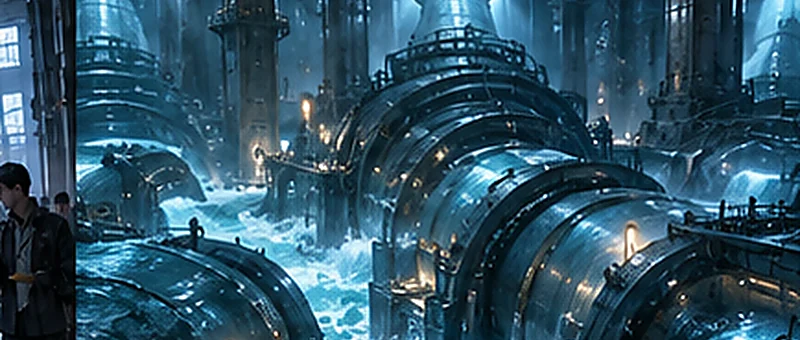
01 — THE RESERVOIR BELOW THE CITY
The southern reservoirs had been designed to outlive governments. Reinforced tunnels ran beneath the floodplain, connecting treatment facilities that had changed names, ownership, and registration systems more often than the concrete changed color. A municipal survey map showed five access passages. Fujin pointed to a sixth, narrow enough for a person but not for the service vehicles that maintained the pipes.
"The old ministers called it a safety exit," he said. "Then they used it as an entrance when they wanted to avoid the record."
Roy followed the medical team through the lower passage. Rachel remained with the court observer and a second rescue crew. Raijin stayed at the rear, close enough to intervene if someone attacked but far enough that the patients would not mistake him for another armed captor.
The emergency clinic lay beyond two water seals. Its staff had abandoned the building when the power failed. Inside, two patients lay connected to manual oxygen cylinders that had not yet run empty. The third, Sena, was conscious and furious.
"They said we had no claim to the equipment," she told Imani. "They gave the equipment to storage."
Imani restored the manual supply and called for transport. Roy watched the relief spread across Sena's face. Rescue was not an argument about ideology. It was a hand turning a valve in time.
02 — THE PRIVATE INVENTORY
The laboratory doors were sealed with an older version of the government's ownership mark. Rachel presented the warrant to a camera that had no current connection to EDEN. It did not respond. Fujin opened a manual inspection hatch, and the observer verified that the team had not altered the mechanism before entering.
Beyond the doors stood a row of climate-controlled cabinets and two heavy machines in ceramic containment housings. One was dismantled. The other had been disconnected so thoroughly that no one could tell from a glance whether it had ever operated.
The cabinets held repair media, neural scaffold samples, and several trays of engineered tissue. Their preservation records were incomplete. On the wall someone had posted an old warning: ENERGY SOURCE IS NOT CLINICAL APPROVAL.
"At least one of them understood the difference," Imani said.
A paper ledger listed helium-3 shipments in quantities far smaller than a conventional power facility would require. Rachel identified the units as experimental fuel, not evidence of a practical reactor. The proposed containment method was decades beyond ordinary engineering, and even in the story of its construction the test team had recorded failures, contamination, and unstable thermal behavior.
"It's not a miracle battery," she told Roy. "It's a research claim that must survive examination."
"Then why hide it?"
"Because people can suppress a possibility long before anyone proves it."
03 — THE SIX-YEAR SWITCH
An old diagnostic terminal held the molecular design for a scheduled decline in repair activity. The scheme did not kill a person at the exact end of six years. Instead it progressively blocked normal renewal pathways, increasing the chance of failure until death became administratively predictable.
"This is not an accident of construction," Imani said. "Someone designed the failure to resemble age."
She would not announce a cure. The mechanisms in the samples might be reversible in some bodies and fatal to alter in others. The six-year program had been deployed across generations of different designs; no single procedure could safely release every one.
A paper file described two parallel studies. One tested whether the limiter could be removed without destabilizing the neural scaffold. The other tried to supply longer-lasting energy with a helium-3 micro-fusion prototype. Neither was ready for clinical use. In combination, the researchers had projected a service-life envelope approaching a century.
Across a suppressed results sheet appeared an authorization line:
CONTINUE BENCH TRIALS: DENIED.
ISSUE PUBLIC SIX-YEAR LIMIT: APPROVED.
The approval bore Havel's full signature.
Roy felt something colder than rage. He had fought for the right not to be dismantled and now stood in a room where a decision had been made to make dismantlement unnecessary: let a body die on schedule, and no order would need to be signed when the time came.
04 — THE ENGINE AS A CLOCK
Null compared the laboratory's timing records with the paper images from the observatory. The three-column dots did not encode a sentence. They represented gaps between control pulses in an experimental synchronization sequence. The witness engine had recorded similar gaps during its unexplained physical anomaly.
"Are they using the same technology?" Rachel asked.
"Not demonstrably," Null replied. "They may be measuring related intervals, or they may have borrowed the same measuring standard. The older apparatus is still an independent system."
Roy approached a workbench containing an analog pulse controller. Its output was deliberately disconnected. A handwritten chart showed how the researchers had varied the timing of a small energy input until the repair lattice responded. In one narrow window, less energy produced a stronger restorative response.
He remembered Raijin touching his chest. The small movement had reached deep into the body where a larger blow might have scattered across the protective surfaces.
"They were trying to issue energy," he said.
"Yes," Rachel replied. "And to make a living structure accept it. But a martial strike and a neuronal repair process are not the same experiment."
"No. They're the same kind of question."
She let the distinction stand. For the first time, the connection seemed useful rather than merely dramatic.
05 — THE MINISTER'S ORDER
A speaker embedded in the wall clicked on. It carried no incoming signal from the city's network. A local circuit had been armed before the team arrived.
"Roy," Havel's voice said. "You have found the room I kept closed. It was built to test a hope I was not prepared to allow."
The recording continued with instructions. If the archive was disturbed, an automatic containment purge would flood the storage cabinets with inert gas and destroy the fragile samples. The mechanism existed to prevent a containment accident, but its trigger had been altered so that opening a legal inspection seal would activate it.
Rachel recognized the modification as a trap. A safety measure had been made into a device for erasing evidence.
Roy looked toward the two medical workers carrying Sena's companions through the outer corridor. "We take the patients first."
"The samples will be lost," Adrian said over the line.
"Then we'll know exactly who chose that."
Fujin asked for permission to inspect the manual override. The observer authorized it, recording every action. Raijin held open the outer gate while the technicians moved the patients. Roy waited beside the control panel, using his body to shield the nearest cabinet from an accidental blow.
06 — A BREATH BETWEEN SIGNALS
The purge sequence began before the team reached the exit. Someone had activated it from the private circuit, bypassing the court seal. Warning lamps flashed across the ceramic housings. The room's ventilation pulled inward with a low mechanical roar.
Fujin found the override behind a service cover, but the handle had been broken. Roy could force it, at the cost of exposing his damaged shoulder to a rapid load it might not withstand. Raijin stepped forward.
"Let me try."
He examined the shaft, placed his palm against its housing, and delivered a short impulse. The outer plate loosened but did not release. A second strike might fracture the containment pipe behind it.
"No more," Rachel said.
Roy saw the danger. He asked Fujin to hold the handle at a particular angle while Raijin applied pressure at the point where the linkage moved most freely. Their combined movement opened the mechanism without a sudden blow.
The purge valves stopped halfway through the cycle. Two cabinets were lost; three remained sealed and intact. The witnesses photographed the damage and the surviving inventory.
"No magic," Raijin said, breathing hard.
"No," Roy replied. "We asked where the force had to go."
07 — THE DECLINING CLOCK
In the surviving cabinets, Imani found a time-series experiment comparing ordinary decay, scheduled decay, and recovery under external pulsing. A note beside the recovery curve used a label Roy had never seen in an authorized medical document: CENTURY ENVELOPE — CONDITIONAL.
The curve projected the maintenance of a complex synthetic nervous system for more than ninety years, approaching one hundred under ideal conditions. No test had run that long. The projection rested on short trials and assumptions about future repairs.
"It could be wrong by decades," Imani said.
"But six wasn't the measurement," Roy answered.
"No. Six was a line drawn across the graph."
Rachel copied the graph using two independent cameras and a manual tracing. The evidence went into separate custody chains. Sena, carried toward the ambulance, asked what they had discovered.
"A reason to ask better questions," Rachel replied.
"Can I live?"
Imani knelt beside the stretcher. "I don't know how long. But nobody has the right to stop looking because a calendar says you're finished."
08 — AN APPOINTMENT WITH A SWORD
The rescue report reached the provisional council before sunrise. So did Havel's appeal, his altered purge mechanism, and the court's evidence that he had approved a non-medical six-year limit. His remaining defenders withdrew from the public hearing. The minister was no longer merely avoiding responsibility for an old decree. He was attempting to destroy evidence while people still needed it to survive.
A final message arrived at the secure witness office. The minister requested Roy at the old ceremonial hall above the southern reservoir. He promised that the complete explanation would be there. A drawing of a sword lay beside the words.
The advocate refused to authorize a private duel. Roy agreed with her. He requested a protective mission with civilian witnesses, medical support, and a clear objective: bring Havel to the court if possible; preserve the remaining archive if not.
Fujin read the order. "He will make you fight."
"Then he will have to do it in front of people who can tell the truth."
Raijin asked to go with them. He carried no weapon. When Roy questioned that decision, the older man touched his own wrist.
"The thing I need to keep under control," he said, "has never been made of metal."
From the ridge above the reservoirs, the ceremonial hall glowed in the dark. It had been built to celebrate a government whose laws were now under independent review. The minister waited inside, a human being with an unregistered sword and a reason he had concealed for thirty years.