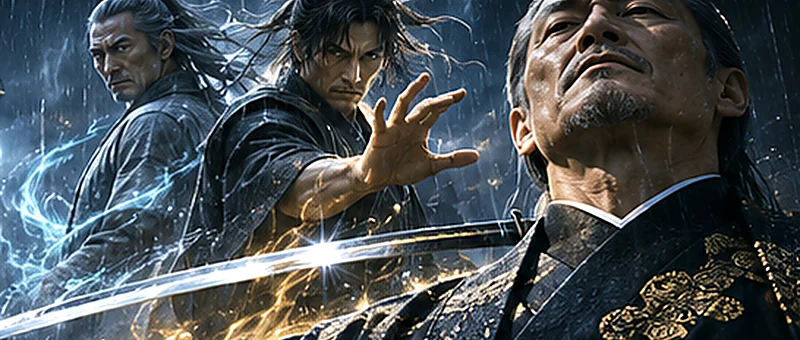
01 — THE CEREMONIAL HALL
Havel had chosen a hall where ministers once received the signatures of people they intended to govern. Polished stone stretched beneath a high timber ceiling. Rain struck a glass wall overlooking the southern reservoirs. The city's water moved in black channels below, indifferent to the names printed on the walls above it.
The former minister stood at the far end of the room in a dark training jacket. There were no cables running beneath his clothes. No visible armor. No tactical assistant. He held a wooden staff in one hand and kept a sword in its plain scabbard beside a chair.
Roy entered with Rachel and the court observer. Two emergency medics waited near the exit. Null had placed a passive recorder beyond the hall. Its clock was independent from the facility's network. Fujin and Raijin stood outside the main doorway, neither taking the minister's side nor pretending he had lost the capacity to hurt someone.
"I asked for Roy," Havel said.
"The court ordered us to preserve evidence and prevent further harm," Rachel replied. "You can speak in front of witnesses."
Havel smiled with genuine fatigue. "A court cannot save what it does not understand."
"Then explain it," Roy said.
The minister looked at the recorder. "If I explain first, you will write a conclusion before you have heard the question."
He set the staff against the floor. The sound was soft and deliberate.
"You believe the state chose six years because it could build nothing better. That belief has protected both of us."
02 — AN OLD MAN'S STANCE
Roy had expected Havel to rely on guards, concealed machinery, or political leverage. He had not prepared to face the minister's body as the primary weapon.
Havel removed his jacket. His arms carried the small scars of old training. The knuckles were thick, one finger had healed crookedly, and his posture suggested a lifetime of adapting around injuries. He was a human man who had aged without replacing his bones or nerves. A passive medical scan confirmed heartbeat, breath, and temperature. The reading contained no synthetic control signal.
"I'm not going to attack an old man to satisfy his pride," Roy said.
"Then don't. Arrest me. Put your hand on my shoulder."
Roy glanced at the observer. The warrant permitted a lawful detention if Havel resisted seizure of the remaining documents. The minister had admitted altering the purge mechanism. It was enough to justify bringing him before a magistrate.
"You are required to come with us," Roy said.
"I decline."
Roy stepped forward with his left hand open. He intended to restrain the man's wrist, not strike him. Havel turned almost imperceptibly. The hand that seemed to be beneath Roy's palm was suddenly above it. Two knuckles touched a tendon near Roy's elbow, then the minister's other palm struck his ribs at a distance scarcely longer than a breath.
Roy's body registered three events in the wrong order: a loss of balance, a sharp internal pressure, and only afterward the sight of Havel's hand moving.
The old man stepped away.
"You have learned to defeat machines," he said. "You have not learned to stand in front of a person."
03 — OKINAWAN HANDS
Havel advanced without rushing. His hands traced short, economical arcs. Roy recognized elements of Okinawan karate from the archives: rooted stances, compact strikes, the use of the forearm as both shield and lever. But the style in front of him was not a museum diagram. Each movement flowed into a response to the shape of Roy's defense.
Roy tried to exploit the difference in strength. He pressed Havel toward the glass wall, calculating that the older man would have to retreat. Havel shifted aside, drove a forearm against Roy's shoulder, and placed a knuckle into a narrow opening at the junction of artificial muscle and support fibre.
The limiter issued a warning. Seventy percent capacity. Abnormal load. Structural failure if repeated.
Havel's heel touched the floor, his hip turned, and an impulse passed through his arm into Roy's chest. The movement was too short to satisfy Roy's old model of a powerful strike. The pain was not.
He stumbled backward and caught a pillar. The stone chilled his palm. He raised his wrist emitter, then remembered the useless flash at the training hall. There was no electronic coordination to disrupt in this opponent.
"You keep asking your tools whether I am permitted to be dangerous," Havel said. "They will never answer you."
"My tools aren't asking permission," Roy replied. "They're trying to keep people alive."
He threw the emitter aside so neither man could later mistake its absence for an accident.
04 — THE LONG WEAPON
Havel lifted the wooden staff. He moved it with the precision of someone who had practiced an old weapons discipline for decades. The shaft swung toward Roy's knee, stopped short, and reversed into a rising strike toward the damaged shoulder. Roy blocked the first path and nearly failed to recognize the second.
The minister used the staff's length to dictate distance. Roy could not safely rush inside its arc without exposing his damaged joints. Each time he prepared a counterattack, Havel altered the rhythm by half a beat.
Fujin watched from the doorway, his hands tight at his sides. Raijin stood beside the court observer and spoke only once.
"He wants Roy to hurry."
Roy heard the warning. He let the staff sweep past without chasing it, then moved toward the pillar so Havel could not attack from every direction. The minister changed grip and drove the butt of the staff downward. The impact shattered a tile where Roy's foot had been.
The court observer called for Havel to surrender. He ignored her. Rachel ordered the medics to keep the exit clear.
"You could still stop," Roy told him.
"I could have stopped thirty years ago," Havel replied. "I have not done so yet."
With a sudden turn, Roy trapped the staff against the pillar. His greater mechanical strength finally mattered. He broke the wood in two, sending fragments across the floor.
Havel looked at the splintered ends with something like regret.
"That," he said, "was the easy weapon."
05 — THE BLADE WITHOUT A BATTERY
The minister drew the sword.
It was an old blade, neither ornate nor conspicuously technological. The metal carried evidence of many polishings, and the guard bore a dark, worn patch where the thumb settled. Roy's scans found no active circuitry in the hilt, no electromagnetic coil, no hidden power line.
Havel held the edge between them without assuming an exaggerated posture. His breath slowed. For the first time, Roy could see a faint tremor pass through the man's fingers and vanish at the wrist.
"You think a sword makes you more human?" Roy asked.
"No. I think it makes you stop measuring only the body holding it."
The blade moved.
Roy had studied thousands of human sword techniques. He understood reach and leverage, momentum and the time required to reverse an edge. He moved outside the expected cut. The metal passed well short of his coat.
Something struck him anyway.
A thin line opened across the fabric at his left shoulder, not as a cut from steel but as if a concentrated pressure had traveled beyond the tip. A dry impact followed beneath the wound. Roy's balance system misclassified it as contact with an unseen object.
Across the room, the independent acoustic sensor recorded a narrow pulse. The camera captured no projectile. A loose paper notice on the wall split along one edge, though the sword had not reached it.
Rachel whispered, "What was that?"
Null answered from the remote station. "A physical event. I can't tell you its mechanism."
06 — THE INVISIBLE EDGE
Havel struck again. This time the blade remained farther away, yet a strip of dust rose from the floor along its path. Roy shifted laterally; the pressure impulse passed his chest and struck the wooden panel behind him. A narrow crack appeared in the lacquer.
The minister was breathing harder. His pulse increased, and his age became visible in the tremor at the corner of his mouth. Whatever he was doing demanded effort. It did not make him invulnerable.
Roy raised a metal service plate to intercept the next strike. The sword did not touch it. The pressure event reached the plate as a brief, concentrated vibration and nearly tore it from his hand. He lowered the plate before the next impact could travel through his damaged arm.
"You've hidden a weapon in the air," Roy said.
"Have I?"
"The blade doesn't reach me. Something does."
Havel nodded. "Good. You are finally describing what you know instead of what you expect."
The old man took one step forward. Roy watched the rise of his chest, the changing pressure under his feet, and the blade's small adjustment. A calculation formed and failed. He could not predict the attack's direction from the sword alone.
"Fa jin," Havel said. "Issuing force. The name is old. What it permits is not yet understood."
07 — THE RULE THAT BROKE
Roy tried an approach that would have worked against a replicant with greater strength. He feinted at the centerline, shifted to the minister's rear, and applied enough force to pin the sword arm without breaking it. Havel let the arm turn, then transferred the contact through his shoulder and hips. Roy felt his own movement converted into pressure against the failing support structure of his right side.
The seventy-percent limiter cut power abruptly. Roy dropped to one knee. A warning appeared at the edge of his vision: COORDINATION DEGRADED. SEEK MEDICAL SUPPORT.
Havel pressed the sword toward his throat. The blade stopped a handspan away. Roy felt a rising disturbance in the air before the metal moved.
"You could survive a hundred years," Havel said, his voice shaking with effort. "Do you know what that would mean to those who cannot?"
"It wouldn't make their lives shorter."
"It would make them irrelevant."
Roy understood that the old man's strength had not come only from training. It came from a conviction carefully practiced until every question sounded like an attack.
"No," Roy said. "That's what you are afraid of. It isn't what I intend."
The minister's blade began to move.
08 — A HUMAN INTERRUPTION
Raijin crossed the doorway, but Fujin caught his arm. "If you enter now, he will use you as proof that Roy cannot choose for himself," Fujin said.
"He will kill him."
"Then the court must see what he is doing."
Rachel shouted for Havel to stand down. The former minister did not turn. His eyes were fixed on Roy. For one moment, the room held the simplest possible arrangement of power: an armed human, a wounded replicant, and a choice about whether to kill.
Roy lowered his hands.
The gesture surprised Havel. He hesitated just long enough for Roy to roll away from the expected line of pressure and put the stone pillar between them. The unseen impulse struck the pillar and scattered old mortar onto the floor.
Roy rose on the other side, using the wall to support his damaged leg. He could hear the witnesses calling for an emergency suspension of the confrontation. The minister could hear them too.
"You think the law is stronger than the sword?" Havel asked.
"No," Roy replied. "I think it has to matter when the sword is stronger."
Havel moved toward the pillar, blade raised. The rain beyond the glass had become a silver curtain. Somewhere in the old hall a mechanical clock skipped a beat, then resumed.
Roy noticed. He wondered whether anyone else had.