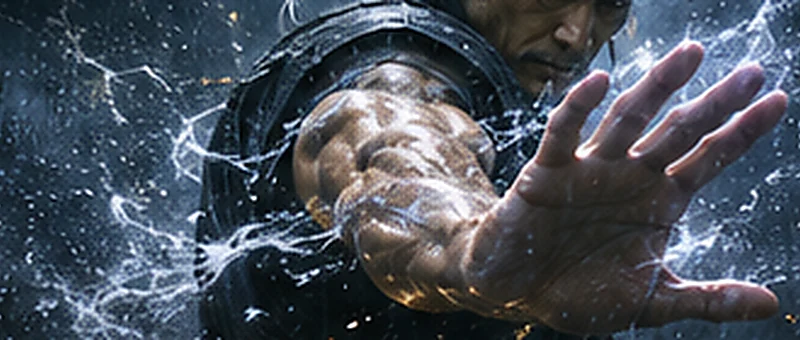
01 — THE FIRST STRIKE WAS STILL INSIDE HIM
The pain from Raijin's first touch did not fade in the way ordinary damage faded. Roy could map the region beneath his sternum, watch its inflammation diminish, and measure the structural fibres repairing themselves. Yet every time he stepped into a rapid turn, the left side of his body behaved as though an impact were still moving through it.
Imani called the phenomenon delayed coupling. She used the term reluctantly. It described an observation, not an established diagnosis. The external impulse had been small; the resulting internal oscillation had traveled along several connected support structures. Roy's body had been engineered for blows delivered from outside, not for a precisely phased disturbance that found the path between its defenses.
"If he can do it once," Roy said, "he can do it again."
"And you can choose not to let him put his hand on you."
"I may have to enter that building."
"Then make a better plan than standing still and hoping technology makes him ordinary."
The council had authorized a supervised inspection of the annex's upper rooms. Havel had responded by submitting an appeal. The appeal did not cancel the order, but it created a delay in which evidence could disappear. Rachel was preparing another filing when Raijin sent a plain message to the public advocate: I WILL GIVE A DEPOSITION IF ROY MEETS ME IN THE TRAINING HALL.
Roy read it without enthusiasm. He could refuse. He could also ask questions without submitting to another demonstration. The wording troubled him because it was both a demand and a confession waiting to happen.
02 — THE HALL WITHOUT MACHINES
The training hall was an old municipal recreation center beside a flood barrier. Its wooden floor had been replaced so many times that no two planks shared the same color. A line of windows admitted the pale light of morning. Nothing in the room contained a network transmitter. Nothing resembled a replicant arena.
Fujin waited at the entrance. He inspected Roy's clinic diagram before permitting the encounter to proceed. Two civilian witnesses sat on a raised bench; an independent medic kept a paper record of Roy's vital signals. Raijin had agreed to demonstrate without aiming for injury. Roy had agreed to stop at the first sign of system destabilization.
The arrangement was almost reasonable.
Raijin approached with his hands loose by his sides. "Do you want an explanation," he asked, "or revenge?"
"An explanation."
"Then don't use the equipment you brought. It will only make you imagine that you have an answer."
Roy looked down at the compact pulse emitter around his wrist. Against electronically controlled hunters, it could temporarily overwhelm local sensing and coordination. He did not remove it. He placed it in a sealed box, then asked the witnesses to certify the seal.
"I still don't trust you," Roy said.
"Good. Trust is not a substitute for distance."
Raijin stood just beyond reach. The floor creaked beneath his weight. He waited for Roy to set his stance.
03 — HUMAN ELECTRICITY
Roy initiated a slow exchange. He pushed forward with his left hand. Raijin redirected the arm with a touch so light that Roy could have mistaken it for accidental contact. A second later, Roy felt his own balance change. Nothing had struck him; his force had arrived somewhere he had not intended.
"You move before I finish moving," Roy said.
"I move while you're telling yourself what my next movement means."
They repeated the exchange. Roy changed angle, speed, and the timing of his breath. Raijin adjusted without an obvious preparatory motion. Twice Roy would have struck an ordinary opponent. Twice his hand passed through space the man had occupied a moment before.
"Fa jin," Raijin said at last. "Issuing force. Your archive probably translates it as an explosive blow. That's convenient and incomplete."
He placed two fingers against a padded training block, took a breath, and released a short movement through his feet and hips. The block jumped farther than Roy expected. The force plate beneath it recorded a steep impulse over a very brief interval.
"That much I can explain," Roy said. "Joint coordination, impulse duration, elastic release."
"Yes. Begin there."
Then Raijin demonstrated a second movement, using the same apparent distance and a different sequence of contraction. The force plate recorded less overall force, but a sensor embedded deep in the block registered a larger local vibration. The block's surface barely moved.
Roy stared at the trace. "The path changed."
"That is what your body discovered first."
04 — THE WRONG WEAPON
An alarm sounded outside the hall. Someone had activated an unauthorized municipal drone above the flood barrier. Its guidance signal resembled the old government's threat-identification system. Null identified the transmission, then cut his receiver connection so the device could not use him as a relay.
The drone entered through a broken upper window. Its targeting light passed over Raijin and fixed on Roy.
For one second, Roy was back in the old hunt. He raised his wrist, forgot the sealed box, and reached for an electromagnetic answer that was no longer attached to him.
Raijin moved first. He pushed Roy aside, let the drone's dart strike the wooden floor, and drove a fist into the metal frame with a compact motion. The drone fractured against the wall, its rotor continuing to spin after its control system had died.
"You saved me," Roy said.
"The machine was aimed at you. That didn't make its violence legitimate."
Two security officers arrived and secured the wreckage. The witnesses recorded the interruption and terminated the demonstration. Raijin asked to make a statement. He named the annex, Havel's protective trust, and an older command authority that had survived the provisional charter only because its records had never been entered into EDEN.
"The minister has men who still think protecting him means attacking anyone who asks a question," he said. "I have been one of them."
05 — THE DEVICE THAT DID NOTHING
Roy insisted on documenting the device's failure as well as Raijin's skill. The demonstration had shown a human nervous system producing extraordinary timing and force transmission. It had not shown the mysterious blade effect described in the old guards' stories. Those stories could still be exaggeration.
Outside the building, another armed drone approached. This one carried a local command unit of a type Roy recognized. The council officer authorized him to disable it before it reached the waiting crowd.
Roy retrieved his wrist emitter, aimed, and released a concentrated electromagnetic pulse. The drone fell inert. The crowd scattered from the sound of its impact.
Then a man ran from a service passage toward the officer, holding a short baton. He wore no mechanical implants. Roy instinctively swept the emitter in the man's direction. The pulse flashed harmlessly across clothing and wet pavement.
The assailant kept running.
Raijin intercepted him, trapping the arm and forcing the baton to the floor. He did not strike the man's head. He held him until the officer secured his wrists. Afterward he looked at Roy.
"You knew it wouldn't work," Raijin said.
"I knew. I used it anyway."
"A mind under threat reaches for what it has survived with before. That is human too."
Roy did not thank him for the comparison. He thought of the five hunters who had once obeyed a command because no alternative had been provided. He wondered how many habits remained inside him that had never been given the chance to become choices.
06 — THE BODY AS A CIRCUIT
That night, Imani examined the force traces. Rachel brought a mechanical model of a human arm and the hospital's record of Roy's damaged support fibres. They did not call the martial artist's skill supernatural. They did not claim to have fully described it.
"Your architecture assumes protection against a large force with an identifiable direction," Imani explained. "A short disturbance can exploit the interfaces between materials. Humans have interfaces too, but their nervous systems adjust to them continuously."
"Then he can hit harder because his neurons are faster?" Roy asked.
"Not exactly. He can place a smaller amount of force more efficiently. That doesn't mean he's creating energy out of nothing."
Rachel paused at the word efficiently. She placed the helium experiment beside the force trace from the training block. In the laboratory notebook, a synthetic repair lattice responded to precisely timed pulses. The researchers had spent years trying to deliver more energy. Their best result came when they learned to deliver the same energy at the moment the system could use it.
"They were measuring different things," Rachel said, "but they were asking the same question."
"What question?"
"What happens when power is no longer the limiting factor, and timing becomes the problem?"
07 — THE NAME UNDER THE INK
Adrian used the charter's evidence provisions to examine the obscured signature on the six-year summary. An independent document specialist compared pressure marks on the original sheet. The erased name was not a scientist. It was a civil servant who had managed the emergency continuity office under Havel.
His testimony existed in an old sealed deposition. The office had been ordered to stop an experiment not because it failed, but because it indicated that the authorized service life was not the maximum service life.
"Do you understand what you're claiming?" the advocate asked the witness in the recording.
"I'm claiming we did not test the maximum," he said. "We tested whether a political limit could be made to look biological."
The recording ended before he named the person who gave the order. The appendix containing that name was missing.
Roy listened twice. He did not allow himself to feel relief. A suggestion that the limit was artificial was not yet a method of removing it. The people who needed hope most had already been promised too much by officials who never intended to keep a promise.
But he could hear the difference between a failed experiment and a forbidden one.
08 — RAIJIN'S REFUSAL
Raijin came to the public advocate without guards. He signed a deposition admitting his assault on Roy and identifying the private protective trust that had paid him. He did not ask the court to excuse his actions because Havel had saved him as a young soldier.
"He did save my life," Raijin said. "That remains true. So does what I did for him afterward."
The advocate offered the standard protections for a cooperating witness. Raijin refused anonymity. He wanted his name attached to his account, even if his employers retaliated.
Outside the hearing room, Roy approached him. The two stood beneath the same low corridor lamp, neither raising a hand.
"I still don't understand the second impulse," Roy said.
"Neither do I completely," Raijin answered. "Practice is not the same as explanation."
"Can it be learned?"
"Some parts. Other parts depend on a body that grew up learning what its own limits feel like."
"You think my body cannot learn."
Raijin considered the question.
"I think it will learn differently."
A message arrived on the advocate's terminal. Havel had left the annex during the night. Fujin had not followed him. The court seal was intact; the documents remained in place. Only the minister's sword was missing.
Raijin closed his eyes. "Now he's going to make the argument he always meant to make."