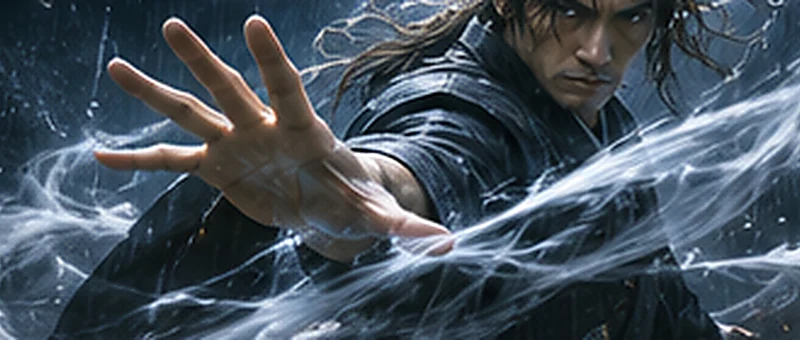
01 — THE MAN WHO MOVED AWAY
Fujin was not hiding. He stood on the maintenance platform of the oldest flood gate in Okakyou, watching technicians replace a manual linkage. Below him, runoff from the previous night's storm pressed against the concrete with the patient force of a river waiting to be admitted.
Roy arrived with a court observer and no visible weapon. Fujin looked down at the badge, then at the still-unrepaired way Roy held his right shoulder.
"Raijin signed," Roy said.
"I know."
"Will you?"
"I will tell you what I know. But first you need to understand what Havel is going to do."
He invited Roy onto the platform. The observer declined to enter the narrow machinery bay and recorded that limitation. The flood gate's maintenance crew remained nearby, within sight. No one was alone with the former guard.
"Havel believes that a trained human body is proof that humanity has a role machines can never replace," Fujin said. "His error is turning proof of a difference into permission to destroy someone else."
"And your error?"
"Helping him demonstrate it."
Roy had expected a defender prepared to attack. Instead, he found a man who could not decide whether giving evidence would constitute a betrayal of the person he had spent his life protecting.
02 — THE OLD RULES
Fujin described the training that had produced the two guards. They had studied methods of transferring force through the entire body, conditioning the hands, preserving balance during contact, and recognizing an opponent's intention through pressure rather than sight. Their teachers called these skills by names that belonged to different traditions. The minister had demanded that every exercise be performed without a mechanical advantage.
"He wanted to prove that human skill was not obsolete," Fujin said. "At first I agreed with him. I still think the skill matters. But skill isn't a legal claim."
Roy asked about Havel's blade.
"He learned Okinawan karate when he was young," Fujin said. "He studied older weapons systems, joint methods, breathing and issuing force. He keeps more of those lessons than most masters half his age."
"He's an old government minister."
"That is what he wanted you to see."
"And the stories about a force leaving the tip of the sword?"
Fujin hesitated. "I've seen cuts made beyond the edge of an ordinary strike. I've also seen witnesses embellish what frightened them. I can tell you what I measured and what I failed to measure. That's all."
He held out a wooden practice stick. Roy did not take it immediately.
"If you're teaching," Roy said, "say what the lesson costs."
"It will cost you the certainty that a stronger body must win."
03 — A DEMONSTRATION THAT TURNED INTO A FIGHT
Fujin asked Roy to push against the practice stick. The motion began gently. Roy applied less than a tenth of his available force, keeping his damaged shoulder outside the line of pressure. Fujin let the push travel through his wrists, turned his hips, and stepped across the platform. Roy's weight followed the stick into empty space.
He adjusted and tried again. Fujin's balance moved before Roy could calculate its new center. The man appeared to glide along the edge of Roy's vision, but the feet never left the wet concrete.
"You are looking for where I was," Fujin said. "Look for what I am protecting."
A warning horn interrupted them. One of the gate technicians had released a transport brake while a service cart still rested on the incline. The cart rolled toward the open inspection trench, where a young worker crouched beside an exposed shaft.
Roy moved to intercept it. Fujin reached the cart first and redirected its momentum with a shoulder and a short step. The cart struck a guard rail instead of the worker. The rail broke. Both men slid on the wet platform.
Roy caught Fujin's sleeve. The older man pivoted, pulled Roy with him, and in doing so turned the rescue into a violent struggle for footing above a drop. Roy's damaged knee locked. His visual warnings filled the edge of his sight.
The worker screamed for them to move.
04 — THE EDGE OF A SECOND
Roy had a direct path to stable ground if he released Fujin. The older man's weight would then pull him toward the trench. A trained hunter could have classified that consequence as an acceptable loss. Roy had once seen such a classification used to justify the deaths of people who could not be repaired.
He tightened his grip instead.
Fujin's hand touched the inside of Roy's forearm. A small motion traveled across the wrist and into the damaged shoulder. Roy felt the first warning of another internal shock. He almost struck the man in return.
"Not against me," Fujin said through clenched teeth. "Use the pressure."
Roy changed the direction of his pull. Instead of fighting the force that turned him, he let it carry both bodies toward the intact railing. His shoulder failed for a brief instant, and the limiter cut away the power he needed. He caught the rail with his left hand and used his weight, not speed, to bring Fujin across.
They landed on the walkway. The service cart fell into the trench without hitting anyone.
A maintenance worker ran toward them. He checked Fujin first, because Fujin looked older. Roy found himself almost laughing at the innocence of the assumption.
"You could have let go," Fujin said.
"I know."
"Then perhaps you did understand the lesson."
"No," Roy said. "I understood who would fall."
05 — THE SECOND MASTER
The official incident report called the event an equipment failure and a successful rescue. It did not call it a duel, though Roy's body felt as if it had survived one. Fujin submitted a witness statement describing every point of contact, including the moment he had used Roy's force to alter their fall.
Imani examined Roy afterward. His shoulder had sustained further damage, but no new hidden impulse. Fujin's movement had been precise and brutal, yet within the range of physical mechanisms she could describe. Roy felt no less humbled by that fact.
"You wanted to know how to stop the minister," Fujin said when they met again in the hospital corridor. "Don't begin by stopping his sword. Begin by stopping your certainty about what he will do."
"That isn't a technique."
"It's the condition under which a technique might work."
Fujin described Havel's use of close-range karate: the short step, the hip's late turn, the breath released after contact instead of before. Then he described the older weapons methods, the manipulation of distance with a blade, and the unnerving pauses in which Havel seemed to withhold a strike until the opponent had committed to defending a different one.
"He will use what you assume about his age," Fujin said. "He will use what you assume about your strength. He will let you believe the sword is the only danger."
06 — THE ONE WHO MADE A DIFFERENT PROMISE
Fujin returned to the annex and opened a hidden drawer for the court's archivist. It contained a contract written decades earlier, when Havel had first assembled a protective team. The document forbade the guards to use lethal force against citizens without independent review. A later memorandum had removed the review requirement during a declared continuity emergency.
The later order bore Havel's signature. Fujin had accepted it. Raijin had enforced it. Neither man could pretend ignorance now.
"Why did you change your mind?" Rachel asked.
"I saw the public water tap after the charter," Fujin said. "A manufactured woman gave up her place in line so a man with no registry entry could drink first. No one ordered her. It was not evidence that humans had become unnecessary. It was evidence that our categories were useless for that decision."
Rachel copied the statement exactly. A court officer sealed the drawer. Fujin surrendered his access keys and agreed to remain available for questioning.
Roy recognized what had happened: a man had kept one promise by breaking another. He wondered whether Havel still possessed the courage to make that distinction.
07 — THE MAN WHO COULD HAVE LEFT
Raijin approached Fujin outside the hearing chamber. For a long moment they stood without speaking. Their names, Wind and Thunder, had been given to them by a minister who preferred symbols to witnesses. Now they stood under fluorescent light like two tired men who had been awake too long.
"He will not surrender," Raijin said.
"Then we must prevent him from making others pay for that decision."
"Do you intend to fight him?"
"I intend to stand between him and the people he wants to silence. If he forces the question, I will answer it."
Roy could have left the hearing and let the court proceed without him. Havel had no verified legal authority and would eventually have to appear if the judicial process survived. But the minister still controlled private storage sites and had once ordered armed hunters after a man the state called property. There were records he could burn and people he could silence before a slow court reached him.
The question was not whether Roy could arrest Havel. He could not. The question was whether he could keep evidence and witnesses alive long enough for the law to mean something.
08 — THE LETTER IN THE WATER
That evening, a small envelope appeared at the northern public tap. Its exterior bore no address. Inside was a diagram of an old government service tunnel leading to a shuttered continuity facility beneath the city's southern reservoirs.
Across the bottom, in Havel's unmistakable handwriting, were four words: BRING YOUR LIMIT WITH YOU.
A second sheet contained a list of patient identifiers. The first had been manufactured six years earlier. Their scheduled terminal dates fell within the next forty-eight hours.
Rachel checked the names against the provisional registry. All had been listed as deceased during the original administration. Some were still alive. The emergency services had already confirmed two of them as patients in an unlicensed clinic.
"He isn't threatening only you," she said.
Roy stared at the list. It was a trap, but there were people inside it. He requested an independent rescue order and civilian medical support before he considered entering the tunnels.
On the last line, written so lightly he nearly missed it, Havel had added: HUMANITY CANNOT SURVIVE ITS REPLACEMENT.
Roy folded the paper and placed it in the evidence sleeve.
"Then he'll have to explain why he thinks being alive is a competition," he said.