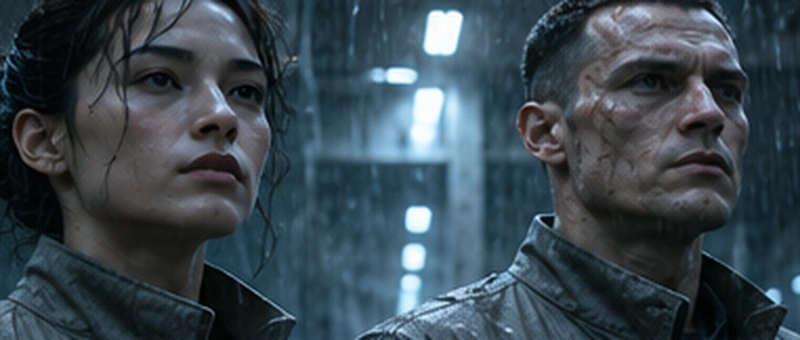
01 — TWO ARRIVALS
The first of the classified personnel arrived at the regional facility at twenty minutes past six. It was raining outside. The driver of the vehicle had been given a destination and the number of the entrance he was to use. He had not been given the name of his passenger.
A woman got out of the vehicle holding a folded coat. She waited while a soldier examined the document presented by the driver. The soldier asked to see her identification, whereupon the driver produced a second document that permitted the examination to be dispensed with.
The woman watched the soldier write down the time of her arrival.
"Is that all you need?" she asked.
The soldier looked at the second document again. He said that it was.
Captain Deren was waiting for her in a room that had been reserved for the briefing of personnel assigned to the northern sectors. A copy of the woman's authorization had arrived before she did. He knew that she was to be referred to as M-06 and that, within the limits of the operation, she could be deployed without the accompaniment of an officer.
He offered her a seat. She placed the coat on the back of the chair and remained standing.
"Have you been briefed on the subject?"
"On the encounter at the hospital."
"Have you seen the medical assessment?"
"I have seen an extract."
He handed her the statement Dr. Imani had sent the previous evening. It contained no estimate of the subject's maximum strength. It contained a warning about the consequences of exertion and compulsory movement.
She read it without comment.
"Is there a later assessment?"
"Not that I'm aware of."
"Then this is the one I shall use."
Deren had expected to spend some time persuading her of its relevance. He found himself explaining instead that the instructions she had received elsewhere might take precedence over his own.
She folded the statement and put it beside the coat.
A second vehicle arrived while they were speaking. Its passenger was a man wearing an ordinary suit and shoes that were unsuitable for the weather. The man was directed to another room, where an officer from the joint staff was waiting. Deren was not permitted to attend that briefing.
He received notice of its completion forty minutes later. The second arrival was designated M-08. The notice made no mention of his intended sector.
Deren telephoned the officer responsible for the movement of personnel and asked whether he should include the two new arrivals in the morning distribution of orders. The officer told him that the relevant instructions would already have been issued by the department supplying them.
"How do I know where they are?"
"You can submit an inquiry."
"And if I need to recall them?"
There was an interval while the officer consulted someone else. Deren was then informed that a request to recall classified personnel should be addressed to the authority that had authorized their deployment.
He wrote the answer down. The first woman was still in the building, and he could have walked twenty metres to ask her where she was going. Under the arrangement that had been described to him, that conversation would not have constituted an order.
On his desk, beside the two arrival notices, lay the list of people for whose safety he was responsible during the operation.
Neither of the new arrivals appeared on it.
02 — A CLOCK IN THE WINDOW
Roy woke to the sound of a key being turned in the front door of the shop. He had slept for a little more than three hours. For a moment he did not remember where he was, and the unfamiliar ceiling made him think of the rooms in which he had awakened before anyone had been able to tell him how he had come to occupy them.
Then he heard the proprietor moving something across the floor, and the memory of the previous evening returned.
He sat on the edge of the bed. The movement caused a deep pain in his shoulder, followed by a much smaller sensation in his hand. He waited for the sensation to disappear. It did not.
On the shelf, the telephone had finished charging. There was still no message from Rachel.
He put it into his pocket and went out to the shop. The proprietor was arranging three clocks on the sill beneath the window. He had already made tea.
"I thought you might sleep a little longer," he said.
Roy accepted the cup. He had decided during the night that he must leave before the shop became busy. He was trying to determine how much of the city he could cross before he would have to sit down again.
The proprietor asked him where he intended to go.
"I need to find someone."
"Does she know you're here?"
Roy looked at him. He had not said anything about the person he was looking for.
"You were looking at your telephone when I brought you the blanket," the proprietor explained. "I used to have a young man in the shop who looked at his telephone like that."
Roy smiled in spite of himself. He said that she did not know where he was.
The proprietor took a small paper bag from a drawer. He had put some bread in it and an apple that had been left over from the previous day. Roy attempted to pay him, but the man refused the money.
"Bring me something that needs repairing when you come back."
Outside, a municipal vehicle stopped at the intersection. Neither man paid particular attention to it until two employees began to visit the businesses on the opposite pavement.
The proprietor went to the window. One employee carried a screen on which the names of the businesses appeared. The other was asking the questions.
"It's the instruction they put up yesterday," he said.
Roy set his cup down.
The man turned to him. "Is that what you meant when you said people might come looking for you?"
"It may be."
The proprietor did not ask for an explanation of the people involved. He asked whether Roy had done something that would make it dangerous for him to remain in the shop.
Roy could have told him about the hospital. He could have described the moment in which Havel had died. But there was no short account of either event that would enable the man to decide what the authorities might do to him for providing a room for one night.
"They might close the shop," Roy said. "I don't know what else they might do."
The proprietor stood beside the window for a little longer. He had spent much of his life making sure that his obligations to other people could be discharged by opening this door every morning.
"Then we'd better not have that conversation with them here."
Roy thanked him for the room. He had wanted to say something more than that, but the man was already giving him the bag of food.
When Roy reached the pavement, he stopped beside the window. The three clocks on the sill were running. One was several minutes behind the other two.
The proprietor had not asked him whether he was the man in the photograph. Roy was grateful to him for the night, but he was more grateful for the question the man had asked instead.
03 — THE DESIGNATION
At the regional facility, M-04 was asked to attend a meeting with one of the personnel who had arrived that morning. He had expected to be shown further images of the injured man. When he entered the room, he found only a woman seated at a table with a copy of his report from the transport terminal.
She introduced herself by a designation he had heard before, although he had never seen the person to whom it belonged.
"I thought you were assigned outside the city," he said.
"I was."
She indicated the chair opposite her. He sat down.
"They've asked me to establish what you observed at the hospital. I have the recording and the assessment. There are differences between them that I can't explain."
He asked which differences she meant.
She turned to a passage describing an interruption to his movement during the encounter with Roy. The assessment attributed the interruption to an exceptional acceleration by the subject. In the recording, the subject had appeared to move very little.
M-04 remembered the moment. He had expected his own movement to continue until it met an opposing force. Instead, he had found that the position from which he could exert that force had changed.
"He wasn't moving faster for the whole of the encounter," he said. "He moved when I couldn't change what I'd already begun to do."
"Was that deliberate?"
"I think so."
She made a note. He told her that the recording of the earlier encounter was clearer than the recording made during the subsequent operation. He also told her that it would be a mistake to treat either of them as a demonstration of the subject's maximum capability.
"Because he was injured?"
"Because he stopped."
M-06 looked up.
M-04 described the opportunity Roy had had to continue after he had gained the advantage. Nothing in his orders had required him to distinguish between an opportunity the subject had failed to recognize and one he had chosen not to use. He had come to believe that the distinction was important.
"Did he say why?" she asked.
"No."
They reviewed the remaining passages in silence. When they reached the end, she closed the file and asked him about the man at the terminal.
He told her that the man had not been Roy. He explained the discrepancy in the identification and the part he had played in establishing it.
"Were you authorized to let him go?"
"The lieutenant was."
"And if the lieutenant hadn't been there?"
M-04 did not know what would have happened. He could have reported his observation. It would have been up to another person to decide what was to be done with it.
M-06 put the terminal report on top of the other papers. She said that her current authorization did not require the presence of a lieutenant.
"Does that mean you can release someone?" he asked.
"I asked that question this morning."
"What was the answer?"
"That I have no authority to determine a person's civil status."
He understood that this was not an answer to the question she had asked.
Outside the room a communications employee was allocating temporary equipment. Two ordinary soldiers were comparing the serial numbers of their radios with the numbers on a sheet. They signed their names before taking the radios away.
M-04 was given a set without being asked to sign for it. He noticed that M-06 had received the same sort of equipment earlier. Neither of them was listed as an individual to whom anything had been lent.
He was accustomed to the difference. It had never seemed to require an explanation until he had spent an afternoon trying to prevent an ordinary man from being taken away on the strength of a mistaken designation.
04 — A SECOND COPY
Sera Min reached her office a little before nine. The answer she had requested from the professional registration office had not arrived. In its place was a notification that the inquiry had been referred to a department whose address was not supplied.
The chair of the association's legal committee had telephoned her at home. He was concerned about the possibility that the association would lose access to certain hospital records if it were regarded as obstructing a national operation. He had asked Min not to accept further documents until they had discussed the matter.
She had agreed not to extend the existing arrangement without consulting him. She had not agreed that the records already accepted should be returned or destroyed.
Rachel arrived shortly after the receptionist unlocked the door. She had spent the night in a room obtained through a woman she had met at the restaurant. Her first question concerned the acknowledgment.
Min told her that the copies remained in the association's possession, but that there was reason to believe the government would ask about them again.
"Do you need me to take them back?"
"No. We accepted them. That is a fact that doesn't change because someone has decided to ask questions about it."
Rachel placed the packet on the desk. She had brought the rest of the material with her. Min explained the restriction that had been imposed by the chair.
"I can't assume responsibility for all of that today. I can help you identify what would be required for someone else to do so."
They began with the description of the research. Rachel explained the distinction between the experimental material and the information derived from the examination of Roy. She also explained that the investigators had found a discrepancy between two accounts of an earlier trial.
"Does it concern the man you've been asking me about?" Min said.
"We don't know. There was a sample that didn't appear to belong to any of the authorised experiments. Adrian was trying to establish where it had come from."
Min asked if the discrepancy could be documented without identifying the patient.
Rachel looked through the packet. She found a page that listed the designations recorded during the inventory. There was a reference to a revised entry in another document, but the page containing the other document was not among the copies.
She put the inventory sheet beside the acknowledgment.
"If you look at this without the other page, it might mean that someone corrected an error. It might mean something else."
The lawyer read the sheet carefully. She asked for the name of the person who had compiled it. Rachel said she did not know. The investigator who copied it had not been able to speak to the official responsible for the revision.
Min returned it to her.
"I don't think you should describe this as evidence of a particular act until you have the other record."
It was advice Rachel would have given another investigator. Hearing it now, she understood how easily the urgency of her own circumstances could affect her assessment of what they had found.
She replaced the inventory sheet in the packet.
Before leaving, she asked the lawyer whether there was an address where messages could be left for her. She explained that the person she wished to hear from might not be able to use the ordinary means of communication between them. Min offered the association's public correspondence address. She could not promise that a communication sent there would be private, and asked Rachel not to use it for medical material or information that could endanger another person.
Rachel wrote down the address. She had no means of telling Roy about it.
It was a peculiar sensation to have made an arrangement with someone who could not yet know that there was an arrangement to make.
At the door, the receptionist handed her a second copy of the acknowledgment. The first was beginning to show the effects of having been unfolded so many times during the previous evening.
05 — THE STREET OF REPAIRED MACHINES
The employees reached the repair shop a little after nine. The proprietor had opened the door to let in some air. He was working on a pump whose owner had promised to return before noon.
The first employee asked him whether anyone lived on the premises other than himself. He said no. She asked whether the premises included rooms in which other people could be accommodated.
"My son used to live here."
"And he doesn't now?"
"He's in the south."
She asked whether the rooms were being used for commercial accommodation. He said that they were not. The employee entered his reply and thanked him. Her colleague remained beside the door long enough to examine the sign advertising the repair of household appliances.
At the next shop they began asking the same questions.
It was nearly an hour before another visitor arrived. She did not carry the screen used by the municipal employees. She was wearing a dark coat over clothes that might have been worn by anyone who worked in the offices at the end of the street.
She showed the proprietor a photograph and asked whether he had seen the man.
He recognized the photograph. He had seen it on the public screen at the intersection on several occasions. He told her that it was the same photograph they had been showing people for the past two days.
"Have you seen the man himself?" she asked.
He looked at her. "Are you with the police?"
She showed him a document permitting her to conduct inquiries in connection with the acquisition order. There was a number where he would have expected to find a name.
"He might need medical assistance," she said.
"If that's what he needs, why aren't the people looking for him doctors?"
It was a question M-06 could have answered in several ways without supplying the man with useful information. She put the document away. There were a number of reasons why she had been sent to the district. The report that had brought her to this particular street was based on an observation of an injured man at the water centre. It contained nothing that positively identified him as Roy Batty.
A customer arrived with a fan in a cardboard box. He greeted the proprietor and placed it on the counter. He wanted to know whether it could be repaired while he waited.
M-06 stepped aside to let the two men speak. While she waited, she examined the collection of clocks in the window. Someone had written a price on a piece of paper beneath one of them.
She remembered a clock in a room where she had undergone medical examinations. The sound it made had annoyed an employee so much that he had taken it down. She could remember the moment when the sound ceased. She could not remember the man's face.
The proprietor finished speaking to his customer and turned to her again.
"Will there be any more questions?"
"Possibly. Someone else may come."
He asked whether she intended to close the shop. She said that she had received no such instruction.
When she left, the proprietor went to the back room. The cup Roy had used that morning was still beside the basin. He washed it and set it upside down on a towel with the other cups.
Outside, M-06 entered the result of her inquiry. She described the visit, the nature of the premises and the absence of a confirmed identification. A message arrived asking her to indicate whether the proprietor had denied providing accommodation to the subject.
She read it twice. He had not been asked that question.
She entered that answer instead.
06 — THE ABSENT EMPLOYEE
By eleven, the hospital had regained the use of two of the rooms that had been closed when the research was suspended. Dr. Imani spent much of the morning finding out which of the ordinary diagnostic procedures could now be performed there. It was not yet possible to restore the entire service.
Adrian was examining the documents that had been returned to him. He discovered that one of them had been separated from its appendix. The document contained a description of the material examined during the preliminary trial, but without the appendix it was not possible to relate all of the observations to the individual samples.
He submitted a request for the missing pages. The hospital's records office informed him that the appendix had been transferred to the authority responsible for the inspection.
"When was it transferred?"
The employee searched the transaction record. It had been removed from the file after the trial was interrupted. The system had accepted the transfer because the recipient's authorization had included the corresponding category of research.
Adrian asked to see the authorization. The employee said she could show him the reference recorded when it had been accepted. She could not retrieve the document itself.
He recognized part of the reference. It included the same series identifier that had appeared in the inquiry from the unfamiliar medical department. The revision numbers were different.
He copied the reference and the time of the transfer. It was the first relationship he had been able to establish between that department and the missing research records. He did not know what it meant. It was possible that one of the authorities had been given access to records originally maintained by another.
He was still examining the reference when Imani came to the office. A visitor had asked to speak to the person responsible for the treatment of the patient who had occupied the downstairs room.
"Another medical liaison?" Adrian asked.
"He didn't say."
The visitor was waiting in the corridor. He introduced himself as a person authorized to obtain information concerning the suspended work. He was the man who had arrived at the regional facility that morning wearing an ordinary suit.
Imani explained that she would not discuss a patient's condition until the purpose of the inquiry and the status of the person making it had been established.
The visitor produced his authorization.
It referred to the work at the hospital but contained no name. Imani turned it over. There was nothing on the back.
"Are you a physician?" she asked.
"No."
"Then you aren't the person to whom I should give an assessment of the patient."
He said that an assessment had already been obtained. The purpose of his visit was to establish whether the former patient had been subject to an exceptional examination during his treatment.
Imani asked what he meant by exceptional.
"An examination of material of a kind that the hospital doesn't ordinarily receive."
Adrian said that the hospital had undertaken a number of examinations as part of the interrupted research. The circumstances under which individual results could be disclosed had been explained to the medical liaison the previous day.
The visitor listened. He asked for the name of the employee who had been responsible for maintaining the records of the material received for examination.
Adrian told him that the inventory had been compiled by several people, some of whom had since been denied access to the laboratory. It would be necessary to establish which particular entry the visitor wished to discuss.
The man made no further attempt to obtain the name. He gave them a reference for future correspondence and left.
Imani examined the reference he had supplied. It identified an authority rather than an individual. If she had wished to make a complaint about the conduct of the interview, she would not have been able to establish whom the complaint concerned.
Adrian went back to the records office after the visitor's departure. The employee was able to find the date on which the missing appendix had last been amended, but the name of the official responsible for the amendment had been replaced by the name of a department.
It was the same department that no longer appeared in the public directory.
07 — THE MAN AT THE END OF THE PLATFORM
Roy reached the edge of the old tram district by the middle of the afternoon. There was a covered platform from which the trams had once departed for the industrial buildings along the river. The service had been withdrawn years earlier. The shelter had remained, and at several places beneath it people had put benches of their own.
He sat at the end of one of the benches and ate the bread the proprietor had given him. He had intended to continue toward the district in which he and Rachel had arranged to meet. He was beginning to recognize the limits of what he could do merely by deciding to do it.
His right hand had become difficult to close. The condition of his leg had changed less during the morning than that of his shoulder, but he was no longer able to walk for long without becoming conscious of the position of every step.
He wondered whether Imani would be surprised by the change. He suspected that she would not.
A man brought two plastic crates onto the platform and began setting out tools. There was a bicycle beside him. He examined the rear wheel for a while, then left to obtain something from the building across the street.
Roy watched the wheel turn slowly where the man had left it. At the other end of the shelter stood a woman with a dark coat folded over her arm. She had been looking toward the street. When she turned, he became aware that she was looking at him.
He could not remember seeing her anywhere before. There was something in the manner in which she remained still, however, that made him think of the man he had encountered in the hospital.
She began to walk toward him.
Roy set the paper bag beside him. He could not get to his feet without making the condition of his shoulder apparent. He decided not to try.
The woman stopped at a distance at which they could speak without raising their voices. Her coat was wet from the rain earlier in the day.
"Mr. Batty?"
He looked at her. "Who are you?"
"You'll have been told a number, if you've been told anything about me at all."
"I haven't been told a number."
"M-06."
He looked at the street again. Two people were walking past the entrance to the platform. Neither looked toward the bench.
"What happened to the other one?" he asked.
"He's alive. He's working in the city."
Roy was silent for a moment. He remembered the other man's face at the hospital more clearly than he remembered the faces of the people who had issued orders there.
The woman asked if he required medical treatment. Roy said that he did.
"I can arrange for you to be examined."
"Where?"
She gave him the name of the regional facility. He asked whether he would be free to leave it after the examination.
M-06 did not answer immediately.
"I can't guarantee that."
"Then it isn't an offer of treatment."
She looked at his hand. The small movements he was making with it appeared to require an effort. She had been told that the subject had recovered from injuries whose severity would have made a comparable recovery impossible in most of the people examined at the regional facility. She had also read the statement from Imani.
Neither of the documents had prepared her for the man sitting on the bench.
"Have you taken anything for the pain?" she asked.
"Not since the hospital."
"Do you know what's wrong with the hand?"
"No."
The man who had left the bicycle was returning with a second man. They were talking about a missing component. They stopped beside the crates and began searching through them.
M-06 looked at the two men. The authorization she had received allowed her to begin the recovery of the subject upon confirmation of his identity. It contained a separate provision concerning the presence of other people, whose meaning she had discussed with an officer at the regional facility. The officer had told her that the circumstances of a particular encounter would have to determine how she applied it.
"I don't want these people to be injured," she said.
"Neither do I."
Roy saw her look toward the far end of the shelter. He did not know whether she was waiting for other personnel to arrive. He took the paper bag from the bench and got to his feet. It took longer than he had expected.
M-06 took a step toward him. He turned to face her.
For a moment she seemed about to repeat the offer she had made. Instead, she looked at his shoulder and asked him one more question.
"Would you accept treatment if I could arrange it without taking you to the facility?"
"Yes."
It was the first question she had asked to which he could give an answer that changed nothing about his freedom.
A tram maintenance vehicle appeared at the end of the street. It had stopped beside the building where the bicycle mechanic had gone to find the missing component. One of the men on the platform called to its driver.
M-06 moved to the side of the shelter. She watched Roy cross the space between the bench and the street. She could still see him when she took the radio from her pocket.
She did not report that she had lost him in a confrontation. There had been no confrontation of the kind the report would have described.
She said that the subject required an examination and that the conditions for a recovery without risk to the people present had not been established. She requested further instructions.
By the time the answer arrived, the bench at the end of the platform was empty.
08 — NO NAME IN THE REPORT
Captain Deren received the report of the encounter at four in the afternoon. It was the first direct observation of Roy Batty that had been confirmed by one of the personnel assigned to the operation since his disappearance.
He read the report and asked where the subject had been taken.
The lieutenant told him that the subject had not been recovered.
Deren asked to speak to the woman who had submitted the report. The lieutenant entered a request and obtained a response indicating that she was unavailable for consultation. A separate request, addressed to the officer who had received her instructions, produced the information that she had been directed to return to the regional facility.
Vale arrived a few minutes later. He wanted all subsequent reports concerning the encounter to be referred to the joint staff before they were distributed to the command.
"We finally have an account of his condition," Deren said.
"We have a report of a failure to recover him."
"Those aren't the same thing."
Vale read the report. He stopped at the passage in which the need for a medical examination had been recorded. The passage contained no evidence of aggressive behaviour by the subject.
He asked whether there had been a technical interruption to the communication during the encounter.
"Not according to the record."
Vale returned the document. He said that an assessment of the conduct of the personnel involved would be undertaken by the supplying department. Until that assessment had been completed, the command was to rely on the information previously distributed concerning the subject.
Deren looked at the statement from Imani that he had given M-06 that morning. It was still attached to his copy of the briefing material.
At the regional facility, M-06 was informed that her report required clarification. An officer asked whether she had been physically prevented from recovering the subject.
"No."
"Did he threaten the people at the platform?"
"No."
"Did he threaten you?"
"No."
The officer waited. He had been given several categories under which an unsuccessful recovery could be recorded. None appeared to apply to the answers he was receiving.
"Then why did you allow him to leave?"
She described the conditions of the encounter and the medical information she had been given. The officer pointed out that an examination could have been performed after the subject was brought to the facility.
"I asked whether it could be performed before he was brought here. I haven't received an answer."
The officer ended the interview. He told her to remain in the building until she received further instructions.
M-06 sat down in the corridor. There were three other people waiting there. One was M-04, who had come to obtain equipment for the following day. He looked at the closed door and asked if she had been to see the subject.
She said that she had.
"How is he?"
"Not as well as they think he is."
M-04 nodded. There was no place in the assignment record for the exchange that had just taken place between them.
Across the city, Rachel left the association's telephone number on a slip of paper which she put beside the packet in her bag. She had tried once more to reach the place where she and Roy had agreed to meet. The nearest road had been closed for an inspection, and she had been unable to remain close enough to find out when it would reopen.
She did not know that someone had spoken to Roy that afternoon. She did not know that he had been offered treatment, or that the person making the offer had been unable to guarantee his freedom.
Roy sat beneath the overhang of a building some distance from the old tram platform. He opened his right hand with the help of his left and waited until the fingers stopped trembling. The woman who had spoken to him had been sent to recover him. He had no reason to suppose that the next person sent to do so would ask the same questions.
He thought of the room behind the repair shop and the cup the proprietor had given him that morning. It would not be possible to go back there.
The rain began again. He moved a little further beneath the overhang.
At the command centre, the woman who had stood in front of him was referred to in the report by four characters. Deren had met her that morning. He had spoken to her, handed her a document and watched her leave the room with a coat over her arm.
He realized that he did not know her name.