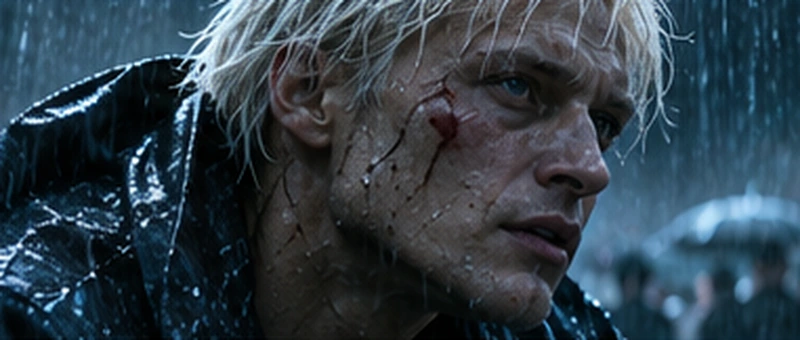
01 — THE MORNING WITHOUT A NAME
Roy awoke with the impression that someone was standing on the other side of the wall. He kept his eyes closed until he could distinguish the sound that had awakened him. Water was falling from the edge of the roof onto a metal shutter. There was nobody there.
The light had moved across the pavement while he slept. He did not know how long he had been asleep. His watch indicated that it was a few minutes after nine.
He turned his right hand over. Two of the fingers moved when he tried to close them. The others followed after a delay. He could not remember whether the delay had been as pronounced before he went to sleep.
He would have liked to ask Imani what it meant.
The bottle of water the man at the laundry had given him was lying beside his leg. He drank a little, then put the bottle back into his coat. The dressing beneath his shirt felt stiff where it had dried. He decided not to disturb it in a place where he had nothing with which to replace it.
From the opening at the end of the building he could see a road. A truck was delivering supplies to a workshop on the opposite side. Two men were receiving the goods, comparing the markings on the boxes with a list that one of them held. It seemed an entirely ordinary thing to be doing on the morning after an extraordinary night.
Roy waited until the truck had left before attempting to stand.
There had been a time when he could have raised himself from the ground without giving any thought to the movement. Now he had to decide where to place his left hand. It was an unpleasant kind of education. Each ordinary movement had acquired a number of separate parts, any one of which could fail.
Once he was standing, he remained against the wall for several seconds. His leg held his weight.
He found a piece of paper near the entrance. It was a notice concerning the redevelopment of the property. The company named at the bottom was not one he recognized. The proposed completion date had passed nearly two years earlier. Nobody had removed the notice.
Outside the building, someone had painted a new number over an older one. The old number was still visible around the edges of the paint.
He thought of the various descriptions under which he had been known since his awakening. Some had been entered into medical records; others had been attached to decisions made in rooms he had never entered. The latest was the one that had appeared on the public screens the previous night.
The subject may be in possession of classified technology.
The sentence had seemed less absurd when he had been too tired to think about it. He had spent part of the morning trying to move his own fingers. Somewhere else in the city, an officer might be explaining that those fingers represented technology that the state was entitled to recover.
He took out his telephone. Its remaining charge was lower than he had expected. Rachel's name was still there, and nothing had arrived from her.
He had agreed to a meeting place before he knew how the streets would be closed. If she had failed to reach it, she would have had to make another decision, just as he had. He could not undo either decision by looking at the telephone.
He put it away and stepped into the daylight.
02 — THE OPEN DOOR
The first cafe Roy encountered was serving breakfast to people from the surrounding workshops. It occupied half the ground floor of a building whose upper windows were covered with plywood. A woman at a table near the entrance was reading the morning news on a small terminal.
Roy stopped across the road. There was no military vehicle in sight. That was not the same thing as knowing that the room was safe.
He had enough money for food. He had not yet established whether he could spend it.
At the hospital he had been asked to confirm his identity before receiving many of the things he needed. At this cafe a person entered carrying a handful of coins, and the proprietor seemed to take more interest in whether he wanted coffee than in where he had come from.
Roy crossed the road.
The proprietor brought him tea and a bowl of rice with vegetables. Roy paid before he began to eat. His injured hand remained beneath the table. He was halfway through the meal when a bulletin appeared on the terminal at the next table.
The woman who had been reading put on her glasses. She turned up the sound.
A government spokesman was explaining that the previous day's restrictions had been intended to ensure public safety during an operation involving classified material. He said that transport services had resumed in most of the city. He did not mention a hospital patient.
Then a photograph appeared in the corner of the screen.
Roy lowered his eyes. The image had been taken before the events in the diagnostic building. He looked healthier in it than he did now. He wondered how many people would notice the difference and how many would mistake it for evidence that the man in the picture was someone else.
"They killed a minister, didn't they?" a man asked from another table.
"One of them did," the woman said.
"What do you mean, one of them?"
She moved the terminal closer to him. The photograph disappeared while he was trying to read the notice below it.
Roy finished what was left in his bowl. It was difficult not to listen. He heard somebody say that the dead minister had been responsible for the new water regulations. Somebody else said that the government had been withholding information for days. The proprietor told them that the two assertions could both be true without having anything to do with each other.
When Roy stood to go, the proprietor glanced at his shoulder.
"Have you hurt yourself?"
"Yes."
"There is a pharmacy on the next road. The large one has closed, but the smaller one ought to be open."
Roy thanked him. He had prepared himself for more questions. None came.
In the doorway he passed a young woman arriving with a child who wanted to know if the trains were running again. The mother said that they would find out when they reached the station.
He held the door for them, using his left hand. The child did not look up at his face.
It was the first useful thing Roy had managed to do that morning for somebody other than himself.
03 — A CHANGE OF ADDRESS
Rachel was still at the community association when the first list of available accommodation arrived. Most of its entries referred to public facilities in districts where the transport service had been restored. Beside one of the addresses someone had added a handwritten warning that the building was already full.
A volunteer offered to arrange a place for her at a municipal hostel. The offer was accompanied by a form.
Rachel read it before answering. The association had required no registration when she arrived during the night. The hostel required a permanent address, proof of identity and a declaration of the reason for requesting emergency accommodation.
"What happens if you don't have an address?"
The volunteer showed her a box to select at the bottom of the form. She said that someone at the hostel would explain the procedure.
Rachel returned the paper. She said that she would try to make another arrangement first.
The woman apologized. "We're supposed to give you somewhere to go."
"You already did. Thank you."
Rachel had spent some of the night comparing the documents in Adrian's packet. She opened it once more at the end of the table. There was an observation concerning a culture that had remained stable for longer than the investigators had expected, and a later observation that made the first result much less encouraging. The two pages were separated by a set of equipment readings.
She put them together. It would have been very easy to remove the second observation and describe the first as a discovery.
The older documents were more difficult to arrange. They had not been written for the investigators in the hospital. A reference in one record seemed to relate to a group of subjects described elsewhere under a different category. Neither record contained the information needed to identify them.
Rachel copied the reference into her notes. She had no intention of supplying the missing information with an assumption.
She tried to contact the hospital through the public number. After a long wait, an employee answered. The employee said that the research wing could not receive external calls at present. Rachel asked whether the restriction was medical or administrative.
"Administrative, I think. I haven't been told when it will end."
"Can you tell me whether Dr. Imani is there?"
The employee began to look for the name, then said that she was not permitted to provide information about staff movements during the operation.
Rachel thanked her and ended the call.
She could imagine what would happen if she asked for Adrian. It would not tell her whether he was free to speak, or even whether he knew that she was trying to reach him.
She took a fresh sheet of paper and added the hospital's response to the account she had written during the night. The important fact was that the people who could explain the records were becoming more difficult to reach. The reason was not yet something she could establish.
At noon, the association was to return the waiting room to its ordinary use. Several travelers had already left.
Rachel closed the packet. There was no sense in remaining at a table merely because she had been sitting at it when she last imagined Roy on the other side of the city.
The volunteer gave her a street directory that had been left by another visitor. Rachel folded it and put it into her bag. She went outside with no new address to write on the form.
04 — A PERSON NOT FOUND
Captain Deren discovered that the morning assessment had been distributed to a number of agencies that had not participated in the operation the previous day. The new version contained an entry for a man whose current position had not been established.
Below it was a list of actions to be taken by the recipients.
He read the list in Colonel Vale's absence. He had been asked to comment on the instructions affecting the hospital, but there was no separate copy of those instructions. They had been incorporated into a much larger document.
Some of the actions were familiar to him. Others concerned functions usually performed by civil servants. A request for medical assistance might produce a notification to an agency that had nothing to do with the provision of medical assistance. An inquiry about a passenger could result in the circulation of information about several other passengers.
Deren asked the lieutenant beside him which provisions would cease to apply if there was no confirmed identification of the subject.
The lieutenant looked through the documents. He could not find a provision that answered the question.
"I think we're waiting for a termination instruction, sir."
"For the entire operation?"
"Yes, sir."
Deren turned back to his report. He described the subject as injured and in need of treatment. He also described the extent of the damage to the hospital and the interruptions to its ordinary work. The latest version of the public assessment contained neither of those observations.
When Vale entered the room, Deren asked him whether the medical information would be included in the notices sent to institutions outside the original district.
"They have identification material."
"An employee at a clinic needs to know what to do with him if he arrives there."
"The clinic needs to notify the relevant authority."
"Before treating him?"
Vale looked at the other officers in the room. "We're not writing clinical instructions, Captain."
"That is precisely what concerns me."
The colonel did not respond. He asked for the report to be forwarded to the medical liaison and turned to the latest possible sightings.
One concerned a man in a shop. The description matched Roy's photograph, but the man had left before the witness supplied any additional information. Another concerned a patient who had refused treatment in a different district. The patient had turned out to be a woman.
The information continued to arrive. There was no corresponding increase in what the command knew about Roy.
Deren remembered the empty field on the display earlier that morning. It had been useful in the time since its last entry was removed: it made the limits of their knowledge visible to everyone who read it.
In the revised assessment the field had been replaced by a map. Every possible sighting was represented there. The city looked full of information.
There was still no confirmed position.
05 — THE MAN IN THE WAITING ROOM
M-04 had been sitting in the waiting room of the regional facility for almost two hours when a medical employee came to examine his hands again. There was nothing to indicate that the examination had been requested because his condition had changed. The employee was completing a series of assessments that had to be entered before the next deployment.
He held out his hands. The employee removed the coverings from the small cuts he had sustained in the diagnostic building.
"Any change in sensation?"
"No."
She began a series of tests. The first few were ones he had undergone many times. The last was unfamiliar. She asked him to hold a position until instructed to release it, then recorded something on a separate instrument.
When she finished, she told him that there was no need for further treatment of the cuts.
"Am I to return here after the next assignment?" he asked.
"That depends on your instructions."
"Is this part of the assignment?"
She looked at the second instrument. "It's part of the assessment."
He did not ask her to explain the distinction. The employee appeared to have been given no more information about it than was necessary to complete her work.
He watched her enter the result into the terminal. The page containing the examination had several fields that she could not alter. One of them concerned the interval between mandatory reviews. He recognized the arrangement of the fields. He had never been shown the document from which their values were obtained.
A uniformed officer arrived and asked the employee whether the man was available for immediate assignment. She confirmed that he was.
M-04 stood. He was given a description of the district in which his presence might be required. There was no confirmed position for the subject. He could expect to receive further instructions when he arrived.
"Has there been an assessment of his injuries?" he asked.
The officer said that he had read the report made at the hospital. He saw no reason for M-04 to concern himself with the subject's injuries until he was in a position to recover him.
"There was considerable impairment at the time of the last encounter."
"Then you have that information already."
The officer left him beside the door while he spoke to the employee. M-04 could hear part of their conversation. It concerned the date of his next examination and whether it would have to take place before he was reassigned to another region.
The employee said it could be reviewed if necessary.
Nobody asked him whether he expected to be in the same region when the date arrived. There was usually little reason to ask a soldier such a question. M-04 wondered whether the people using the term reviewed were referring to his whereabouts or to something that had nothing to do with them.
When the officer returned, M-04 accompanied him out of the room.
06 — THE PRICE OF A BANDAGE
The smaller pharmacy was open. Its proprietor had put a sign in the window explaining that the supply of certain medicines had been interrupted. Behind the counter there were boxes of dressings and a row of plastic bottles. Roy recognized few of the names on them.
He placed some money on the counter and asked for a clean dressing.
The proprietor wanted to know the extent of the injury. Roy described its location without removing his coat.
"Have you seen a physician?"
"Yesterday."
"Then you should go back."
"I can't."
The woman looked at him. For a moment he expected her to ask why. Instead she brought a packet from beneath the counter and told him that it contained the size of dressing he had requested.
A bell sounded as someone entered the pharmacy behind him. Roy turned too quickly. The pain beneath his ribs became sharp enough that he had to put his hand on the counter.
The person who had entered was an elderly man carrying a prescription. He apologized for having startled Roy, although he had done nothing more than open the door.
The proprietor looked from Roy to the elderly man. She asked Roy whether he could wait a little while, then took the prescription and attended to it.
Roy had intended to leave as soon as he had purchased the dressing. He remained where he was because the effort required to take the first few steps had become uncertain.
When the elderly man was gone, the woman brought him a chair. She said that she could dress a minor injury, but she was not qualified to deal with whatever appeared to have happened to him. There was a physician whose office was usually open at this hour.
Roy unfolded the medical instructions Imani had given him. He had not meant to show them to anyone until he found someone in a position to help. The woman read the first part, then offered them back to him.
"You need somebody who understands this."
"I know."
She asked if there was anyone she could contact on his behalf. He told her that there was not, for the moment.
She offered him the use of a small room at the rear of the shop where deliveries were ordinarily unpacked. He could replace the dressing himself if he was able to do so. She asked him not to leave any medical waste where her assistant might handle it unknowingly.
Roy thanked her.
It took him longer than he had expected. Even when he had finished, he was not satisfied that the result was as good as what Rachel had accomplished in the building above the street. The last time she had changed his dressing, he had been thinking about how to persuade her that they could remain together. He had paid too little attention to how difficult it was for her to do the work.
When he returned to the counter, the proprietor had put the money he had given her beside the packet. The price, she explained, was less than the amount he had placed there. He took what was left.
She asked whether he could walk as far as the next road.
"Yes," he said.
He waited until he was sure that the answer was true.
07 — THE UNCLAIMED MESSAGE
Rachel reached the building of a professional association shortly after one. She had found its address among a list of institutions that Adrian had mentioned during an earlier discussion about the future of the research. It was an organization of physicians and laboratory staff. She did not know the names of the people working there.
The receptionist listened while Rachel explained that she wished to speak to someone who could advise her on the preservation of research records during an interruption to a laboratory's work.
"Which laboratory?"
Rachel named the hospital.
The receptionist looked toward a door behind the desk. She said that someone from the association's legal committee was expected later in the afternoon. The woman would not necessarily be able to provide advice on the scientific records, but she might know what could be done about the interruption.
Rachel asked if she could leave a general inquiry without identifying the patients involved.
"Of course. We don't need patients' names for that."
The receptionist gave her an ordinary piece of paper. Rachel wrote a few sentences. She made no claim about the significance of the research. She asked whether there was an independent means of establishing the existence and dates of laboratory records when access to the originals had become restricted.
She hesitated over the space provided for a reply address. In the end she asked if it would be possible to return for an answer instead of having one sent to her.
"I don't see why not," the receptionist said. "It might not be ready today."
Rachel kept the packet. She had wanted to find a place where it could be left, but she had found only someone willing to consider the question. For the time being, that was worth something.
She sat on a bench outside the building and opened her telephone. There was no message from Roy. The last exchange between them was so ordinary that it hurt to look at it now. It had concerned the time at which she expected to arrive at the hospital.
She began to write a new message. She wanted to tell him that she had found somewhere she might obtain assistance. She wanted to ask whether he had been able to get something to eat. Neither of those things could be conveyed without creating the possibility that he would receive the message at a moment when it was dangerous for him to respond.
She read what she had written.
Then she removed his name from the screen and saved nothing.
There had been a separation she remembered from another life, a life that had ended in a way she still could not reconcile with everything she had subsequently learned. The present separation was different. She knew where she had last seen Roy. She had helped him reach that place. There was no evidence that he had died there.
There was also no evidence that he was safe.
A man on the bench beside her was speaking into a telephone. He was telling someone that he would be home later than expected. When he finished, he put the telephone into his pocket, stood and went away.
Rachel remained on the bench for a little longer. She had never considered an ordinary conversation such as his a form of privilege.
08 — AN UNREMARKABLE MAN
By early afternoon the streets around the commercial buildings had begun to fill with people from the workshops. The first shift of some of the factories was ending; others were receiving their afternoon workers. A man stood on the pavement selling fruit from two wooden crates.
Roy was tired. He had eaten, found a clean dressing and walked farther than he had believed possible when he awoke. It did not follow that he could repeat those accomplishments in the hours remaining before nightfall.
The street he reached offered several routes toward the centre of the city. At the far end there was a transport terminal. He had thought of going there until he caught sight of the public notices around its entrance.
His photograph was among them.
It seemed strange that a photograph could remain in one place while the person it represented was standing in another. The men and women passing beneath it had more information about the photograph than they had about the man on the other side of the road. Some of them did not look at it at all.
Roy stopped at a low wall beside a shuttered shop. A man carrying a toolbox sat down at the other end. He was waiting for a bus. After a while he asked Roy if he knew whether the service had resumed.
"I haven't taken one today."
The man said that he had been trying to reach his workplace since seven. He had eventually gone to collect a set of tools from his brother instead. He was not sure whether to return home or try again to reach the workplace.
Roy listened. The man's account contained no mention of the minister, the hospital or the classified operation. He wanted to earn enough money that day to make it worth having left home. Roy understood what he meant.
Across the road, two uniformed personnel came out of the terminal with an employee. The employee pointed toward one of the boarding areas. They walked in the direction he had indicated.
Roy watched them until they were no longer visible. He did not know why they were there. He had to resist the tendency to assign himself a place in every measure taken by the government.
The man beside him got up when a bus appeared in the distance. He lifted his toolbox and wished Roy a good afternoon.
Roy returned the greeting.
For a few seconds after the man left, the place beside him remained empty. Then another person sat there. A woman opened a bottle of water and began to read something on her telephone.
Roy thought about what it would mean to live among these people without being able to enter the places in which their names were recorded. A person could be invisible to a particular institution and still require food, shelter and assistance from someone living within its reach. He had not removed himself from the city by becoming difficult to locate. He had only lost a number of the means by which he had been able to live in it.
The notice at the entrance of the terminal was replaced by another municipal announcement. The new one concerned transport.
He rose from the wall.
He did not know whether there was a place in the city where he could remain until he was able to look for Rachel. He did know that he was in no condition to undertake another confrontation with the people sent to recover him.
He began to walk toward the older buildings beyond the workshops. There was a shaded pavement on that side of the road, and he could stop again if he needed to.
Behind him the terminal continued to receive passengers. Somewhere in the city, the people searching for him were waiting for a report that would allow them to continue their work.
Not one of the people who had sat beside him that afternoon had asked him for his name.