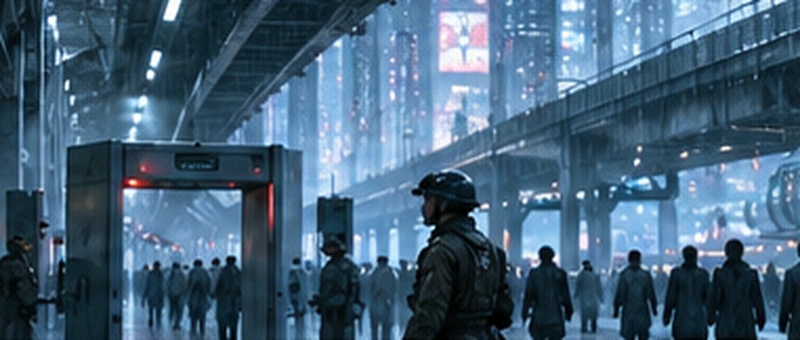
01 — THE SECOND MAP
At three in the afternoon, a municipal engineer was asked to remain in a meeting after the other representatives of the transport authority had been dismissed. He had been expecting to discuss the interruption to the eastern tram service. Instead, an officer showed him a map of Okakyou on which the city's principal transport facilities were represented by white squares.
The engineer recognized the map. His department had prepared it for a joint exercise concerning the evacuation of districts at risk from flooding. It had been revised several months earlier to include the distribution centres for emergency water supplies.
On the wall beside the map was a photograph of a man.
The officer asked how many of the white squares were connected to the municipal identity network.
"All the terminals. Not all the stops. It depends on when they were built."
"And the ones that aren't?"
"They send passenger totals. We don't know who the passengers are."
The officer wrote something down. He asked a similar question about the emergency water centres.
The engineer explained that the distribution system recorded the amount of water issued against each household allowance. The identity of the individual who collected it was not always established. In some districts it was quite usual for one person to collect water for several households.
"Could that be changed?"
"Not without changing the instructions we give people."
The officer told him that a new instruction was being prepared.
It was then that the engineer began to understand the purpose of the meeting. He looked again at the photograph. He had seen the man's face earlier in the day while waiting for a tram. He had not associated it with the operation of a water centre.
Captain Deren was present when the answers were summarized for the command. By that time, several other departments had received similar inquiries. Colonel Vale wanted a common procedure for reporting an identification obtained through any of the participating services. The existence of a report would not, in itself, be sufficient grounds for an arrest. It would be sufficient grounds for the dispatch of authorized personnel.
Deren asked whether the municipal authorities could decline to take part.
"They've been directed to cooperate," Vale said.
"By the authority that issued the acquisition order?"
"By an authority with jurisdiction over the operation."
Deren did not pursue the question in front of the engineer. The man had already gathered his papers and was waiting for someone to tell him whether he could leave.
When the map was replaced by a new version later that afternoon, a number of the white squares had been joined by blue lines. From the explanation beneath it, Deren understood that the lines represented institutions whose records could now be referred to the operation without a separate request.
He thought of the engineer's answer about the water centres. People had been instructed to use them because water was necessary to their existence. It had not been part of the instruction that the same transaction might establish their presence in a military search area.
The officer responsible for the display asked whether the map should include facilities that had not yet confirmed their cooperation.
Vale said that it should. Their status could be changed when confirmation arrived.
The second map covered nearly the entire city. It was more impressive than the first, and no more successful at showing where Roy Batty was.
02 — THE WOMAN WITH THE GREEN CARD
Roy reached a street where the buildings stood close enough together to keep the pavement in shadow for most of the day. A little further on, a queue extended from the entrance to a covered courtyard. Above the entrance was a sign that had once belonged to a public baths. Someone had attached a smaller sign beneath it to indicate the new use of the building.
Water distribution. Afternoon allocation.
He decided to join the queue. There was not much left in his bottle, and he did not know how far he would have to walk before finding somewhere to spend the night.
In front of him stood a woman with two containers tied to a small wheeled frame. One of the wheels kept catching against the uneven pavement. When the queue moved, she had to lift the frame a little before she could move with it.
Roy offered to help her.
She looked at the position of his right arm. "Which of us is supposed to be helping the other?"
He smiled. She pulled the frame past the obstruction and thanked him anyway.
There were notices just inside the entrance, most of them concerning the daily allowance. A new sheet of paper had been fixed over the instructions for visitors from other districts. The change had taken effect at two that afternoon. All collections exceeding a specified emergency quantity required verification at the counter.
The woman removed a green card from her bag.
"Is that new?" Roy asked.
"The card? I've had it for years. The notice is new."
She showed him the other card in the bag. It belonged to her sister, who lived on the floor above her. Her sister's illness made it difficult for her to come to the centre. She hoped that the card would still be accepted.
There was a discussion at the counter when her turn came. The attendant had been instructed to obtain the identity of the collector before authorizing a collection against a second allowance. The woman's card was in order. Her sister's address appeared to be in order. The difficulty was that the terminal would not accept the transaction without a further declaration.
"What declaration?" the woman asked.
The attendant looked at the display. "I don't know. It's asking for an authorization number."
A supervisor came over. He asked the woman to wait while he telephoned another centre. Behind her, people began to complain. The woman moved aside with her empty containers.
Roy stepped up to the counter and held out his bottle. The attendant directed him toward a tap at the end of the courtyard. The emergency quantity did not require a card if it was not being taken away in a distribution container.
He filled the bottle. While he was replacing the cap, he heard the woman explaining her sister's condition for a second time, now to a different employee.
He could have left. There was nothing he could do about the authorization number. He remained long enough to see the supervisor return to the counter and accept responsibility for the collection on the centre's own account.
The woman did not thank the terminal. She thanked the supervisor.
Roy carried one end of the wheeled frame with his left hand while she brought it over the threshold. Even that small effort produced a pain he had not expected. He let go before they reached the pavement.
"You should have somebody look at you," she said.
"I'm trying to find somebody."
She gave him directions to a street where a number of older shops still remained open. She knew of a man there who repaired household equipment and sometimes provided a place to sit for people who had become tired on the way home from the centre.
She asked Roy no questions about his card. When they parted, she was more concerned about whether he had understood her directions than about anything he might have been obliged to declare at the counter.
03 — THE RECORD OF A RECORD
A little before four, Rachel returned to the professional association. The receptionist recognized her and led her to a small office on the second floor. The woman waiting for her there introduced herself as Sera Min. She was a lawyer who advised the association on disputes involving medical institutions and professional obligations.
Rachel sat down opposite her. She placed the general inquiry she had made earlier beside the packet but did not open the packet yet.
Min explained that the association had no power to demand access to a government facility. Nor could it intervene directly in an order issued under the national continuity provisions. It could, however, assist a member in documenting an interruption to work and establishing whether the records affected by it were subject to ordinary medical or research obligations.
"Are the records in your possession?" she asked.
"Some of them."
"Originals?"
"Copies. There may be things I don't know about the originals."
Min asked whether the packet contained personal information about patients. Rachel told her that part of it did. She explained that she wished to preserve the scientific record without making the identity or condition of a patient available to anyone who had no proper reason to know it.
The lawyer looked at the packet for a moment.
"Those are two different obligations. We need to make sure we don't satisfy one by violating the other."
It was the first answer Rachel had received that acknowledged both of the things she was trying to do.
She took out two pages that Adrian had prepared for a discussion of the experimental results. Neither contained the identity of a patient. One recorded the period during which the material had remained stable. The other gave the criteria by which the investigators had judged the trial unsuccessful.
Min read the dates and the references at the top of both pages. She asked if an independent laboratory could reproduce the result.
"Not from these pages. They would need the conditions of the experiment and the material that was tested. There are also observations in the packet that we haven't been able to explain."
"Then what do you want us to confirm?"
"That these records existed. I don't want someone to be able to say later that the trial succeeded because the page describing its failure has disappeared."
Min put the pages down in the order in which Rachel had given them to her.
She proposed that the association record the receipt of copies of the two non-identifying pages and prepare a dated acknowledgment of their contents. It would not certify the experimental result. It would not establish that the copies were complete. It would establish what the association had received that afternoon, while the work at the hospital was interrupted.
The remaining material would require a different arrangement. Min would not accept it until she knew more about the restrictions that applied to it and the obligations of the people involved.
Rachel agreed. She watched the receptionist make the copies, then checked both of them before signing a short description of what she had provided. The description included the fact that the second page was a record of failure.
For the first time since leaving the hospital, something she had carried out of it existed in the keeping of an institution that was not part of the hospital.
Min handed her the acknowledgment. "This isn't immunity from an order to surrender the material. You understand that?"
"Yes."
"If such an order is made, there's a difference between having to surrender a document and being the only person who can say what was on it. That's all we've established today."
Rachel looked at the two dates printed on the acknowledgment. She put it into her bag with the packet.
Before she left, she asked Min about a person detained under an acquisition order. She described no particular individual. The lawyer said she had seen no published procedure governing examination of the legal status of a person recovered under the classified provisions.
"Can they be represented?"
"I don't know."
Rachel had spent much of the day receiving answers that placed her no nearer to Roy. This one was different only in that it had come from someone qualified to recognize the absence of an answer.
04 — A MAN AT THE TERMINAL
The report reached Deren shortly after five. A passenger at a northern transport terminal had been identified as possibly corresponding to the subject of the acquisition order. The identification was described as probable. A local security employee had taken the passenger to a room adjoining the platform.
Deren asked the officer reading the report what made the identification probable.
The officer brought up an image from the terminal. It showed a fair-haired man in a dark coat. His right hand was in his pocket. The image was of considerably poorer quality than the photograph that had been distributed to the city.
"They have his identity record," the officer added.
"And is it Roy Batty's?"
"No, sir."
The man's identity record was that of a maintenance electrician. There was an employment entry and a history of travel between two districts. The security employee had been unable to establish immediately whether the man in the room was the person entitled to use the record. He had therefore requested assistance.
A military liaison officer proposed sending M-04 to the terminal. He was already in the northern district and could reach it before the personnel originally assigned to the report.
Deren requested that he be accompanied by an officer empowered to decide whether the passenger could be released. There was a brief discussion about whether such authority was necessary. Eventually a lieutenant was assigned.
When M-04 entered the room at the terminal, the passenger was sitting beside a table on which his personal belongings had been arranged. A supervisor from the transport authority was trying to reach the man's employer.
The passenger was angry. He had been asked several times to explain why the photograph on his employment record was older than the photograph on another document. He had given the same explanation each time. He wanted to be told whether he had missed the last connection to the district where he lived.
M-04 looked at his face. He had seen Roy at close range in the hospital. The man before him was not Roy.
"This is not the subject," he told the lieutenant.
The lieutenant asked him whether he had made that judgment on the basis of appearance alone.
"I have met the subject."
"There may have been a change in his appearance."
M-04 turned toward the passenger. There was a pale mark on the back of the man's right hand, where the skin had been injured many months earlier. He had seen Roy's hand when he recovered his own balance after their encounter. There had been no such mark.
He described the difference to the lieutenant. The transport supervisor received confirmation from the employer a few minutes later. Together the observations were sufficient to authorize the man's release.
The passenger collected his belongings. He asked who would pay for the time he had lost. The supervisor told him where he could make a complaint. No one in the room was able to tell him what would happen to a complaint concerning the military operation.
After the man had left, the lieutenant completed the report. M-04 watched him select the category for an unsuccessful identification. There was no field for the passenger's missed connection.
He asked whether the command would receive a copy of the corrected record.
"Of course."
"The same people who received the first one?"
The lieutenant looked at the screen. He said that the correction would be sent to the central operation. He could not say which other departments had received the photograph taken at the terminal.
M-04 was instructed to remain in the district. He walked out to the platform and watched the passengers waiting for a train. The electrician was no longer among them.
He understood how little the man had done to become part of the operation. For a moment he wondered how much he himself had done to become part of it.
05 — THE CLOCK THAT HAD STOPPED
The shop to which the woman had directed Roy was narrower than the other shops on the street. Through its window he could see a row of electrical appliances waiting to be repaired. Above them hung a dozen clocks, none of which indicated the same time.
The proprietor was trying to get a defective fan to turn when Roy entered. He switched it off and looked up.
Roy explained that a woman from the water centre had suggested he might rest there for a while. The man pointed to a chair near the door.
"I'd offer you a fan, but as you can see, I've had some difficulties with it."
Roy sat down. He could feel the strain in his leg now that he was no longer moving. The man went back to the fan without asking any more questions.
On a shelf above the workbench lay a collection of parts from water pumps. Some belonged to a type that Roy remembered seeing in the older districts of the city. The proprietor said that the manufacturer no longer supplied the seals. He had been taking usable parts from pumps that could not otherwise be repaired.
Roy asked how long the district had relied on the water centre.
"Since they stopped bringing water to the upper floors. Some buildings can still manage. It depends on the pipes."
The man took a clock down from the wall and laid it on the bench. He removed its cover and turned one of the wheels with the point of a small instrument.
Roy noticed a photograph tucked against the frame of the window. It showed the proprietor standing beside a much younger man outside a larger workshop. The proprietor followed his gaze.
"My son. We used to have a business in the next district. He was better at deciding which things weren't worth repairing."
"Where is he now?"
"In the south. He wanted me to go with him. It would have meant leaving quite a lot behind."
The man gestured toward the clocks. Roy could not tell whether he was referring to them or to the people who had brought them to the shop.
A public announcement began to play from a loudspeaker across the street. It reminded the inhabitants of the district that assistance should be provided to authorized personnel carrying out inquiries under the current emergency measures. It said that ordinary commercial activity was not affected.
The proprietor stopped working until the announcement ended.
"They said that yesterday, too."
He turned the clock over. A few minutes later its second hand began to move. He set it on the bench beside Roy and found a piece of paper on which to write the owner's name.
There was a sound outside. Roy looked up. A municipal vehicle had stopped near the intersection, and two employees were attaching notices to the buildings. The proprietor went to the entrance to see what they were doing.
When he came back, he took his telephone from the workbench. Businesses offering overnight accommodation were to confirm the identities of their guests. There was a separate instruction for people maintaining employment records. He was trying to decide which parts of the announcement applied to a repair shop.
Roy asked whether the man lived in the building.
"Upstairs. There are two rooms behind the shop as well. My son used to keep his equipment there."
The proprietor looked at Roy's shoulder again. He asked whether he had somewhere to go that evening.
Roy said that he did not.
"You can stay until morning. But if you need a doctor, I won't be able to do much for you here."
Roy looked toward the street. The employees had reached the building next door. He did not know whether they would enter the shop, or whether the proprietor had recognized him already.
"There may be people looking for me," he said.
The man was silent for a moment. He pulled the repaired clock a little closer to himself. Then he asked Roy whether those people could be expected to come to the shop that evening.
"I don't know."
The proprietor considered that answer. He told Roy that the offer remained open. He added that he wished to be told if the situation changed.
Roy thanked him. He had found a place to spend the night, but it belonged to someone whose life could be altered by the decision to let him remain there. He had not thought about that part of the offer until he had heard himself accept it.
06 — THE DEPARTMENT THAT DID NOT EXIST
At the hospital, Dr. Imani was permitted to return to her office shortly before six. The laboratory corridors were still subject to restrictions. She had spent part of the afternoon helping to arrange treatment for patients displaced when the diagnostic building had been closed.
A woman from the administration had left a number of documents on her desk. Among them was a request from the military medical liaison for an assessment of the probable condition of a former patient of the hospital.
The name was Roy Batty.
Imani read the request twice. It asked for a determination of the patient's ability to sustain further physical activity and for an estimate of the time required before he could regain his previous level of function. There was no reference to an examination of the patient.
She telephoned the number given at the bottom of the page.
A man answered. He said that the request had been prepared to assist the personnel conducting the operation.
"Has he been examined since he left the hospital?" Imani asked.
"Not to my knowledge."
"Then I can't provide a current assessment. I can give you the reasons why he needs medical attention."
The man told her to include any relevant findings from the period during which he had been in her care. He seemed dissatisfied when she explained that the findings could not be used to predict the behavior of an injured body on the basis of a fixed output percentage.
"Could he have exceeded the recommended limit?"
"He already did. That is one of the reasons you cannot use it as a description of his present condition."
The man asked her to put her answer in writing.
Imani wrote a short statement concerning the limitations of her information. She added that an attempt to compel the patient's movement could result in deterioration and that the absence of visible distress should not be taken as evidence to the contrary.
Before transmitting it, she checked the destination entered into the hospital system. The name of the receiving medical department was not one she recognized. A colleague searched the public directory and found no institution corresponding to it.
Imani returned to the telephone and asked whether a physician would receive the statement.
"It goes to the medical liaison."
"Who is the physician responsible for interpreting it?"
The man explained that the department was not publicly listed. He was not permitted to give the names of its personnel.
She asked whether that department had assumed responsibility for the patient's treatment.
He said that it had not.
After the call, Imani sent a statement confined to the need for immediate medical examination and the risks associated with compulsory movement. She retained a copy in the hospital's medical correspondence. The detailed findings remained in the patient's record.
There was a knock at the door. Adrian Tyrell stood outside carrying a box of documents that had been returned to him after inspection. He had been told that he could continue some of the analytical work, provided that it did not require access to the restricted samples.
Imani showed him the request she had received.
Adrian said he had been asked a similar question concerning the range of possible performance of the material that they had examined. He had been unable to identify the department making the inquiry.
"Did they use the hospital's name for the sample?" Imani asked.
"No. They gave it a designation I had never seen."
He opened the box and found the page on which he had written the designation. The request had been withdrawn before he could determine what it referred to. It consisted of a series identifier and a revision number, followed by the word reference.
Imani did not recognize it either.
Adrian put the page back. They could not assume that the two inquiries concerned the same material, merely because the addresses were unfamiliar. He said that he would ask for clarification if the request was repeated.
Outside, someone was removing a temporary barrier to allow a nurse to pass. Imani could see the ordinary signs for the wards beyond it. She had worked in the hospital long enough to know who was responsible for the people in each of those wards.
For the man they had treated in the room downstairs, she could no longer point to a single institution that had accepted responsibility for his care.
07 — A NAME ENTERED TWICE
Rachel had almost reached the end of the street when she saw the notices around the entrance to the station. The notice concerning the acquisition operation was not the one she remembered from the previous evening. There were now two separate instructions beneath the photographs.
Roy was to be located and reported to the designated authority. Rachel was to be made available for questioning in connection with the removal of restricted research material.
Her photograph was smaller than his. The name beneath it was hers.
A train arrived and a group of passengers emerged from the station. A man looked briefly at the two photographs on his way out. Rachel moved away from the entrance before the next group reached it.
She had intended to take a train to the district where she and Roy had agreed to meet. She had been unable to get there that morning and had decided to try again after leaving the association. The presence of the notice did not prove that anyone at the station would recognize her. It did establish that she could place the research material at risk merely by attempting to make the journey.
She crossed the street and opened the directory the volunteer had given her. There were two other stations within walking distance. She looked at the distance to the place she wanted to reach, then closed the directory.
At the association, Sera Min received a communication from the professional registration office. It concerned the preservation of documents originating at the hospital. The association was asked to identify any person who had sought its assistance in relation to the suspended research.
The receptionist brought the communication to Min's office. She knew that a woman had been there that afternoon, but she did not know whether the request applied to her.
Min read the document. It made reference to the acquisition order, although a copy of that order was not attached. The office sending it had previously dealt with questions of professional registration, not with investigations concerning classified material.
She telephoned the official whose name appeared on the communication. He explained that his department was collecting information on behalf of another authority.
"Are you requiring us to identify people who have consulted a lawyer?"
"We're asking you to identify people who have approached your association about the research."
"That includes people who have consulted a lawyer. Is there an exemption for confidential legal consultations?"
The official did not know. He said that he would submit the question to the authority that had issued the request.
Min asked for the answer in writing. Until it arrived, she was not prepared to provide the information.
The receptionist waited until she put down the telephone. "Did we do something wrong?"
"No. Someone has asked us a question. We need to establish whether they have the right to an answer."
Min was aware that there might be consequences for the association if the request were followed by an order. She decided to notify the chair of the legal committee before leaving the office.
She looked through the acknowledgment prepared for Rachel. There were two entries bearing the same name. One identified the person who had supplied the documents; the other identified the person who had checked and accepted the description of them. Min had established neither the woman's civil status nor her entitlement to use the name. Neither determination had been necessary to acknowledge receipt of the pages.
The receipt was a record of an event that had occurred in her office. The communication on her desk sought information that might lead to the detention of the person who had made it possible for that event to occur.
For the moment, both documents remained in her keeping.
08 — BEFORE THE LIGHTS WENT OUT
By the time the proprietor closed the repair shop, Roy had been shown the room in which he could spend the night. It contained a narrow bed, an old cabinet, and a shelf that held a number of manuals for equipment no longer manufactured. The proprietor had moved a box of electrical fittings off the bed.
Roy sat near the window. His telephone was almost exhausted. The proprietor had offered him a charger when he saw it, and Roy accepted it with some hesitation. He connected the telephone and waited for the screen to light.
There was no message from Rachel.
He had asked himself several times that day whether she had reached the hospital or found a way to contact Adrian. He could not remember her mentioning any other place where she might go. There had been too many immediate difficulties to discuss all the ones that might follow their separation.
He opened the last conversation between them. It occurred to him that he was reading words written by a woman who had believed she would see him again very soon.
He wanted to write something that would let her know he was alive.
Instead, he put the telephone on the shelf. No promise about the following day could be made with any confidence. He would have to find another way of reaching her, if she had not already found another way of reaching him.
The light in the room flickered. From the shop he heard the proprietor call out that it was the same problem they had been having for several weeks. Roy went to the door, but the man told him not to get up on his account.
At the command centre, a report concerning identity checks was being prepared for the evening briefing. Captain Deren read the account of the incident at the transport terminal. He was relieved to learn that the passenger had been released. He also learned that three other people had been detained temporarily in circumstances that were not yet fully explained.
He asked for the original and corrected versions of the terminal report to be circulated together. The officer responsible told him that he could amend the records maintained by the operation. Other recipients would have to amend their own copies.
Deren looked at the map. The blue lines had increased in number during the afternoon. A report from a residential district had been added to it, along with the locations of two pharmacies. Neither of the pharmacies had confirmed the identification of the person described in the report.
Vale entered with a memorandum from the joint staff. During the following morning, further classified personnel would be assigned to the operation. Their designations were to be supplied to the officers responsible for receiving them, not included in the ordinary assignment records.
"How many?" Deren asked.
"The final number hasn't been confirmed."
"Will they receive the same instructions as M-04?"
Vale said that they would receive the instructions appropriate to their assignments. He did not elaborate.
Deren looked toward the partition behind which the liaison officers were working. There were now people in the building whose authority he could not determine by looking at their uniforms. By morning there would be personnel whose presence could not be established through the records he ordinarily used to account for the people under his command.
Across the city, Rachel sat at a table in a crowded restaurant. She unfolded the acknowledgment she had received that afternoon. She read it again, then returned it to her bag. The next time she went to the association, she would need to ask whether the lawyer could help her establish a means of receiving communications independently of the hospital.
In the repair shop, the electricity failed for a few minutes. Roy waited until the light returned before checking the connection to his telephone. From his window he could see the public screen at the intersection. It had gone dark when the power failed and was now displaying its usual announcements.
A notice directed anyone with information concerning the man in the photograph to contact the designated authority.
Roy moved back from the window. There was a clock in the shop that he could hear through the wall. It had not stopped during the interruption to the electricity.
He listened until the sound became familiar.