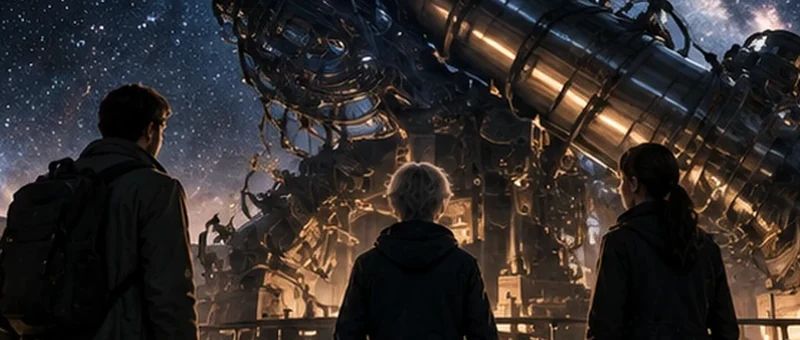
01 — THE OBSERVATORY
The observatory stood on an inland ridge where the city had once been able to see the stars. Its dome was a blackened shell, and the road up to it had been cut into three separate ownership parcels. In the morning rain, the barriers looked like arguments left unfinished.
Roy had brought a court order, not a weapon. Imani had brought the hospital's clock records. Adrian carried the registration ledger, and Null carried nothing that could connect to an outside network. Rachel walked beside Chronos, who was holding his own paper inventory folded inside his coat.
The first gate did not recognize anyone's credentials. A maintenance worker opened it manually after examining the order. That was how the new charter was supposed to work: slowly enough for the right person to say no.
Inside the observatory, a circular room held a telescope pointed at a roof that had collapsed decades earlier. No sign suggested the place had ever been a laboratory. Old boxes contained school visits, weather logs, accounts for replacement mirrors. The records were disappointingly ordinary.
“Ordinary is useful,” Null said. “It tells us what somebody bothered to leave intact.”
Chronos found a scratched inscription near the eastern wall: FIRST LIGHT IS NOT FIRST CAUSE. It was not a message from the future. It was a piece of a lecturer's motto, used on dozens of public astronomy posters. He was almost relieved.
Then Adrian found the missing procurement entry. The clock component from the hospital had not been purchased by Tyrell or Helix. It had been borrowed from the observatory in exchange for a machine the observatory's director had never ordered.
The ledger called that machine a witness engine. No technical specification followed. Only a return date: eleven years before Roy had come back into the world.
02 — THE ENGINE THAT DID NOT ANSWER
Beneath the former photographic darkroom was a small reinforced vault. It held a steel housing the size of a refrigerator and two manual keys in separate transparent boxes. A brass notice identified the housing as a timing reference, not an intelligence system.
Null examined the cabling. “There is no transmitter.”
“Could it have sent the message?” Rachel asked.
“Not through any path I can identify. That isn't the same as proving it didn't.”
A recent tamper seal had been laid across the old door. Someone had visited the site since the first transmission, but they had not forced entry. Roy insisted on recording the seal before breaking it. The court officer accompanying them took photographs and witnessed each step.
The engine contained rotating discs, a light source, and a long strip of ceramic carrying marks too small to see without magnification. It had no speaker. It had no screen. Its exposed terminals did not form any modern data standard.
Chronos reached toward the casing and stopped. “I remember this shape.”
“Before you saw it?” Roy asked.
“No. I mean I can make sense of where the parts go. I don't know why.”
Rachel checked that distinction in her notes. The team had learned how easily a boy could be made to offer the answer an adult wanted.
Adrian found a handwritten instruction beside the keys: NEVER RUN THE REFERENCE WITHOUT TWO INDEPENDENT OBSERVERS. The line continued on another page: NEVER ALLOW THE OBSERVERS TO BECOME THE SAME AUTHORITY.
They had come looking for a source older than an archive. What they had found so far was a machine built by people unusually afraid of a single witness.
03 — A SKY ON PAPER
The observatory's original star charts had been copied onto paper after a previous electronics failure. Null laid one over the time marks from the hospital camera. The correspondence was imperfect, but several intervals matched an abandoned method for measuring light against a fixed mechanical shutter.
“It may be recording a physical event,” she said, “rather than transmitting a sentence.”
“Then why did we receive words?” Adrian asked.
“We don't know whether the words were part of the event or somebody's interpretation of it.”
The witness engine yielded an image only after the observers turned the two keys. Light traveled through the ceramic strip and fell across a sheet of photographic paper. It exposed three nested rings and a faint boundary that repeated on neither side. The image resembled no constellation the telescope had been built to observe.
Roy thought of the broken-circle authentication halves in the archive. There was an obvious temptation to declare them parts of one hidden design. But the shapes differed, and the observatory records showed the rings had been used as calibration marks in an older optics project. Resemblance was not ancestry.
A logbook placed an early version of the optical system decades before Tyrell had developed replicant memory engineering. That was historically interesting. It was not evidence that anyone had lived before humanity.
At the back of the logbook, a technician had left a question instead of a result: WHAT ARE WE MEASURING WHEN THE OBSERVER CHANGES?
“Everything we touch comes back to a witness,” Rachel said.
“Maybe that's because nobody was ever meant to solve this alone,” Chronos answered.
Roy looked at the boy. For the first time since the military record had resurfaced, Chronos did not look as though every new fact might erase him.
04 — THE WRONG OWNER
Before they could finish, an armed private recovery team arrived at the lower gate. Their authorization named the observatory equipment as abandoned property incorporated into a Helix successor portfolio. They possessed an inventory, a recovery license, and an injunction obtained from a tribunal that no longer had jurisdiction.
The gate worker refused entry. The commander threatened to remove him.
Roy walked downhill with the council officer beside him. He kept his hands visible. Beyond the barrier were six contractors whose weapons had once been enough to make a legal argument unnecessary.
“The order is under review,” the officer said. “You may contest ownership. You may not seize evidence.”
“Our client funded the preservation,” the commander replied.
“Preservation does not establish ownership of a witness,” Roy said.
A contractor recognized him. Fear passed among the others, and Roy understood how little effort it would take to turn their fear into a fight. He had been built to win this kind of encounter. His reconstructed body was less powerful now, and for that he was almost grateful. The choice not to start a fight felt less like a calculation of strength.
From the observatory, Null had already sent a copy of the recovery claim to an independent magistrate. The old injunction was suspended within minutes. The recovery team remained at the gate until a second witness certified they had left.
No one was injured.
Chronos stood at the ridge when Roy returned. “Did you want to hit them?”
“Yes.”
“Why didn't you?”
“Because I wanted us to keep what we'd found more than I wanted to prove I could stop them.”
“That sounds difficult.”
“It was.”
Their relief lasted until Null showed them the funding record. The recovery team had not been sent by an active Helix department. Its instructions had been issued by an automatic ownership process—one that continued spending money and exercising rights after the organization that created it had ceased to exist.
05 — THE FIRST WAS A QUESTION
The obsolete ownership process led to a sealed physical dossier left in the observatory's municipal archive. Its first page identified a joint study financed by three vanished institutions, none of them the author of the mysterious transmission. The study had investigated whether an observer's record could remain coherent after every instrument used to create it had been replaced.
The premise was mundane enough to disappoint Adrian: timekeeping, error correction, the preservation of evidence. But its last experiment had produced a contradiction. Two isolated recording systems reported the same external event with mutually incompatible orders of cause and effect. Their clocks had not merely disagreed about the hour. In one record an indicator changed before the test began.
The researchers had halted the experiment. One proposed fraud. Another proposed a mechanical fault. The director wrote that neither explanation had yet survived replication.
A margin note mentioned a phrase seen in later archives: BEFORE THE FIRST. On this older page, however, it did not mean the first human, first machine, or first consciousness. It described the interval before the first verified observation of an event.
“That's not the answer to who sent the message,” Roy said.
“No,” Rachel replied. “It may be the reason someone chose those words.”
Chronos sat with his paper inventory open. He had imagined the sentence might tell him where his oldest memories began. Instead it was a reminder that an event and the record of that event were not identical.
“They told me Daniel died and I was manufactured,” he said. “What if they had been talking about different things all along?”
“Then the records can be corrected,” Roy answered. “You don't have to be corrected to fit them.”
The distinction did not solve the universe. It mattered to a boy who had been classified as terminated.
06 — THE LIGHT OUT OF ORDER
At sundown the witness engine moved without anyone touching the keys. A rotor shifted a fraction of a degree and stopped. No mains current fed it; a mechanical spring had been wound decades before. That accounted for movement, but not for the timing.
The external monitors showed a two-second gap. In the room, both observers reported hearing three taps on the metal housing. A pressure recorder captured only two. Null sealed each observation before comparing them.
A new pattern appeared on the ceramic strip: a pair of marks separated by an interval smaller than the apparatus could reliably resolve. The team repeated the exposure using blank paper. The marks reappeared.
Adrian whispered, “It knows we're here.”
“It may only be operating,” Null said. “Machines aren't intelligent because they surprise us.”
Then the observatory lights failed. Emergency power should have restored them immediately. Instead, a generator started, stopped, and started again while the first attempt was still visible on the diagnostic trace.
Roy ordered everyone away from the engine. No one argued. Chronos was the last to leave, carrying the two witness logs, one in each hand.
Outside, they watched the western sky. An ordinary aircraft crossed above the ridge. Its position lights briefly appeared in two places along the same path, then converged. The effect was recorded by municipal weather cameras, the observatory's mechanical camera, and the pilot's flight instruments. No single network carried all three records.
This was the great event the team had feared and sought: not an announcement from an ancient god, but a measurable contradiction shared by independent witnesses.
The city authorities shut down air traffic over the ridge. Hospitals were warned of navigation errors. Rachel asked the council to publish the raw observations with their uncertainties intact.
“People will panic,” Adrian said.
“They may,” she answered. “We are not protecting them by pretending we saw nothing.”
07 — WHAT CHRONOS COULD DO
The witnesses gathered in the emergency room of the observatory while engineers cut power to the instrument. Chronos studied the logbooks and identified a manual brake hidden beneath the oldest rotor. He could reach it through a narrow service aperture designed for a small adult technician. His present body could fit. Roy could not.
“No,” Rachel said at once. She had learned enough about the military to mistrust any plan that treated a child's dimensions as an invitation.
Chronos looked at her. “You can ask me.”
She did. Roy described the aperture, the chance of injury, and the possibility that stopping the rotor would destroy evidence. The engineer verified every claim. Chronos asked for a second way out. They found one: a removable rear panel, opened by hand.
He did not go alone. The technician remained at the access door; Rachel held the safety line; Null monitored the independent sensor. Chronos entered, released the old brake, and backed out as the rotor slowed.
The contradictory traces stopped growing. The aircraft instruments returned to agreement. Whether the brake had caused that change or merely coincided with it remained unproved.
When Chronos emerged, his hands were shaking. Roy offered him water.
“I wasn't brave,” the boy said. “I was frightened.”
“You can be both.”
“I chose it because nobody ordered me.”
Roy did not tell him that the choice made him Daniel Reed. Nor did he tell him it proved he was not. For years his own life had been caught between those two demands.
Rachel wiped grease from the boy's sleeve. She remembered Daniel's hands covered in laboratory ink, and felt the ache of resemblance without asking Chronos to inhabit her grief.
On the recorder, the engine had one final exposure. It was a series of dots arranged in three columns. No alphabet or known machine code immediately decoded it. The result was preserved as data, not translated into prophecy.
08 — BEFORE ANY NAME
The next morning the provisional council released the observatory measurements. Scientists argued over the instruments. Citizens asked whether the sky itself had become unreliable. A corporation filed a renewed ownership claim. The magistrate scheduled hearings. None of it resembled the neat ending Roy might once have demanded.
But the recovery team had been refused without a death. The hospital's evidence remained intact. The public received what the investigators knew and what they did not. Chronos retained the right to decide which procedures could be performed on his body.
Adrian called with a final archival finding. The dossier's oldest catalog entry predated the technology that could have generated the modern text of WE WERE NEVER YOUR CREATION. That made the message's assertion neither true nor false. It made the relationship between an old measurement and a new sentence worth investigating.
“They might be making a claim about themselves,” Adrian said. “Or the words could be a deliberate trap. We still cannot identify a sender.”
“Then don't name one,” Roy replied.
Below the ridge, the city had begun repairing an elevated water main. Technicians carried tools past a queue of people waiting at the public tap. A woman was teaching a stranger how to request service without a recognized identity. The same small act that had opened the last days of the old struggle went on despite everything the sky had done.
Chronos stood beside Roy. “If Daniel was my first life, do I owe him something?”
“Perhaps the truth,” Roy said. “But you don't owe him your future.”
“Even if I am him?”
“Even then.”
Rachel joined them with a printed copy of the new evidence. She had underlined a sentence from the final report: INDEPENDENT OBSERVERS CONFIRM A PHYSICAL ANOMALY; ITS ORIGIN REMAINS UNKNOWN.
It was an honest sentence. They had witnessed something the available rules did not explain. They had not found permission to surrender their judgment to whoever or whatever lay behind it.
Then Chronos unfolded the paper he had carried since the hospital. Beneath I ASKED TO READ THE RECORDS and I CHOSE TO STAY, he wrote a third sentence: I WILL DECIDE WHAT COMES NEXT.
Roy watched him put the paper back into his coat.
From far below came the sound of a bell announcing that the first trains were running again. Rain moved across the hills. Somewhere an engine sat silent, and in three separate archives its impossible measurements waited to be tested by people who had not been in the room.
The first was not an answer. It was the question they had finally learned to ask without giving up the right to choose.
END OF BOOK VII.