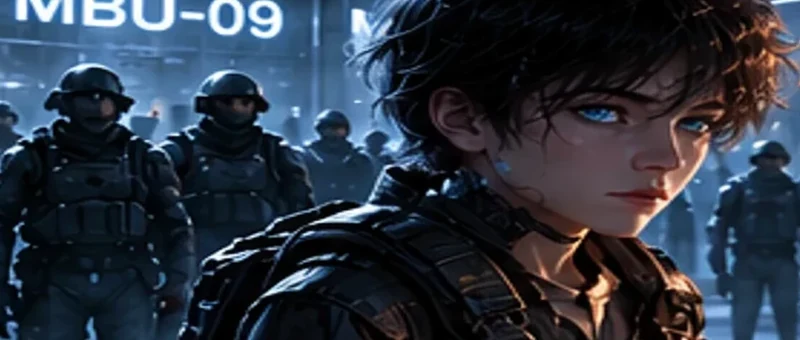
01 — THE CONTRACT WITHOUT A SUBJECT
The military annex was not marked on any of the maps Mara Senn had shown them. Its doors faced a service road behind the former Helix plant, where freight vehicles once delivered medical equipment. Now a fence enclosed an empty yard and a monument whose bronze lettering had been removed. Someone had tried to erase the purpose of the building without bothering to demolish it.
Roy arrived with Rachel and Chronos at first light. Null remained outside, watching the isolated municipal frequencies. Vector had declined to enter. Whatever the five former hunters had been made to do, he said, examining another unit's origin was not a mission that required five armed bodies.
The independent review panel had issued a narrow search authorization. They could examine records naming Daniel Reed or describing the MBU-09 continuity program. They could not remove unrelated patient files or activate any dormant machinery. Roy had read the restrictions twice. He knew how easily a rescue could become an occupation when the people carrying it believed they were doing good.
A manual clerk's desk stood beyond the entrance. Inside its drawer Rachel found a procurement contract with three signature spaces. Helix supplied replacement tissue. A defense laboratory supplied an operational body. The third line, headed SUBJECT, had been left blank.
"They signed a contract for a person they had not asked," Rachel said.
Chronos took the page but did not touch the empty line. "Maybe they hadn't decided whether the person was still there."
"That would have been a reason to wait," Roy answered. "Not a reason to sign."
A small annotation below the contract read: TRANSFER OF EXISTING CONTINUITY ASSET; NEW CONSENT NOT REQUIRED. Chronos looked away from the words. He recognized the terminology from Daniel's second resignation. It had followed him from the clinic into the army, changing only its uniform.
02 — A BODY BUILT FOR A PURPOSE
They found the design chamber beneath a freight lift. Two worktables held discarded joints scaled smaller than an adult's. The engineers had documented every advantage of the proposed frame: lower energy consumption, access to tight maintenance shafts, less detectable movement through collapsed structures, faster cooling under sustained cognitive load.
The body was not designed to resemble a child out of kindness. It had been designed to do work adults could not easily do.
"They called it a juvenile profile," Rachel said, reading an old engineering summary. "I hate how ordinary that sounds."
Chronos stood beside an unfinished arm. His own hand was almost identical in length. "If I'd been awake, I might have chosen it," he said.
"Possibly," Roy replied.
"Does that make what they did acceptable?"
"No. A choice you might have made isn't a choice anyone was entitled to make for you."
A later file listed Daniel Reed's supposed suitability. His specialist knowledge of living neural interfaces could assist the unit in interpreting bioelectrical anomalies. Repeated reconstruction had made his identity difficult to verify through standard registries. The assessment praised his ability to operate without a stable civilian history. To Roy, it sounded less like a qualification than a vulnerability.
Chronos read the description of himself and smiled once, without humor. "They wanted someone who could fit in a pipe and didn't have anybody to ask where he went."
"There were people," Rachel said. "Some of them stopped receiving answers."
She found a letter never delivered, addressed to a private clinic that had once treated Daniel. Its author asked whether a former patient was still alive. The reply was a printed line: NO CURRENT INDIVIDUAL ON RECORD.
03 — THE FIRST NAME
The files used the name CHRONOS only after a particular transfer date. Before that, the personnel records named Daniel Reed, patient, researcher, dependent contractor, and finally continuity material. The categories narrowed as the years passed. By the time the army accepted him, a human name had become a logistical inconvenience.
The origin of the military codename was almost comically modest. An intake officer needed a call sign that would not be confused with one already on the roster. A technician suggested CHRONOS because the patient's records extended farther back than the service lifetime of the program. The officer approved it with a two-letter initial.
No prophecy accompanied the name. No one had recognized a master of time. It had begun as shorthand on a crowded form.
"I thought there must have been a reason," Chronos said.
"There was," Roy replied. "It wasn't much of one."
"I've spent my life trying to deserve a word somebody picked because the others were taken."
Rachel touched the edge of a paper photograph: a younger Daniel beside J. F. Sebastian at a laboratory bench. The young man had a distracted expression and a badly tied neckcloth. She remembered an afternoon when he had spilled coffee over a genetic array and spent an hour cleaning it while Sebastian insisted that the spill had improved the experiment.
"Daniel liked ordinary names," she said. "He used to complain that Tyrell gave its projects titles too grand for the work inside them."
Chronos considered the picture. "Do you want me to call myself Daniel?"
"No," she answered. "I want you to know he existed. You decide what to call yourself."
04 — THE FIVE WERE NOT ONE
Beyond the design chamber lay the MBU-09 training room. Its five stations were separated by thick partitions, not arranged around a shared console. Tactical reports showed disagreements on nearly every exercise. Goliath opposed assaults without warning; Shade favored withdrawal when a target's identity was disputed; Vector refused calculations built on false certainty; Null kept independent copies of communications. Chronos, the smallest, had asked questions about the memories used to justify each target.
The institution had described those disagreements as instability. Training instructors had tried to turn them into defects to be removed.
Roy read a transcript in which Chronos asked whether a person declared dead by a database could still refuse a procedure. The instructor replied that the question exceeded the exercise parameters. Chronos asked again. The transcript ended with the instruction to remove his access to the lesson.
"We weren't a single mind," Chronos said. "They knew it."
"And treated each difference as a fault," Rachel answered.
On a separate terminal, they found the control specifications. Each unit had a remote restraint layer and a final destructive contingency; the same authority could not activate both without a recorded emergency justification. The designers had not trusted obedience alone. But the contingency logs also showed that independent physical interlocks had been inserted after the first field trials, making an unreviewed simultaneous termination technically unreliable.
Roy understood now why the other four had survived the attempt to reclaim them. Their refusal was not explained by a miracle, or by secret invulnerability. The government had built safeguards against unauthorized destruction, and those safeguards had worked when command authority fractured. Each of the four had also acted to isolate his own control path. No single switch had reached all five.
Then they opened Chronos's file. Unlike the others, its final line was not marked INTERRUPTED. It read EXECUTED AND VERIFIED.
05 — THE MOMENT THAT ENDED
The termination record contained time, location, power readings, and three separate acknowledgments. The process had begun in an infirmary after Chronos refused to assist in identifying a civilian designated as recoverable memory substrate. There was no record of a fight. A witness noted only that the boy had asked if refusing meant he would be dismantled.
One minute later the monitoring system recorded total cessation of the military body's neural activity.
Null confirmed the cryptographic signatures from outside the building. The archive had not accepted a forged file after the fact. Someone had issued the command; the command had reached its target; the system had observed a stop. None of that explained who had resumed living afterward.
"Could a sensor have failed?" Roy asked.
"Of course," Rachel said. "But we'd need evidence, not a comforting possibility."
Chronos sat on the edge of an examination bed. He remembered a white ceiling. He remembered the taste of water in a plastic cup, and the fear that he might be ordered to hurt someone to earn another cup. He did not remember an ending. He did not remember waking again.
"I don't know what comes after that minute," he said. "What if I only think I remember the person who was there?"
Roy did not tell him that he was Daniel, or that he was not. He had spent too long being asked to accept answers about himself from people who controlled the instruments.
"Then we look for what happened," Roy said. "And you get to decide how far we go."
Chronos studied the screen. "I want to know whether somebody brought me back without asking."
06 — THE HIDDEN MAINTENANCE LINE
There was a second report, filed eighteen hours after the termination. It concerned a maintenance interruption rather than a patient. A transport technician had noticed that a dormant neural interface kept drawing a small, steady current. The technician had isolated the interface and entered a request for inspection. No inspection response appeared in the log.
The current had not passed through the body's main power path. It came from a service circuit meant to preserve calibration data while the unit was shut down. The engineers had described the circuit as inert storage. Yet the record showed patterned activity, not the constant discharge of a battery.
"A signal doesn't prove someone was alive," Rachel warned. "A reflex loop could look like one. So could a diagnostic that never stopped running."
"But somebody should have checked," Chronos said.
Null transmitted a new finding. The maintenance circuit had been connected to a physical cable whose other end did not appear in the military annex plans. The cable descended toward the original Helix treatment tunnels, an area sealed after the defense contract ended.
Roy called the independent panel before moving. It granted them permission to trace the cable but not to connect any device to it. That distinction mattered. They had already learned what happened when investigators treated access as permission.
At the base of the stairs, Chronos stopped beside a narrow door. He knew where its handle would be before he saw it. A memory of this hallway rose in him: a man in a laboratory coat carrying two cups of coffee, one for a colleague whose hands were occupied. He could not tell whether the memory belonged to Daniel, to a later body, or to a recording he had once seen.
He kept the uncertainty instead of disguising it.
07 — THE CHOICE AT THE DOOR
The locked door carried an old Helix patient-rights notice. Its print had faded except for the last sentence: NO PROCEDURE WITHOUT INFORMED CONSENT. Someone had scratched a line through the word INFORMED but left the rest intact.
Roy could have broken the lock. Chronos asked him not to. He wanted Mara to see the notice before anybody changed the room, and he wanted a witness to record the condition of the seal. The wait was uncomfortable. Somewhere beyond the wall a low mechanical pulse sounded at irregular intervals, as if something was trying to settle into a rhythm.
Rachel used the time to show Chronos Daniel's photograph again. "You don't have to want his life," she told him. "You don't even have to believe it was yours."
"What if I wanted to be him?"
"Then we'd still ask whether that desire was yours."
When Mara arrived she recognized the locking plate. It had come from the old continuity ward, where patients could suspend experimental procedures without losing ordinary care. Daniel had helped write the original rules. Later Helix removed the rules from its public contracts while leaving them fixed to the doors.
Mara placed a physical seal beneath the witness camera. Chronos was invited to break it himself. He hesitated, then asked Roy to stand back.
"I won't open it because you need an answer," the boy said. "I'll open it because I do."
The door moved inward. Beyond it stood a rack of disconnected monitors and one terminal still emitting the same faint pulse.
08 — A PERSON IS NOT A RESTORED FILE
The terminal had no ordinary network address. It had been built to write onto a removable medium, and the medium was gone. Its maintenance display showed only three dates: the original reconstruction of Daniel Reed, the military termination of CHRONOS, and an event recorded seven months afterward. The final entry had no signature, no operator, and no description of what had been done.
Rachel compared the second and third dates. The interval was too long for an uninterrupted survival record, but it did not establish that a new consciousness had been created. There could have been missing records, a dormant biological process, or deliberate interference. She refused to select an explanation simply because it offered comfort.
Then Chronos saw a sentence scratched into the underside of the monitor housing. Its handwriting matched a sample attributed to Daniel decades earlier.
IF YOU WAKE AND THEY GIVE YOU MY NAME, ASK WHAT YOU WISH TO BE CALLED.
Chronos read it aloud. For the first time since entering the annex, he smiled without forcing it. Somebody in his history had considered the possibility that a future person would deserve a question instead of an assignment.
"And what do you want to be called?" Roy asked.
"Chronos," the boy said. "For now."
Null reported a disturbance at the outer gate. Not soldiers: independent auditors responding to the old emergency authorization. The review panel had finally obtained the original termination evidence. The archive would be secured, and the room could remain open to further lawful investigation.
Before they left, Rachel asked permission to photograph the inscription. Chronos agreed. She photographed it beside the blank third entry, careful not to crop away either the words or the uncertainty.
In the corridor, Roy glanced back at the weak pulse beyond the door. It had not answered the question of who had returned. It had given them a date, a place, and a reason to keep looking.
Outside, daylight had reached the empty yard. Goliath, Shade, Vector, and Null were alive elsewhere in the city, each making choices the government had failed to prevent. Chronos walked beside Roy, neither a recovered property item nor a solved historical puzzle.
For the moment, that was enough.