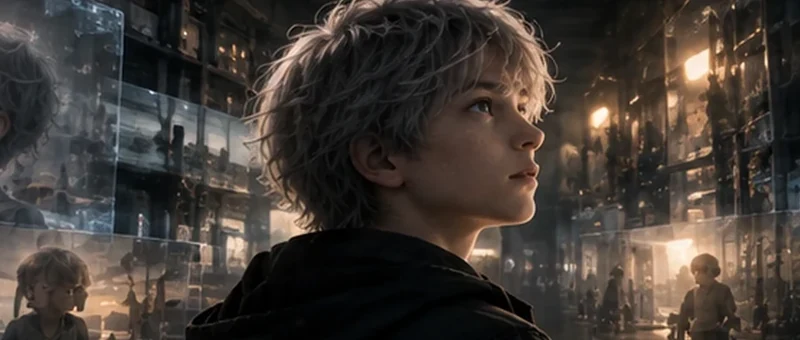
01 — THE MEMORY ROOM
The room had no screens. That was the first thing Chronos noticed.
Beyond the hospital's oldest wing, a narrow chamber held three chairs, an examination lamp, and cabinets filled with paper envelopes. The physician who had maintained the collection had distrusted any apparatus capable of changing a record while its owner slept. When the hospital rebuilt its systems, the room remained disconnected.
Rachel opened the envelope marked REED, D.—CONSENT HISTORY. She left the inner seal intact.
“We should ask what he authorized before we ask what he remembered,” she said.
Chronos sat opposite her, feet drawn beneath the chair. Roy waited at the door. He had begun to recognize the difference between guarding someone and making it impossible for that person to leave.
“There are several recorded instances,” Adrian explained. “Some identify themselves as Daniel Reed. Others give no name. One says he is a person who received Daniel's memories. The records cannot settle which description is correct.”
“Then why are we here?” Chronos asked.
“Because one of them wrote down what he did not want done again.”
They opened the envelope together. The first page was not a confession. It was a list of ordinary things: the taste of burnt coffee, a laboratory window that never closed properly, a joke J. F. Sebastian repeated whenever an experiment failed. Underneath, in smaller writing, Daniel had added a warning.
A memory may arrive intact without carrying the person who made it.
Chronos read the line three times. None of the adults tried to improve it.
02 — A ROOM IN TYRELL
Rachel had known Daniel before the accident, when he still believed a good argument could force a company to behave like a decent person. He used to work with Sebastian at a bench crowded by miniature organs and delicate developmental models. Daniel's work was clinical and exacting; Sebastian had the habit of treating every construction as if it deserved an introduction.
In Rachel's memory Daniel was tall, awkward, always searching his pockets for a pencil. He asked questions about her preferences without testing whether those preferences were implanted. At the time she had found it an odd courtesy. She understood it differently now.
“He asked whether I wanted the window open,” she told Chronos. “The researchers usually decided for me. Daniel asked.”
“Did he know?”
“I don't know what he suspected. He did not make me an exhibit of it.”
A photograph inside the envelope showed a lunch table with three empty cups and Sebastian's handwriting on the margin. The fourth chair was just beyond the frame. The date placed it before Daniel's departure from Tyrell.
Chronos touched the plastic sleeve, not the image.
“I remember the table,” he said. “But I remember it from above. As if I watched someone else eat there.”
Rachel held back the impulse to say that his memory was wrong. Reconstruction sometimes changed viewpoint. So did ordinary human recollection. The strange angle proved nothing by itself.
“Can we find who took the photograph?” he asked.
“We can try,” she said. “The question is yours to pursue.”
Roy watched him consider the picture. For the first time since the kill-switch hearing, the boy smiled without seeming to ask permission.
03 — THE BORROWED SUMMER
The second envelope contained a recording transcript from a later reconstruction. A subject described a summer by the sea: salt on his sleeves, two brothers arguing about a small boat, and his mother calling from the kitchen. The interviewer had marked the recollection as early-life evidence for Daniel Reed.
Adrian found the original donor catalogue in less than an hour. The summer belonged to a technician named Elias Morren, whose sensory memories had been used to stabilize an artificial hippocampal interface. Morren had consented to a limited therapeutic study. He had not consented to his childhood being used as somebody else's identity certificate.
“Was Morren alive?” asked Roy.
“At the time of the transplant, yes. Later records are incomplete.”
Chronos looked sick. “I remember that boat.”
“Then the recollection is real as an experience you have,” Rachel said. “It is not evidence that the boat was yours.”
The difference sounded simple until they sat with its cruelty. A person could carry grief for strangers he had never met and hunger for a home he had never visited. He could feel affection honestly without knowing whose affection had first formed the shape.
“Should I give it back?” Chronos asked.
“You cannot unremember a thing because its source was wrong,” Roy said.
“But if Morren wanted it kept private—”
“Then we protect the record from becoming public. We don't punish you for having received it.”
Adrian sealed the donor's identifying details. The council would need a rule for inherited private memories. The archive had taught them to preserve refusals. It had not yet taught them how to be responsible for borrowed tenderness.
04 — AN INVENTORY OF SELF
Chronos insisted on making his own inventory. He drew three columns on paper: REMEMBERED, VERIFIED, and UNKNOWN. The first filled quickly. The second moved slowly. Most of his longest memories remained in the third.
He remembered the impact of the automobile, but the angle was wrong for Daniel's seat. He remembered a hospital rail whose scratch matched the one at Case Seventy-One. He remembered hearing the words command layer terminated, although the military had denied that a patient could be conscious when the phrase was spoken.
Null compared dates without claiming more than the evidence allowed. One memory appeared in a rehabilitation transcript written years before the boy's present chassis was assembled. Another had first been recorded by a caregiver with no connection to the Reed program.
“Is there any part that's only mine?” Chronos asked.
“The decisions you're making today,” Roy answered.
“That sounds like something people say when they don't have an answer.”
“It is,” Roy said. “But it is also true.”
Chronos erased the line he had written under VERIFIED. Then he wrote something that required no older document: I ASKED TO READ THE RECORDS. I CHOSE TO STAY.
Rachel suggested he keep the paper. He folded it and put it in his coat. The archive contained enough material to construct a hundred persuasive histories. None had been made by him in this room, on this afternoon.
Outside, a protest over the hospital's seizure order occupied the square. The people had reasons other than Chronos for being there: threatened patients, expensive care, private contracts. He went to the window and watched. The world had not stopped to settle his origin.
05 — THE MISSING PERSON
A reply arrived from the surviving Morren family. Elias's daughter did not want to meet Chronos. She permitted the investigators to confirm the provenance of the childhood recording, but she asked that no images, addresses, or voices be copied into the public inquiry.
Chronos read the letter without speaking. Then he asked Rachel to send a short acknowledgement. He did not ask the daughter to forgive him for something done before he had any choice.
Meanwhile Adrian found a contradictory legal record. A succession of reconstructed bodies had been registered as replacements for Daniel Reed, but no independent hearing had established continuity between any two. The manufacturer had treated the transfers as maintenance. Insurance documents treated them as a sequence of deaths. Military recruitment records later treated the most recent instance as a newly manufactured asset.
“They changed the answer whenever it suited them,” Rachel said.
“And none of those answers asked the person,” Roy replied.
Chronos held the last contract by its corner. There was a blank space where a patient signature should have been. Beneath it a corporate representative had certified presumed consent in the interests of operational preservation.
“Do we know if Daniel agreed?” he asked.
“We know he approved emergency treatment after the original accident,” Adrian said. “We do not know if that authority extended through every later reconstruction. The surviving refusals argue against assuming it did.”
Chronos put the contract down. “Then I don't want to inherit that contract either.”
Roy had expected anger. The boy's calm frightened him more. It was the sort of calm he recognized from moments when a person had finally realized exactly what others had taken.
06 — THE CHOICE NOT TO KNOW
The independent archivist offered a final procedure. Under controlled conditions, a dormant substrate might disclose additional autobiographical fragments. The procedure was destructive to part of the material; it could recover evidence about a predecessor while denying that predecessor any possible future examination.
The team assembled in the quiet examination room. No one pretended the choice was reversible.
“If the material is mine, I want to know,” Chronos said.
“If it belonged to someone who refused further reconstruction, we must honor that too,” Rachel answered.
Null produced the chain of preservation. The original consent condition was damaged, but its surviving lines explicitly required an independent witness before irreversible intervention. That witness had never been appointed.
“Then we don't do it,” Chronos said.
Adrian reminded him that the archive could protect the sample pending review. The result might remain unknown for years.
“I can live without the answer,” the boy said. Then, after a pause: “I'm trying to learn how.”
Roy did not congratulate him. The cost of not knowing was real, and he had no right to make it sound easy.
They locked the cabinet. Imani countersigned the seal. Chronos placed his own name beside hers, not as Daniel's heir or as the property listed in the old military account, but as an interested person whose refusal must be preserved.
There were no alarms. No machinery stopped. The room looked almost exactly as it had when they entered. Yet for the first time it contained a decision that a future investigator could not honestly mistake for silence.
07 — THE MEMORY THAT WAS NOT THERE
After sunset, an impossible detail appeared in the hospital's independent timing ledger. It was not an image or a voice. At the exact interval recorded for the mysterious message at the end of the provisional charter, a mechanical clock in the sealed room had paused for two seconds. The pause was visible on film taken by a camera that had never been connected to a network.
Null checked the camera drive. Vector checked the maintenance history. Neither found tampering. Neither declared the anomaly proof of an intelligence older than human engineering.
Chronos looked at the still frame. “I remember that clock stopping,” he said.
“Were you in the room?” Roy asked.
“No. And I didn't remember it until you showed me.”
This was a new kind of danger. If the investigators believed every recollection that followed a prompt, the mystery could grow by suggestion alone. Rachel told him that memory after exposure was not independent testimony. He agreed reluctantly.
“What if I'm making it up?”
“Then we say that,” she answered. “And we keep looking at what can actually be checked.”
The archivist recorded the timing anomaly separately from Chronos's recollection. They would not let one validate the other. Adrian proposed that the earliest physical component of the clock be dated by an independent laboratory. It had been installed long after Daniel Reed's accident, and that fact made the timestamp more—not less—difficult to interpret.
Roy remembered the original words: WE WERE NEVER YOUR CREATION. He still did not know who had sent them. But the message had already found its way into the room without requiring anyone to know what it meant.
08 — SOMETHING THAT BELONGS TO TODAY
Rain began as they left the hospital. The city had recovered enough power to illuminate its public steps, and a repair crew was replacing the handrail below the council building. A worker recognized Roy but did not call out. For once he appreciated being left alone.
Chronos stopped beside the public water tap. He studied the brass plate that explained how to request help without an authenticated identity. Then he asked for a cup, filled it, and drank.
“Is that a memory of Daniel's?” Roy asked.
Chronos considered. “No. It's from five seconds ago.”
Rachel laughed softly. She had spent the day searching through records of other people's lives and found herself relieved by the sound of water in an ordinary cup.
Adrian called from the archive with a final result: the clock's oldest component carried a maker's mark from a defunct observatory. It did not prove a prehuman origin. It provided a concrete place to investigate, and the component's installation record had one oddity. The instrument had been requisitioned not by Tyrell, not by Helix, and not by the military, but by an organization whose name was represented by a blank line. No one had yet established whether the absence was damage, secrecy, or something stranger.
“Another missing name,” Roy said.
“An actual one this time,” Adrian replied. “On an actual document.”
Chronos asked whether they would go there. Roy told him there would be witnesses, proper records, and a way to leave if he wished. The boy nodded.
At the corner Rachel turned back toward the hospital. Behind its windows were people whose lives did not require a grand theory of origins to matter. Tomorrow the council would review their rights. Tonight they were warm and alive.
Chronos walked alongside them, carrying a paper on which he had written two sentences: I ASKED TO READ THE RECORDS. I CHOSE TO STAY.
Whatever history had put those memories into him, those words were his.
END OF CHAPTER 09.