01 — THE MORNING UNDER GUARD
At six in the morning, someone brought a tray of food to Roy's room and apologized for the absence of coffee. The delivery truck had been stopped at the southern entrance. Its contents were being compared with a list of authorized medical supplies.
Roy thanked the attendant and waited until she had gone before trying to reach the tray.
The movement was familiar. Its consequences were not. A sharp sensation traveled from his right shoulder into his neck, and his hand stopped halfway to the table.
Rachel moved the tray closer.
"You could have asked."
"I wanted to know whether I could do it."
"Now you know."
Outside the window, an army mechanic was examining one of the vehicles that had remained in the courtyard overnight. The three grey-coated personnel were no longer visible from the room. Roy did not interpret their absence as a reduction in the force surrounding the hospital.
Imani arrived shortly afterward. She examined his shoulder and the bruising along his ribs, then opened the records of his earlier treatment. The damage from his encounter with Havel had not been confined to one part of the body. Several systems had been compensating for one another when the military replicant threw him against the wall.
"You were recovering," she said. "That isn't the same as having recovered."
Roy asked about the seventy-percent limit. It was a figure he had carried since the first assessment of his injuries, a figure that had followed him through encounters in which it had seemed either too generous or absurdly small.
Imani explained that the figure referred to an upper limit on the overall output his damaged body could safely sustain. It did not describe the strength of every muscle or the speed of every nerve. Nor was it a promise that he could reach that level today.
"I don't intend to find out how far below it you are by pushing you until something breaks."
He looked at the medical chart.
"When will you take the restriction off?"
"When there is a reason to believe you no longer need it."
From the corridor came the sound of a cleaner arguing with a soldier about a trolley. The argument ended when the cleaner asked whether he intended to wash the floor himself.
Roy smiled. His shoulder hurt when he did so.
02 — THE NUMBER ON THE SCREEN
Adrian Tyrell had obtained permission to use a small examination room on the same floor. Lin brought two pressure sensors from the research wing. Imani inspected them before allowing either to be attached to Roy.
The proposed study involved no alteration of tissue and no attempt to override the restrictions. Roy would perform a series of ordinary movements at levels approved by his physician. The instruments would show how the strain was distributed.
Rachel asked him whether he still wanted to participate now that the situation outside had changed.
"Especially now."
"They don't get the results."
"I know."
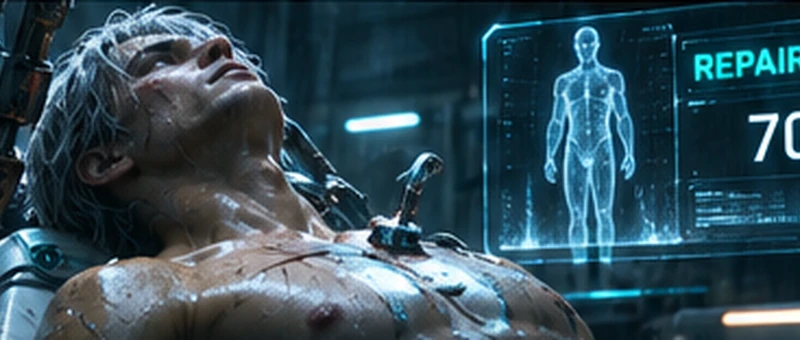
Adrian positioned a monitor so that Roy could see it. A diagram of the upper body appeared, divided into regions. The colors changed as Roy lifted his left hand.
His first attempt was uneventful. During the second, he moved a little farther. A region near the injured shoulder changed color before the arm itself reached the position Imani had marked.
He lowered it at her instruction.
"That's the good arm," he said.
Lin checked the sensors. The same pattern appeared on both measurements.
Adrian explained that a large part of the strain arose from the way Roy stabilized the rest of his body before making the movement. Structures that were supposed to share the load were behaving as though they had different instructions about what constituted a threat.
"Can you change the instructions?"
"Not on the basis of this. But we might be able to understand why they're being given."
Roy asked whether the stranger in the grey coat would have produced the same pattern.
Nobody answered immediately.
Adrian finally said that without access to the stranger's medical data, any comparison would be speculation. Even the assumption that M-04 was subject to the same protective restrictions lacked evidence.
Roy turned toward the monitor. A small number in one corner indicated the permitted range for the current exercise. It was far below seventy percent.
He had wanted to see the number increase. Instead, he watched the color spreading across a part of his body he had not intended to use.
"Again?" he asked.
Imani shook her head.
"After a rest."
He remained seated. For the first time since the courtyard, he was able to look at the record of a physical failure without immediately wanting to correct it.
03 — WHAT THE BODY REMEMBERS
The next recording was made after an interval of nearly an hour. Adrian asked Roy to repeat the movement without attempting to reach the mark on the wall.
Roy stopped a little short of it. The same regions changed color, although this time the change was less pronounced.
He remembered the expression on Havel's face when the old man had raised his sword. Roy had expected to see the preparation for a blow. What he had seen instead was the absence of an effort he had always considered necessary.
Raijin and Fujin had defeated several of Roy's assumptions before he had understood that the assumptions belonged to him rather than to the world. They had been human. Their bodies obeyed limitations that his body had been manufactured to exceed, and yet they had been able to produce movements for which he had no adequate response.
He told Adrian about the sensation of trying to anticipate them. By the time he had identified the beginning of an action, he often found himself responding to something that was already over.
Adrian listened without interrupting. Then he asked whether Roy had noticed anything similar before M-04 moved.
"Nothing. That was the problem."
"We may be talking about two different things."
Roy looked at his left hand.
"They felt the same from where I was standing."
Adrian made a note of the distinction. A shared effect did not establish a shared mechanism. Havel's extraordinary use of force, the human guards' control of their bodies and the military replicant's response time might have had entirely separate origins.
Roy made the movement once more, at Imani's suggestion. This time he let his shoulder remain relaxed until he felt the weight of his own arm. The pressure pattern was different. He reached almost the same position with a slightly lower measured load near the injury.
Lin repeated the measurement. The improvement was smaller on the next attempt and disappeared on the one after that.
"It isn't reproducible yet," she said.
Roy nodded.
He had been manufactured to repeat a successful action. His difficulty now was recognizing an action that ought not to be repeated simply because it had succeeded once.
When Imani ended the session, he had learned very little about the enemy. He had learned something about the person who had tried to fight him.
04 — THE REPAIR THAT WAS NOT A CURE
In the research wing, the century project had acquired a second bench and lost access to several of its regular suppliers. Lin had begun listing the experiments that could continue with the materials already in the hospital.
Rachel studied the list beside the recovered pages from Havel's archive. One of the old proposals described a way to preserve a damaged structural interface without requiring the surrounding tissue to carry a greater electrical load.
The proposed component bore a reference related to the military acceptance standard that had interested them earlier. That connection did not establish that the military had used it in a living body. The original acceptance document remained inaccessible.
They had enough material to reproduce one small portion of the component in a nonliving test specimen. Lin placed it in the chamber. Adrian watched the readings settle.
The result was unremarkable until they repeated the test with the load removed. The experimental specimen returned closer to its original shape than the comparison sample. On the third trial, however, a tiny crack appeared in the new material.
Lin photographed it.
"We would have missed that if we'd stopped after the second test."
Rachel thought of Roy upstairs. He would probably have wanted to know about the first two results before hearing about the third.
Adrian proposed further tests with different specimens. He specifically excluded any use of the experimental material in a patient. The drawings for the helium-3 power source were placed back in their folder; nothing that had happened that morning had made the proposed source of energy any closer to operation.
A hospital engineer entered carrying a notice from the administration. The research wing would have to reduce its electricity consumption while the delivery restrictions continued. The engineer apologized for interrupting their work.
Rachel asked him how much power the wards needed.
"More than we thought yesterday."
She signed the revised allocation. The experimental chamber would remain off during the hours reserved for the intensive-care equipment.
The engineer took the notice away.
On the wall above the bench hung a copy of the provisional charter. Its paper had acquired a crease where someone had moved the desk beneath it. The research group had used the charter to defend its right to conduct voluntary work. That morning, it helped Rachel remember why the work was being conducted at all.
05 — A DIFFERENT SCALE OF MEASUREMENT
The civilian director had requested a second assessment of the acquisition force. He received it at the Secretariat shortly before noon.
The report contained the identifying numbers of the three classified personnel, but no description of their manufacture. Its authors had compared their performance during a reconstruction of the hospital encounter with the data obtained from the original recording.
One of the differences between the two exercises concerned the amount of resistance anticipated from Roy. Another concerned the space permitted for the use of force. The hospital had presented the acquisition team with constraints that did not exist inside the military facility.
The director asked whether M-04 had been working within his maximum capacity.
The officer responsible for the assessment said that none of the recorded actions justified a measurement of maximum capacity.
"Then give me an estimate."
"Of his capacity or of the subject's?"
"The difference between them."
The officer closed the report. He could provide an estimate of their performance under specified conditions. He could not express the difference between two incomplete medical profiles as a single reliable number.
The director appeared to find the objection unnecessarily academic.
General Venn had been listening from the other end of the table. She asked why the assessment had been commissioned at all. There was already adequate reason to believe that the classified personnel could restrain Roy. The difficulty was that the attempted restraint had taken place in a functioning hospital, under a directive whose legality was being disputed.
The director argued that the government's interests extended beyond the resources committed to a single operation. If Roy's limitations were temporary, a future attempt at acquisition might be considerably more expensive.
Venn turned to the technical adviser.
"Do we have evidence that his limitations are temporary?"
"We have evidence that he's receiving treatment."
The director asked for the deployment of additional personnel before the medical suspension expired.
Venn did not approve the request immediately. She asked for an assessment of the effect on the civilian population, including the number of people who would need to be evacuated if the entire hospital were placed under military control.
The director had not brought those figures.
For the remainder of the meeting, the acquisition force was discussed without anyone using Roy's name. Its personnel were discussed without names of their own.
06 — THE WEIGHT OF A CUP
In the afternoon, Imani brought Roy a new shoulder support. It was lighter than the one he had removed before going downstairs to meet Deren. It offered less protection against impact and allowed him to perform a greater range of ordinary movements without assistance.
"This isn't armor," she told him.
"I wasn't going to ask."
"You were looking at it as if it might be."
She helped him adjust it and left him with instructions that seemed to concern almost everything except fighting. Walking. Eating. Sleeping. Returning to the room if the pain changed.
Rachel came in carrying coffee. The morning delivery had finally been released.
Roy took one of the cups with his left hand. He raised it slowly, without attempting to make the movement resemble anything he had done during the experiment. The pain was still there, but he managed to take a drink without stopping.
Rachel sat down opposite him.
"Did you find anything?" he asked.
She told him about the specimen, including the crack that had appeared during the third test.
"So it might work."
"Eventually. In something that hasn't been inside a person."
He understood her reluctance to say more. During his first life, he had sought an answer to the problem of his mortality with very little concern for the lives of the people who might provide it. He had not expected to become someone who would have to protect the people working on that same problem from the urgency of his own need.
He set the cup down.
"If I could get back everything I had before Havel, I don't think it would be enough."
Rachel did not tell him that he was wrong.
"Then getting everything back can't be the only thing we do."
He looked toward the window. He had been considering the army's movements almost continuously since the previous afternoon. Each time he imagined leaving the hospital, the scene in his mind became another confrontation in the courtyard. In every version, he arrived at the same conclusion: somebody would have to be defeated before he could go anywhere.
He had given the army the right to determine the shape of his next decision without ever intending to do so.
"We need to leave," he said.
"Yes. But not through another fight in front of the entrance."
They drank their coffee while the light in the room slowly changed.
07 — THE END OF THE EXCEPTION
Captain Deren received a medical report at sixteen forty. It stated that Roy could be transferred to an appropriate treatment facility under specified conditions. It warned against physical restraint and contained no authorization for the transfer of custody.
Deren forwarded the entire document to General Venn.
The response from the Secretariat arrived before the general's reply. The medical exception was to be reviewed immediately. A military physician had been appointed to assess the suitability of the government annex as a destination.
Sato read the message over his shoulder.
"They've decided he can travel."
"That's not what the report says."
"I know."
The liaison officer approached them with a second notice. Additional military resources had been authorized for the district. A joint planning group would arrive before nightfall to assume responsibility for the broader operation.
Deren asked whether his own command had been withdrawn.
"Not yet," the officer said.
At the edge of the courtyard, M-04 stood beside the woman who had emerged from the vehicle the previous evening. They had been watching the movement of hospital staff between buildings. When Deren called him over, the man turned with the same economy of movement that had characterized his encounter with Roy.
Deren told him that the temporary suspension remained in effect until clarified by the general. He received an acknowledgement.
"There may be a change of command," he added.
M-04 asked when it would take place.
"I haven't been informed."
The man returned to his position. He had not asked what the change would mean for him, or whether anyone would seek his agreement.
Sato watched a delivery driver hand a receipt to a nurse at the entrance. The exchange took less than a minute. The nurse thanked the driver, who called her by her first name.
"What happens to them when the operation is over?" she asked.
Deren thought she was referring to the people at the hospital. He told her that it depended on how the operation was conducted.
She looked at M-04.
"I meant those three."
He had no answer for her.
08 — THE ARRIVAL TIME
Rachel received the notice of the medical review while standing beside the sealed research archive. She read it twice, then called the council's advocate. The advocate said that the council's suspension had not been lifted. She also warned that the proposed military review might proceed regardless of the council's position.
Adrian was checking the latest experimental records. He stopped when Rachel told him about the notice.
They agreed to leave the original research material in lawful custody. They prepared copies of their own observations and an inventory of the files that remained sealed. They had neither a cure to carry away nor a complete description of a technology worth a hundred years of life.
There was, nevertheless, work on the benches that had not existed the week before. Rachel wanted it to continue without depending upon Roy's presence or her own.
She found him fastening the new support beneath his coat. He had managed to put the coat on without calling anyone for help, though there was a thin line of perspiration along his forehead.
"You're not ready," she said.
"I know."
She told him about the review. He listened without interrupting, then asked how much time they had.
Rachel had no reliable answer. The advocate was trying to obtain information from the military liaison. The administration was requesting written assurances concerning the safety of patients. Nobody could tell them when the next order would arrive.
From the far end of the corridor, Imani came toward them. She carried a folder and had not yet taken off the gloves she had been wearing in another room.
Roy told her that he did not intend to remain in the hospital when the suspension expired. She looked at him for a long moment before asking whether he understood the risk of leaving without a confirmed place of treatment.
He said that he did.
"Then we need to talk about what you can actually do," she replied. "Not what you could do before you were injured."
Outside, a low sound passed over the roof. A second followed, close enough to make the glass tremble. Roy and Rachel went to the window.
Several military aircraft were moving above the northern district. They did not descend toward the hospital. Beyond the surrounding buildings, lights began to appear along the elevated road, one after another, where civilian traffic had been diverted.
Deren's vehicles were still in the courtyard. Until then, they had been the only part of the operation Roy could see.
He looked at the hand he had used to hold the coffee cup. It was steady. For the first time that day, he was grateful that such a small thing had been possible.
He was still living under the seventy-percent restriction. There was no new body waiting for him, no undiscovered strength that would make the aircraft disappear.
Rachel stood beside him until the sound of the engines had moved beyond the building.
Then they turned away from the window.