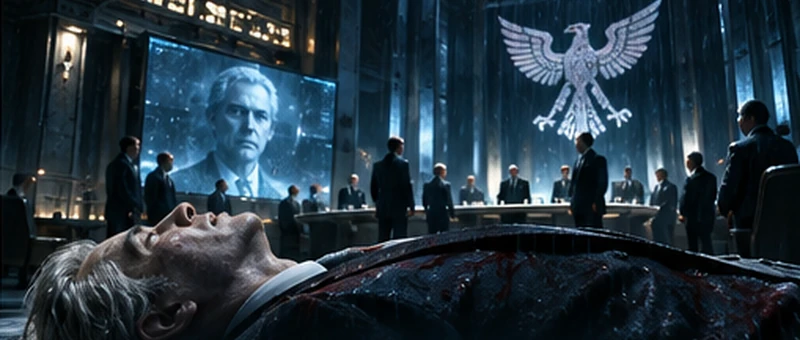
01 — THE SECOND ANNOUNCEMENT
The announcement of Havel's death had occupied the public screens of Okakyou for less than two days when a second announcement appeared beneath it.
This one contained neither a photograph nor a statement from his family. It consisted of a blue government seal and six lines of text describing the transfer of jurisdiction over matters of national continuity.
At the northern water station, a woman stopped filling her container to read it. The man behind her asked whether the water was about to be restricted again.
"No," she said. "It's about the minister."
Neither of them understood why a dead former minister required a change in jurisdiction.
Roy understood enough to leave the station earlier than he had intended. A military communications vehicle had been parked on the opposite side of the street since dawn. Its occupants had not approached the queue, and it carried no visible weapons. Only its antenna was unusual: a narrow black assembly that turned independently of the movement of the vehicle.
He had passed it twice. Both times, the antenna had turned toward him.
At the hospital, Rachel was reading the same announcement. She had three copies open on separate terminals. The first was the public version. The second had been delivered to the provisional council. The third was an internal administrative notice sent to research institutions.
"They've used the same seal," she said when Roy entered. "But the three notices don't give the same authority to the same people."
She showed him the additional paragraph in the third version. It described recovered longevity research as a matter requiring immediate security assessment. The wording did not distinguish between the documents and the people whose bodies might contain relevant evidence.
"Can they stop the trials?" Roy asked.
"They can certainly make it difficult to begin them."
Through the laboratory window, a hospital attendant wheeled an empty bed down the corridor. The wheels caught briefly on the threshold. Roy listened to the familiar sound until it disappeared.
"And the people?"
Rachel closed the public notice.
"That's what I'm trying to find out."
02 — A BODY UNDER SEAL
The examination of Havel's body took place in a government medical facility beyond the northern administrative district. The provisional council's court observer attended under an agreement that guaranteed independent access to the evidence.
She watched an army medical officer compare the injuries with the records taken at the ceremonial hall. The recorded sequence was consistent with a violent encounter. It was also consistent with the witness statements that Havel had continued to fight after being given an opportunity to stop.
The officer acknowledged both findings.
"I need a signed copy of that conclusion," the observer said.
He turned to the terminal beside the examination table. A newly displayed instruction required him to refer all conclusions involving the former minister to the Defense Secretariat before releasing them externally.
"That instruction wasn't in effect when we entered," she said.
"It is now."
She requested that the change be entered into the examination record. The officer did so without protest. He seemed grateful for an obligation that was still clear.
A civilian official arrived while the body was being prepared for transfer. He introduced himself without giving a department. He did not ask how Havel had died. He asked whether the force responsible for the fatal injuries could be reproduced, and whether the manufactured person identified in the evidence retained the capacity to produce it.
"That isn't a question a postmortem examination can answer," the physician said.
The official made a note.
"Then we will require the other body."
The court observer put down her pen. "The other person is not dead."
The official looked at her for the first time.
"I didn't say that he was."
He left without signing the visitors' register. At the end of the examination, the observer requested two certified copies of her own notes. One was refused. She received the other and carried it out of the facility inside a plain paper envelope.
The former minister's body remained under government seal.
03 — THE COMMITTEE WITHOUT WINDOWS
Far below the Defense Secretariat, a meeting began with the doors already locked. General Mara Venn sat at the head of a table designed for twelve people. Only seven places were occupied. The empty seats belonged to departments that had not been invited.
A recording of the minister's final declaration played on the wall. His admissions concerning the six-year restriction were followed by the physician's report and a summary of the council's new research charter.
The recording stopped before his death.
"We cannot withdraw testimony that has entered independent custody," the legal adviser said. "Nor can we reverse the charter with a departmental order."
Venn had read the same advice on the way to the meeting.
"I'm not asking you to reverse it."
The civilian director beside her opened a restricted file. It contained the name Roy Batty and a reconstruction of several recorded incidents. There were gaps in the reconstruction, particularly where the earliest observations of the subject should have been. At the bottom of the file was a designation: NEXUSYS-11.
The director displayed a medical estimate of the subject's current physical condition. The right shoulder remained compromised. Maximum sustained output was substantially below its original design value. The estimate was already several days old.
"He is injured," one of the officers said.
"He was injured when he killed the former minister," Venn answered.
The director moved to the next page. It showed the relationship between the old continuity program and the recently recovered longevity files. Certain blocks of the diagram were covered by authorization markers that even the officers in the room could not open.
"What exactly are we trying to recover?" the legal adviser asked.
"A capability," the director said. "Before it becomes a capability we cannot control."
Venn turned off the presentation.
"The public investigation of the death will continue. Our task is separate. I want the subject located, assessed and brought into custody. If custody cannot be achieved, I want a decision brought back to this table. No improvisation in the streets."
Nobody asked whether the decision would concern the death of another person.
04 — A PATIENT, NOT A PROGRAM
Sena had been permitted to walk as far as the hospital corridor. Imani had written the permitted distance on a piece of paper because the patient did not trust the automatic rehabilitation schedule. Sena considered the distance inadequate. Imani considered that a promising sign.
Rachel found them arguing about the last four metres.
She waited until Sena was seated before explaining that the Defense Secretariat had requested an inventory of the recovered research materials. The request had not yet been accompanied by a patient-specific order.
"Does that mean they can take me?" Sena asked.
"It means they've asked for information they haven't been authorized to receive," Imani replied. "We haven't given it to them."
Rachel had expected fear. What she saw instead was the particular exhaustion of someone who had been required to prove, too many times, that a medical appointment was not a transfer of ownership.
"If I volunteer for the century project," Sena asked, "can they say I belong to it?"
"No," Rachel said.
She explained that the proposed research would begin with nonliving material. There was no functioning century-life apparatus, no treatment that could safely be administered, and no prediction of how long Sena might live. Participation in one trial could never be taken as permission for another.
Sena looked toward the windows.
"Then I want to be told when there's something real to decide."
Rachel promised that she would be.
Afterward she and Imani reviewed the recovered files. They were surprised to find that an old materials standard mentioned in the helium-3 proposal had been issued by a military procurement office. The office had not been named in the scientific report itself. Only a reference number linked the two.
It was a small discovery. It did not explain the observatory, the eleven missing years, or the origin of Roy's body.
But it meant the century project had once depended upon an institution that was now asking for its records back.
05 — THE FORCE NOT USED
Roy returned to the training hall in the afternoon. The public class was over. Two wooden staffs rested against the wall where he had left them the previous morning.
He took one and repeated the movement he had been taught. His feet settled. His left hand moved. The staff flexed slightly, then returned to its original shape.
On the third repetition the brace on his right arm issued a warning.
He stopped.
For most of his existence, stopping had been the thing his body was least willing to do. It had been designed to produce an answer to a threat before the threat could complete its question. Havel and his guards had shown him how unreliable that answer could be.
This time he waited until the warning disappeared. He tried the movement again with less force. The result was cleaner, but it was not the extraordinary impulse Havel had generated beyond the blade of his sword. Roy could imitate the movement. He could not imitate everything that had happened within it.
When he left the hall, a young man stood at the far end of the covered walkway.
He wore a grey coat with no visible identification and held an ordinary paper cup. He might have been waiting for the rain to lessen. Roy moved to the doorway and watched the reflection in the window.
The man turned his head before Roy's reflection reached the glass.
For an instant their eyes met.
Roy felt no immediate danger. The man made no attempt to close the distance. Yet there had been a precision in the movement that Roy associated with very few people, human or manufactured.
A tram passed between them. When it had gone, the man was walking away.
Roy stayed beneath the roof. He did not follow.
He had spent years being observed by machines that could not understand him. This encounter left him with the uncomfortable possibility that the observer understood far more than he did.
06 — THE MATERIALS REQUEST
By evening, the hospital's legal office had received a formal request to preserve the century-project archive in its current condition. It instructed the hospital not to alter, destroy, transfer or release the materials without notification to the Defense Secretariat.
The preservation itself was reasonable. The problem lay in an annex that attempted to include research subjects and potential sources of biological evidence under the same definition as the files.
Rachel read the sentence aloud at the council's emergency session.
"We have seen this language before," she said. "We should not approve it merely because the heading has changed."
The council's advocate requested a narrower order. The government representative promised to submit the objection. He could not promise that the Defense Secretariat would recognize the council as the competent authority.
EDEN recorded both positions and declined to convert the preservation request into a restriction on access to public services. The government representative objected to that decision too.
The session adjourned without a resolution.
Outside, a reporter asked whether the council intended to conceal a cure for replicant mortality. Rachel explained, again, that there was no cure. Another reporter asked whether the man who had killed Havel would be arrested.
"The circumstances of his death are still under independent investigation," she answered. "Being named in that investigation does not make a person state property."
By the time she reached the hospital, an edited recording of the exchange was circulating without her first sentence.
Roy watched it once. He turned the sound off before it began again.
"They're going to make this about me," he said.
"Some of them already have."
"Then I should leave the hospital."
Rachel looked at the brace on his arm. "Where will you go?"
He had several answers. None of them was a place where he could reasonably expect other people to be safe.
07 — THE LOWER FLOOR
At the Defense Secretariat's medical annex, a physician checked the recovery of an officer who had returned from an exercise that morning. The officer sat on the examination bench with his grey coat folded beside him.
There was a narrow cut across one knuckle. It had almost closed.
The physician recorded the condition of the tissue and asked whether there had been any irregularity in the officer's perception of time. The answer was no. She asked whether he had experienced any interruption in memory. Again, no.
An aide delivered an envelope bearing General Venn's authorization.
The officer read it and placed it on the bench.
"The observation was satisfactory," the aide said. "You are not authorized to initiate contact."
"Understood."
The physician signed the examination record. Its first page used the same categories applied to ordinary military personnel. The final page required a separate authorization. The aide covered it while the officer put on his coat.
Downstairs, a human army unit was preparing for an exercise in a reconstructed civilian street. Nobody in the room wore the same insignia as the officer. On a monitor above the entrance, the exercise was identified only by a date and the words INTERAGENCY EVALUATION.
A technician asked whether the two groups would be training together.
"Not today," the aide replied.
Nobody explained why they had been brought to the same building.
08 — THE FIRST CIRCLE
Roy and Rachel left the hospital together after midnight. The rain had thinned until it hung in the air like mist. They stopped at a small shop that sold paper notebooks, batteries and umbrellas. Its owner knew Roy by sight but had never asked for his registry number.
From the doorway, Roy could see the junction leading to the northern water station.
Two military vehicles passed without sirens. A third turned into a government compound that had been empty since the provisional council took office. Lights came on behind the upper windows.
His first thought was that the deployment might concern the crowds gathering around the old ministry buildings. Then Rachel received a message from the court observer. It contained a photograph of the examination report and a short warning: THE SECRETARIAT HAS REQUESTED ROY BATTY'S MEDICAL RECORD. NOT THE MINISTER'S.
Rachel showed him the message.
He looked back at the vehicles.
Until then, pursuit had meant particular people converging on a particular man. He could learn their movements, recognize their faces and sometimes discover the reasons behind their orders. This was different. The city had begun to change its behavior around him before anyone had declared that he was wanted.
"We need to know how much of this is lawful," Rachel said.
"And how much of it needs to be."
They stood beneath the shop's awning while the last military vehicle disappeared into the compound. The owner came outside to bring in a rack of unsold umbrellas. He wished them a good evening and switched off the lights.
Somewhere inside the Defense Secretariat, Roy's file passed from a civilian desk to a military one. Its final line had been amended.
The previous entry had described him as a person of interest.
The new entry contained no reference to his legal identity at all.
ACQUISITION ASSESSMENT: ACTIVE.